

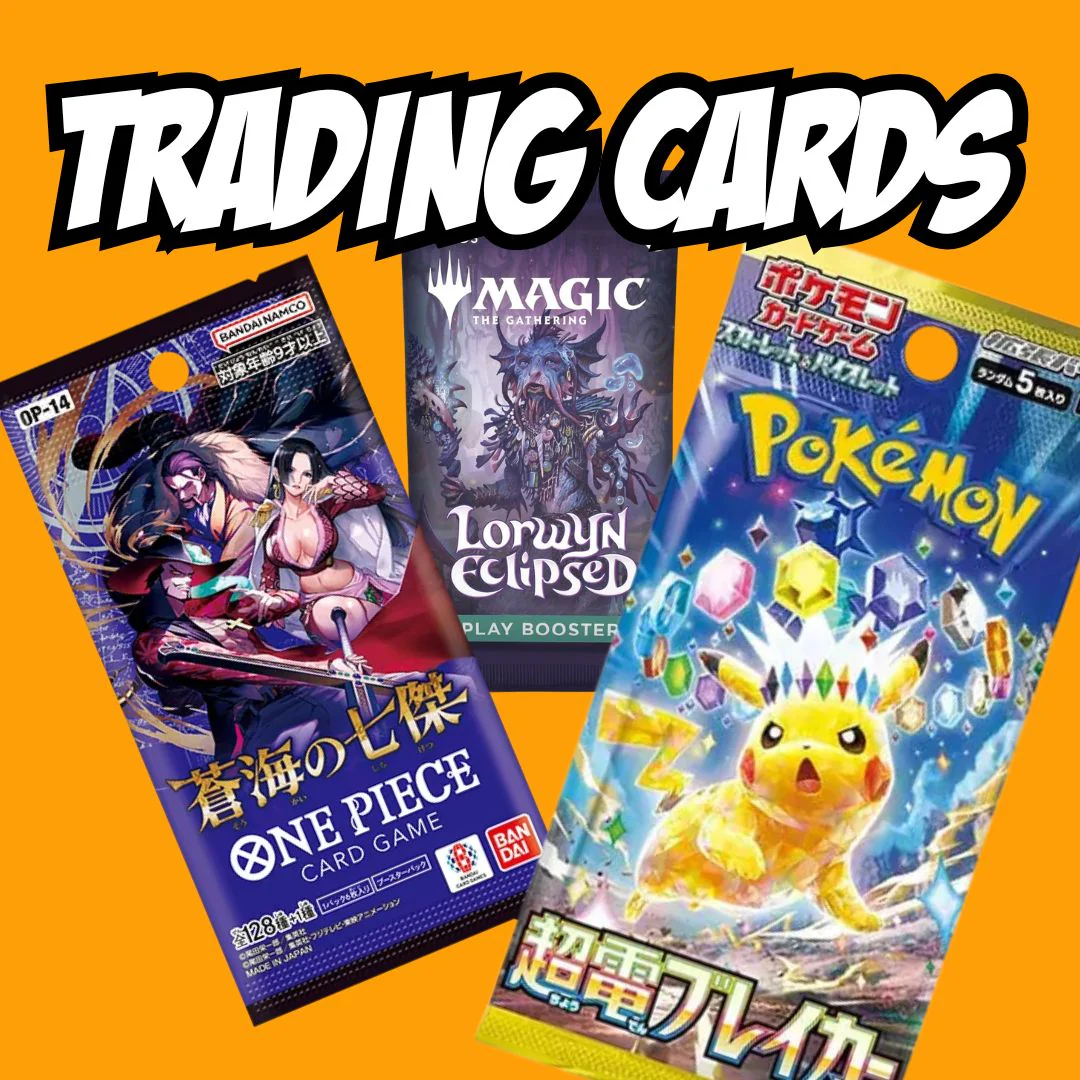
The Perception Shift
The trading card market has transformed far beyond its origins as a childhood pastime and is now widely viewed as an emerging alternative asset class. Recent valuations place the global market in the multi-billion-dollar range, with forecasts pointing to strong growth over the coming years. This expansion is being fuelled by a notable shift in buyer demographics: adults aged roughly 25 to 45 now represent the largest and most active purchasing group. These collectors bring higher disposable incomes, stronger engagement, and a far more investment-driven approach to cards. Which was never seen 5 years or even a decade ago.
Professional grading activity reflects this momentum, with millions of cards authenticated and encapsulated annually and year‑on‑year volumes rising at a double‑digit pace. High-grade rookie cards, particularly those receiving top-tier certification, have delivered impressive short-term returns and have even outperformed traditional equity benchmarks in certain periods.
Within the market, Pokémon remains the most influential entertainment property, while sports cards, including basketball, American football, baseball, and global football still account for the majority of total transaction volume. Together, these factors highlight a maturing ecosystem where nostalgia, financial speculation, and mainstream cultural relevance intersect to create sustained demand for premium-graded cards.
Trading Cards as an Alternative Investment?
The beauty about alternative investments is that, though in the broad sense they have a definition, everything in this avenue is in the eye of the beholder. This isn’t the first time consumers and investors, be they retail or institutional, have made money through the most vague investments. This is no different.
Trading cards have quietly emerged as one of the more compelling alternative investment propositions of the past decade. Unlike traditional financial assets, the value of high-grade cards is in provable rarity. A PSA 10 card of a certain Pokémon or athlete exists in finite supply, and that supply only contracts over time as cards are damaged, lost, or permanently held. Professional grading services have brought a degree of standardisation and transparency to the market that was previously absent, enabling price discovery. Over time these standardised cards have entered several portfolios as an investment.
The Revival: Pandemic
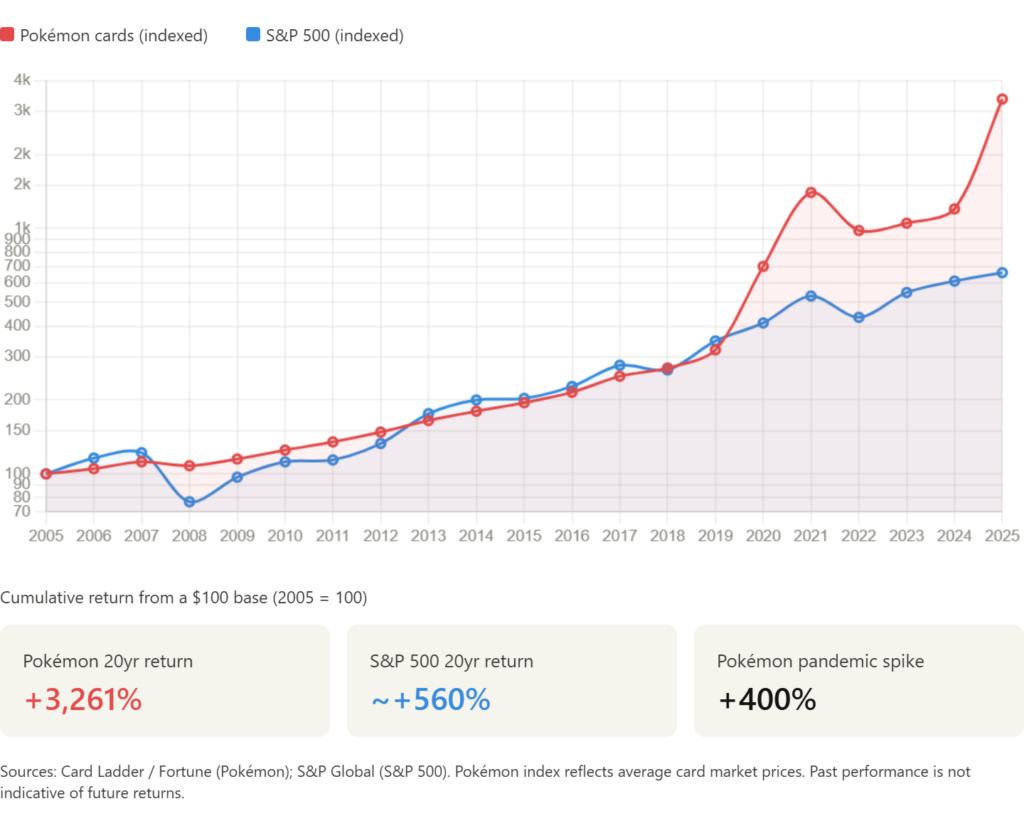
The post-pandemic surge in the trading-card market was driven by a mix of behavioural, financial, and digital factors. During COVID‑19 lockdowns, consumers redirected spending away from travel and entertainment and toward at‑home hobbies, prompting many adults to re‑engage with nostalgic categories such as sports and trading cards. Fiscal stimulus in markets like the U.S. and UK further increased liquidity, while historically low interest rates encouraged investors to explore alternative assets with higher perceived upside. At the same time, social platforms and large marketplaces accelerated price discovery and hype cycles. With influencers and public figures showcasing record sales and drawing new players into the infrastructure. The rapid expansion of third‑party grading, most notably PSA and CGC, added structure, legitimacy, and liquidity, effectively transforming trading cards into a more investable asset class.
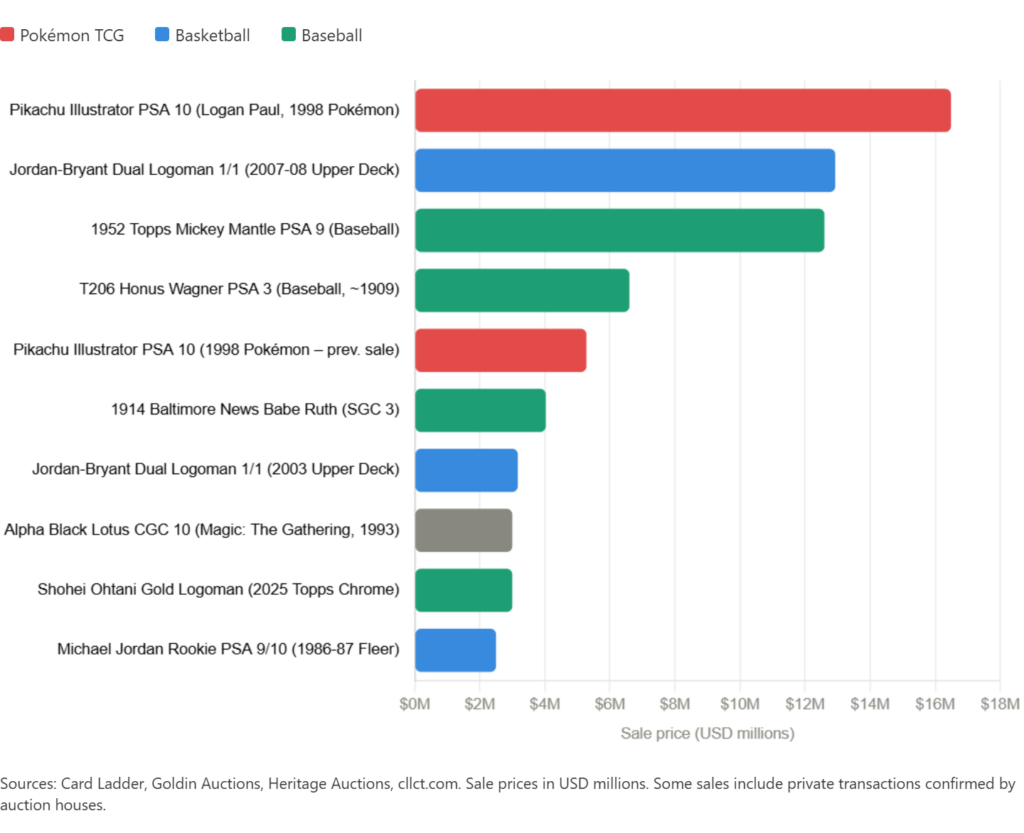
The above table sheds light on the fact that this is not just a ‘hype hobby’; rather, people hold emotional significance and intangible value to cards. This spans beyond cards, with even vintage comics and action figures selling for millions of dollars. With some of the top-valued sales predating the 2000s.
Last 5 years of Pokémon set returns
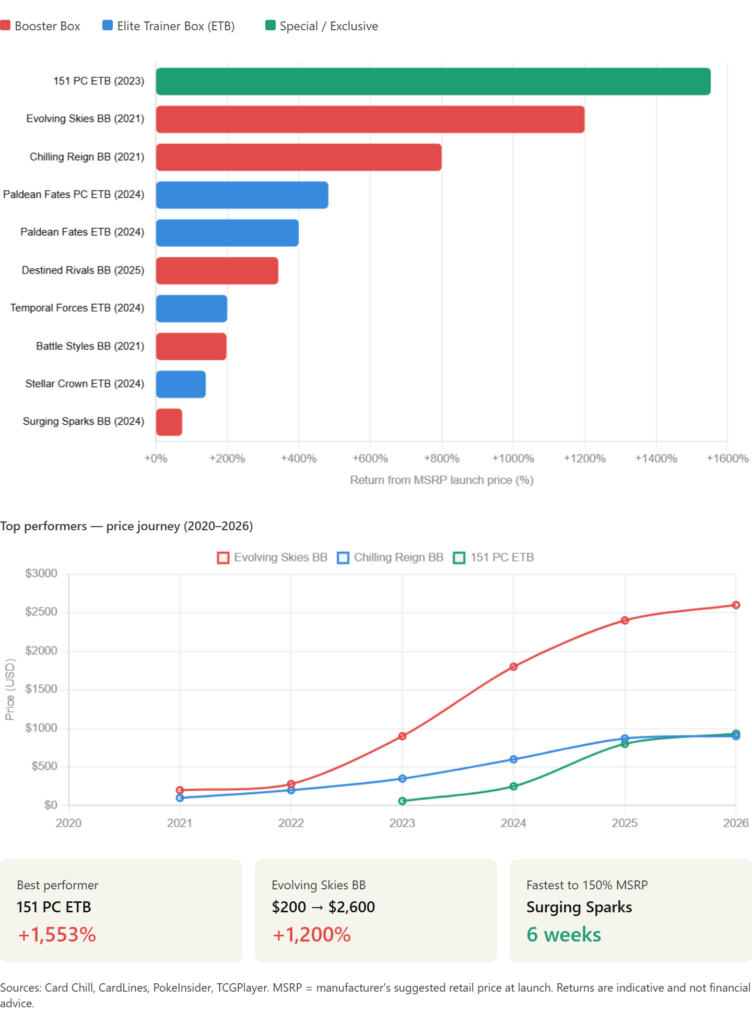
The chart shows that post‑pandemic gains throughout various sets. Pokémon’s 151 PC Elite Trainer Box (2023) dominates with a roughly 1,553% return, while older products like Evolving Skies and Chilling Reign from 2021 have also multiplied in value, highlighting persistent demand for early 2020s sealed products. More recent releases have shown reasonable appreciation, suggesting a market in which only select sets generate outsized upside. It’s not always a win-win situation; no asset is. The fact of the matter and the major downside is that once opened, the value drops significantly. Which leads into the next problem faced by passionate collectors, the hoarding situation.
The Artificial Scarcity Conundrum
Hoarding and engineered scarcity have become major concerns in the trading‑card market, skewing both pricing and access. Large buyers, resellers, and investment groups often snap up product in bulk at launch, creating instant shortages and pushing casual collectors onto the secondary market at elevated prices. Then comes the company’s ethical dilemma, where they could choose to print an underwhelming number of sets to disrupt the market. The result is a landscape where rarity is frequently inorganic rather than natural, fuelling sharp price volatility, speculative bubbles, and brief price spikes that are often followed by pullbacks.
My Personal Take
This is the first time I find myself putting out a paragraph here that’s entirely in the first person. A hobby of this sort, be it trading cards, action figures, or old comics, has a deep nostalgic impact on me, as it does for a lot of others. We live in times where, given a certain amount of liquidity, anything can be monitised. It’s times like this where there is opportunity for buyers with large wallets to drive up the prices. I do personally definitely see the investment angle to this, as the above numbers speak for themselves. This situation is such that I can speak from both an analyst’s and a collector’s perspective, and I still find myself with several unanswered questions.
Disclaimer
The Investor Standard provides general information for education and research only. It is NOT personal advice, a recommendation, or an offer to buy/sell any security. This content has been prepared without taking into account your objectives, financial situation or needs. Past performance is not indicative of future results. Before acting on any information, consider its appropriateness and seek independent advice from a licensed financial adviser.