
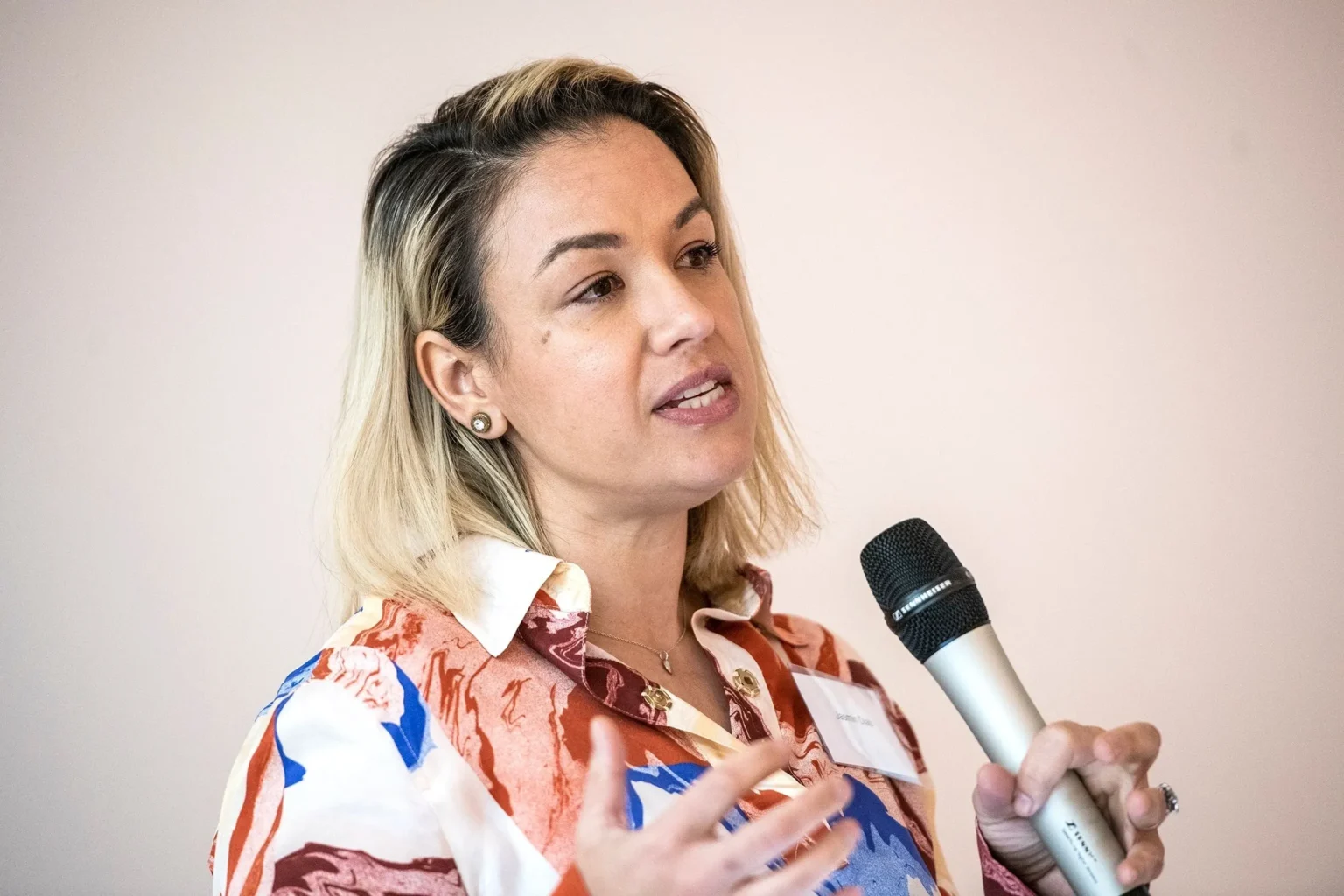
In the latest instalment of The Investor Standard’s CEO & Executive Interviews series, our analyst Peter Boyd sat down with Jasmin Diab, Partner and Managing Director at Global Nuclear Security Partners, for a conversation that cut through several of the laziest parts of Australia’s nuclear debate. What emerged was not a glossy sales pitch for reactors. It was a more serious argument about safety culture, sovereign capability, engineering realism and the strange policy logic of trying to debate an energy option that remains legally fenced off from proper assessment.
- A nuclear career built through security, not ideaology
- Her central argument is that Australia is debating energy with one hand tied behind its back
- Safety culture, not fear, is the real operating principle
- Australia already has more nuclear capaility than the public debate admits
- Her engineering case is really a sovereignty case
- The policy vacuum is the real delay, not the construction clock alone
- The global trend makes Australia look more isolated
- Her final insight may have been about work, not reactors
- The Investor Standard View
What makes this Jasmin Diab interview worth reading is that Diab does not come at the issue from the usual political angle. She comes at it from security, regulation and systems thinking. That shifts the discussion away from culture-war slogans and toward something far more useful: what a country actually needs to do if it wants to have an informed debate about nuclear science and technology at all.
A nuclear career built through security, not ideaology
Diab’s background matters because it explains the lens she brings. She told Boyd she began in the Army, where she studied chemistry, explosive chemistry and physics, before specialising in countering chemical, biological, radiological, nuclear and explosive threats.
I’ve always been interested in nuclear science,
she said.
I find how atoms interact absolutely fascinating.
Later, she moved into postgraduate nuclear engineering to better understand the power engineering side of nuclear reactions.
That path gives her a different kind of authority in this discussion. She is not arguing from a narrow commercial interest. She is arguing from the perspective of someone whose work is built around minimising risk, protecting systems and understanding how nuclear technologies can be used safely and verifiably.
Her current role reflects that. Diab said she spends much of her time “educating industry and supporting industry to design safe, secure and verifiable nuclear facilities so that we can harness peaceful technologies appropriately and make sure that we don’t introduce vulnerabilities that either states or non-state actors can try to exploit.”
That framing is important. It reminds readers that the nuclear industry, at least in its serious form, is not organised around recklessness or blind optimism. It is organised around the opposite.

Her central argument is that Australia is debating energy with one hand tied behind its back
The sharpest point in the interview came when Diab explained what she tells politicians.
You just need to lift the ban on nuclear energy,
she said.
Her argument is not that Australia should immediately roll out reactors. It is that the country cannot have a credible policy debate while one of the available technologies is excluded before proper analysis even begins.
At the moment you are trying to have an energy policy debate where one of the technologies that could support our system can’t be taken seriously because it’s illegal.
That is the part of the Australian nuclear discussion that is often skipped over. The debate tends to jump straight to cost, timelines or social licence without acknowledging that Australia’s legal architecture already shapes which questions get seriously studied and which do not. Diab’s point is that think tanks, regulators and industry have less incentive to devote serious capital to a pathway the law has already excluded.
In that sense, her position is narrower, and more defensible, than many critics assume. She is not saying nuclear must be the answer. She is saying it should be allowed into the analysis.
Safety culture, not fear, is the real operating principle
Diab was especially strong on the subject that dominates most public reactions to nuclear: safety.
She argued that one of the biggest misconceptions is the belief that nuclear energy is inherently unsafe and that disasters such as Chernobyl or Fukushima are easy to replicate.
The industry has two very separate accidents and incidents,
she said, describing Chernobyl as a “human-made accident” involving a 1960s Soviet design pushed beyond its limits, and Fukushima as a site-design failure under an extreme natural disaster.
Nobody died from Fukushima from the radiation there,
she added, noting that many people confuse deaths from the earthquake and tsunami with deaths from radiation exposure.
This is where Diab’s perspective is especially useful. She does not wave away risk. She explains how the industry thinks about it.
If there’s one incident in a reactor, that actually affects industry wide,
she said.
That is why, in her words, the nuclear community places so much weight on “transparent, collaborative communication” and challenging each other’s standards. She linked that directly to nuclear safety culture: if one operator gets it badly wrong, the damage is not localised to one company. It can contaminate trust in the entire sector.
That point is also supported by the broader structure of the industry. Internationally, peer review and operator networks such as the World Association of Nuclear Operators exist because the sector treats shared learning and collective discipline as part of its operating model, not as optional extras. That is one reason the industry remains unusually collaborative relative to many other capital-intensive sectors
Australia already has more nuclear capaility than the public debate admits
A recurring theme in the interview is that Australia often talks as though it has no nuclear base at all. Diab pushed back on that. She pointed to Australia’s existing research-reactor and regulatory experience, especially through Lucas Heights and ARPANSA. That matters because the case against nuclear in Australia is often framed as though the country would be starting from absolute zero. It would not.
ANSTO confirms that OPAL at Lucas Heights is Australia’s only operating reactor and that it is used for nuclear medicine, research and industrial work. Australia also has a long history of research-reactor operation through earlier facilities such as HIFAR.
Diab also noted that Australia’s broader nuclear capability discussion has changed under AUKUS.
AUKUS has allowed us to have a conversation about nuclear that the Australian public didn’t want to have for such a long time,
she said.
That is a useful observation. Even if civil nuclear policy remains blocked, Australia’s naval nuclear pathway is already forcing a more practical conversation about workforce, regulation and institutional capacity. The Australian government has continued investing in that pathway, including long-lead items for nuclear propulsion systems and a dedicated naval nuclear safety regulator.
This does not mean Australia is ready to build civil reactors tomorrow. It does mean the standard claim that the country lacks all nuclear experience is weaker than it once looked.
Her engineering case is really a sovereignty case
Diab was careful not to overstate the economic side of the argument, but her engineering view has clear strategic implications. She said she approaches the issue as
a long-term engineering question rather than an economic question.
The core of her reasoning is that a durable grid needs reliable, high-energy-density power capable of supporting heavy industry. In her view, solar and wind can produce carbon-neutral electricity, but because they are weather-dependent and less energy dense, they struggle to support the level of heavy industry and sovereign manufacturing Australia may want to retain.
That is a bigger point than it first sounds. The future energy debate is no longer just about household power bills or emissions accounting. It is increasingly about industrial capability. If Australia wants to refine more of its own resources, support AI-linked data centres or preserve manufacturing capacity, the conversation shifts from “How many electrons can we generate?” to “What kind of system can deliver high-quality, reliable power at industrial scale?”
That is where Diab sees nuclear fitting in.
We want an electricity grid to endure the next election cycle, endure the next 10 to 15 years,
she said.
At the moment, nuclear is that, that is carbon neutral, that produces quite high energy density, good quality electricity to a grid and can support big industries.
Readers will not all agree with her conclusion, but it is analytically stronger than the caricature often used against nuclear advocates. She is not claiming renewables have no role. She explicitly accepts that some parts of the Australian grid could work well with very high renewable penetration. Her argument is that once heavy industry enters the frame, the problem becomes much harder.
The policy vacuum is the real delay, not the construction clock alone
Diab also gave one of the clearest answers in the interview on timing. Asked how long it would take to build a nuclear power plant, she said turning “dirt to electrons on a grid” often takes about nine years from the start of physical construction, although in practice it can take longer. More importantly, she said the real delay sits upstream: licensing, legal reform, regulation, nuclear liability frameworks and policy preconditions.
That matters because public debate often collapses all nuclear timelines into one vague claim that reactors “take too long.” Diab’s response is more precise. The engineering timeline is one issue. The political and legal timeline is another. In Australia, the second problem may be the larger one.
She specifically referenced the need to amend the Australian Radiation Protection and Nuclear Safety Act and the Environment Protection and Biodiversity Conservation framework, resource the safety regulator properly, and establish liability and insurance arrangements before any civil nuclear build could realistically move. In other words, the long lead time is not just a function of concrete and steel. It is a function of state capacity and political commitment.
That is a useful clarification for investors and policymakers alike. The bottleneck in Australia is not only technology. It is institutional readiness.
The global trend makes Australia look more isolated
Diab also challenged one of the more common Australian assumptions: that the country’s renewable resource base somehow makes it fundamentally different from other advanced economies. She dismissed that pretty bluntly.
What makes us different to them? I’d say nothing. Absolutely nothing,
she said, referring to countries such as France and the UK that are continuing to back nuclear alongside other clean-energy pathways.
Her broader observation holds up. The international picture has continued shifting toward a more favourable policy view of nuclear. Nearly 40 countries have now joined the declaration to triple nuclear energy capacity by 2050, and the World Nuclear Association said the total reached 38 by March 2026.
That does not settle Australia’s domestic case, but it does make the country’s continued prohibition look less like the global norm and more like an outlier position.
Her final insight may have been about work, not reactors
One of the strongest parts of the interview came late, when the discussion turned to women, care responsibilities and workforce design. Diab said the nuclear industry globally loses many women around her age, and younger, because of caring responsibilities for children or elderly parents. Her response was direct: the industry should stop thinking in rigid, outdated employment terms and start designing work around people more intelligently.
If they can only work two days a week, that’s better than not having someone at all,
she said.
If they could only work school hours because they’ve got drop off and pick up, they’re going to work so hard in those school hours.
She broadened the point beyond women, noting that fathers and carers face many of the same issues. Her argument was essentially that modern industries should focus less on preserving traditional work patterns and more on retaining talent and improving productivity.
That part of the conversation may seem separate from the nuclear debate, but it is not. If Australia ever wants to build a serious long-term nuclear capability, civil or naval, it will need more engineers, regulators, operators and technical specialists. Workforce retention and flexibility are not side issues. They are strategic issues.
Read More

The Investor Standard View
This interview does not settle the Australian nuclear question. It does something more useful.
It exposes how often the country tries to debate nuclear through slogans, fear or partisan instinct rather than through systems, institutions and engineering constraints.
Jasmin Diab’s central argument is not that nuclear is magically easy. It is that Australia has boxed itself into a shallow conversation by banning one of the technologies before testing it properly. Her second point is just as important: the nuclear industry’s defining culture is not recklessness. It is discipline, peer scrutiny and unusually high sensitivity to failure because one bad incident can poison trust in the whole sector.
There is also a deeper national question inside her comments. If Australia wants to remain serious about industrial capability, energy reliability and sovereign resilience, then at some point the country will need a more mature conversation about what kinds of generation can actually support that ambition.
That conversation may still be politically difficult. This interview makes it harder to keep pretending it is unnecessary.