
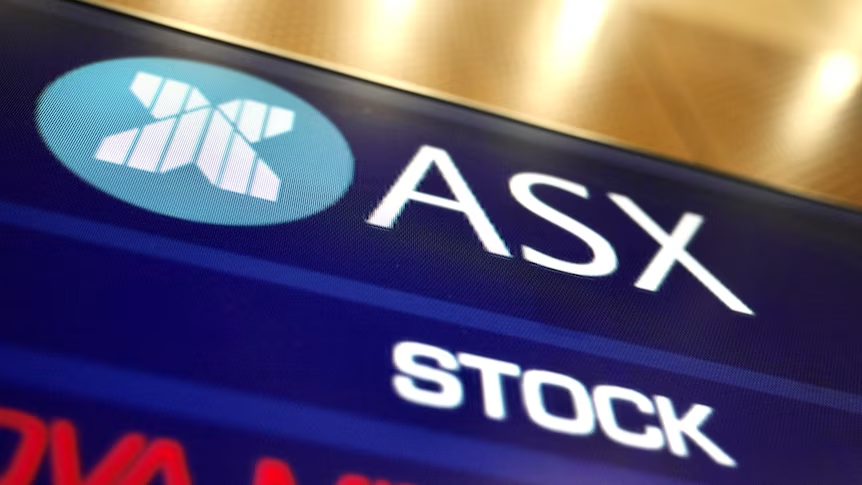
The ASX 200 record high super impact is more than just a market milestone. It directly affects millions of Australians.
The S&P/ASX 200 surged through 9,130 points to close at a fresh all time high, gaining 1.12% or 127 points in a single session. Over the past twelve months, the index is now up 10.5%.
That performance feeds straight into superannuation balances. For the 16 million Australians with retirement savings invested in local equities, this rally represents real compounded gains at a time when inflation remains near 3.8% and rate uncertainty lingers.
Australia’s home bias is delivering again.
Banks and BHP Lead From the Front
Leadership came from familiar names. The Big Four banks carried the index higher, supported by balance sheet strength and steady earnings outlooks. Commonwealth Bank rose 1.8% to $162.45, marking another 52 week high as deposit growth and capital ratios reinforced confidence.
National Australia Bank gained 1.4%, while Westpac added 1.6%, both benefiting from disciplined cost control and stable credit conditions in a labour market holding near 4.2% unemployment. Financials now represent roughly 32% of the index.
Meanwhile, BHP climbed 0.9% to $42.10 as copper prices approached US$10,400 per tonne and gold traded near US$2,900 per ounce. Materials as a sector advanced 1.8%, with support also coming from Rio Tinto and Fortescue. The rally was concentrated in quality.
What This Means for Super Balances
Most balanced and growth super funds allocate between 50% and 70% to Australian equities.
A 1.12% daily move in the index translates to roughly 0.6% to 0.8% portfolio uplift for those funds. On a $1 million balance, that equates to an additional $6,000 to $8,000 annually at current return rates, before fees.
Superannuation assets nationally now exceed $3.9 trillion. Around 65% remains domestically invested, delivering five year annualised returns near 9%.
Large funds such as AustralianSuper, with substantial allocations to banks and miners, are direct beneficiaries of this market structure. SMSF investors heavily weighted toward CBA, NAB, Westpac and BHP have felt the impact immediately.
Why the Banks Are Holding Up
Commonwealth Bank continues to demonstrate what investors describe as fortress balance sheet characteristics. Home loan volumes exceed $500 billion and capital ratios sit near 11.8% CET1, fuelling ongoing discussion around buyback potential.
Return on equity remains around 12%. Net interest margins are holding above 1.80%, even with the cash rate at 4.35%. Cost to income ratios at NAB and Westpac are below 50%, ahead of internal targets.
Credit quality has not deteriorated materially. That stability underpins confidence.
Dividend yields between 3.5% and 4.5%, fully franked, provide an additional return floor.
BHP and the Commodity Tailwind
BHP’s contribution reflects more than short term price action.
Copper remains central to electrification and renewable infrastructure demand. Management estimates that every US$1,000 per tonne movement in copper prices materially impacts earnings.
The integration of OZ Minerals and the ramp up at Olympic Dam continue to strengthen exposure to future facing metals. Gold provides diversification. Iron ore remains resilient despite China property concerns. Investors view BHP as both cyclical and defensive. That combination works well in uncertain markets.
Australia Versus Global Volatility
The ASX rally comes against a volatile global backdrop. The Nasdaq Composite has experienced sharp swings tied to AI sentiment and US policy uncertainty. The S&P 500 trades on elevated multiples relative to history.
Australia’s market structure is different. It is income heavy, it is commodity linked and it rewards steady cash flow generation. While US markets debate growth multiples, Australian investors collect dividends.
That contrast is becoming clearer.
Read More

Risks Still Exist
No rally is without risk. A surprise rate hike from the Reserve Bank of Australia could pressure short term bank margins. A sharp slowdown in China would weigh on iron ore demand. US tech volatility can spill over. However, fully franked dividend yields of 4% to 5% provide a degree of insulation.
History also shows that during 2022’s 12% drawdown, banks and miners cushioned broader losses. Quality remains the anchor.
What Super Investors Should Consider
Super focused investors should regularly review asset allocation settings. Exposure to Australian financials and materials can be accessed through broad ETFs such as Vanguard Australian Shares Index ETF or iShares Core S&P/ASX 200 ETF, or through direct holdings. Rebalancing remains important.
Concentration risk can build quickly when markets trend higher. Monitoring wage growth data, bank trading updates and commodity price guidance will remain key in coming months.