
Financial markets are rapidly reassessing Australia’s interest rate outlook as an oil-driven inflation shock ripples through the global economy. Traders now expect the Reserve Bank of Australia to raise interest rates several times this year as the escalating Middle East conflict pushes energy prices sharply higher.
The change in expectations reflects growing concern that the surge in oil prices could trigger a renewed wave of inflation just as policymakers had begun to regain control over price pressures.
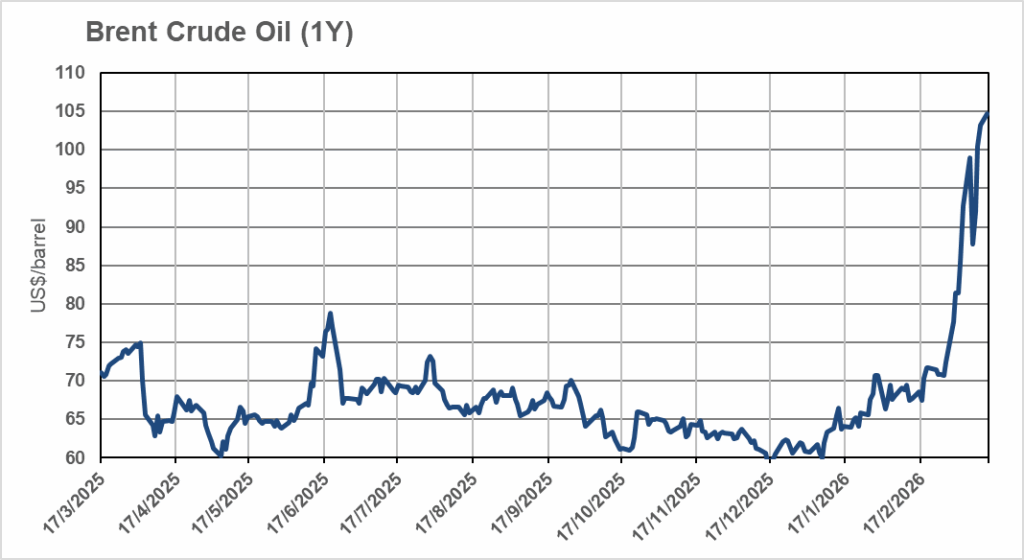
With Brent crude now trading above US$100 a barrel after a dramatic rally, investors increasingly believe the RBA may need to take a more aggressive stance to contain inflation.
Oil Supply Disruption Sends Prices Soaring
The current spike in oil prices has been driven by the escalating conflict between the United States, Israel and Iran. Military strikes on Iran’s major export hub at Kharg Island and the near closure of the Strait of Hormuz have disrupted one of the world’s most important energy shipping routes.
Roughly 20% of global oil supply normally flows through the Strait of Hormuz, making any disruption to the corridor a major shock to global energy markets.
Oil prices have surged about 40% in just two weeks, creating one of the most severe supply disruptions seen in modern oil markets.
Higher energy prices feed quickly into broader inflation because fuel costs affect transportation, manufacturing and household spending.
For central banks, that dynamic presents a difficult policy dilemma.
Inflation Forecasts Begin Climbing
Australia’s Treasurer has already warned that the energy shock could push inflation significantly higher this year.
Treasury now expects headline inflation to reach the mid-to-high 4% range, a notable increase from the 3.8% annual inflation rate recorded in January.
That figure sits well above the RBA’s official 2% to 3% target band, raising concerns that price pressures could become entrenched again.
The duration of the Middle East conflict remains the biggest unknown.
“The biggest variable… is really how long this drags out,” the Treasurer said, highlighting the difficulty policymakers face when geopolitical events suddenly reshape economic forecasts.
Markets Price in a Faster Rate-Hike Cycle
Against that backdrop, investors have dramatically increased their expectations for interest rate increases.
Major Australian banks now broadly expect the RBA to lift the cash rate to 4.1% in the near term, with further increases likely if inflation remains elevated.
Bond markets have taken an even more aggressive view.
Interest rate futures now imply three additional rate hikes this year, which would push the cash rate to around 4.6%. That would mark the highest interest rate level in Australia since 2011, during the peak of the mining investment boom.
Perpetual’s head of investment strategy Matthew Sherwood noted that Australia already faced underlying inflation pressure before the energy shock hit.
The Middle East conflict has simply intensified those risks.
Equity Markets React to Rising Risk
The rising probability of higher interest rates has unsettled equity markets.
The S&P/ASX 200 has dropped more than 6% in two weeks, erasing roughly $190 billion in market value since hostilities began.
Global markets have also shown signs of strain.
Wall Street closed lower on Friday as investors reassessed the outlook for economic growth and inflation. Technology stocks were particularly weak, with major US tech leaders slipping into correction territory after falling more than 10% from recent highs.
Higher interest rates tend to pressure equity valuations because they raise borrowing costs and reduce the present value of future earnings.
Read More

Markets Begin Considering a Long War Scenario
Investors are increasingly modelling scenarios where the Middle East conflict continues for an extended period.
Strategists at AMP have raised the probability of a prolonged war scenario, where instability in Iran persists even if the country’s leadership changes.
Such a situation could keep the Strait of Hormuz under threat for months or longer.
In the most extreme case, some analysts warn oil prices could climb toward US$200 per barrel, a level that would almost certainly trigger a global economic slowdown.
Higher energy prices act like a tax on households and businesses. They reduce consumer spending power while simultaneously pushing up production costs.
That combination creates the conditions for stagflation, where inflation remains high while economic growth weakens.
The RBA Faces a Difficult Balancing Act
For the Reserve Bank, the challenge now lies in navigating a supply-driven inflation shock.
Traditional interest rate policy works best when inflation is driven by strong demand. In contrast, energy shocks increase prices while simultaneously slowing economic activity.
That leaves central banks with limited options.
If the RBA tightens policy too aggressively, it risks weakening the economy further. If it moves too slowly, inflation expectations could rise and become harder to control.
For now, markets believe policymakers will prioritise containing inflation.
The sharp repricing of interest rate expectations suggests investors expect the RBA to act decisively if energy prices remain elevated.
Much now depends on the trajectory of the Middle East conflict. If tensions ease and oil prices stabilise, inflation pressures may fade quickly.
But if supply disruptions persist, Australia could face a prolonged period of higher interest rates and increased market volatility.