


Private credit, which involves lending by non-bank institutions, has grown rapidly in recent years as borrowers seek flexible financing solutions. Its appeal lies in customized loan structures and floating-rate features that help protect against interest rate movements. This expansion has been driven by stricter bank regulations and heightened market volatility, which have reduced traditional lending capacity and increased demand for alternative funding sources. As a result, the private credit market has increased from approximately $2 trillion in 2020 to $3 trillion in 2025 and is forecast to reach around $5 trillion by 2029.
Private Credit Market & Players
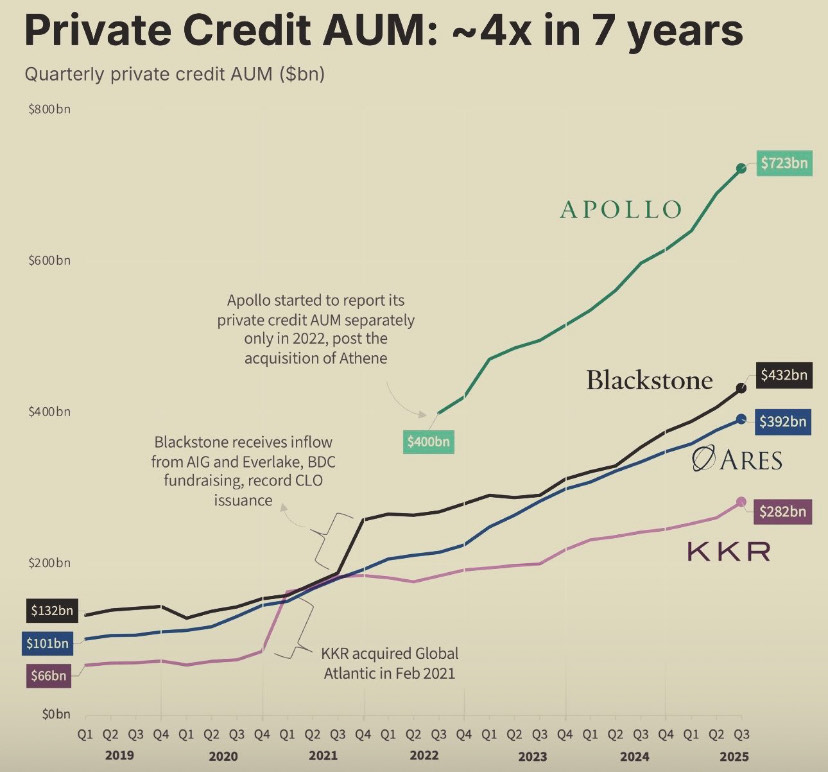
Private credit has grown close to 4x in 7 years. The tightened regulation and rates from banks have given private markets the opportunity to grow at an exponential rate. The big players continue to dominate, with Apollo leading the way. Apollo’s AUM climbed to $723 billion following its 2022 acquisition of Athene. Blackstone grew to $432 billion, driven by capital from AIG and increased BDC fundraising. Ares and KKR reached $392 billion and $282 billion, respectively, with KKR’s rise strengthened by its 2021 acquisition of Global Atlantic. Overall, the sector’s rapid growth highlights strong investor demand and accelerating institutional participation.
The Role of Private Credit in a Portfolio
Private credit is gaining popularity as an attractive alternative to conventional fixed-income investments, particularly for investors seeking enhanced yield. In addition to generating regular income from contractual interest and fee payments. It offers an illiquidity premium that results in spreads above those of publicly traded corporate bonds. Historically, private credit has recorded lower default losses than public credit markets and provides diversification benefits through its relatively low correlation with both equities and traditional bonds. Furthermore, private credit allows for tailored portfolio construction, enabling investors to combine different strategies and better manage risk while aiming to improve overall risk-adjusted returns.
What We Can Expect for 2026
Private credit momentum is set to remain strong, with AUM projected to surpass $2 trillion in 2026 and approach $4 trillion by 2030. Underscoring sustained demand for higher-yielding alternatives to traditional fixed income. Market composition is shifting beyond corporate direct lending toward asset-based finance strategies such as real estate credit, infrastructure debt, and specialty finance. Growth is broadening geographically, with EMEA and APAC gaining traction alongside regulatory support and rising institutional participation. Meanwhile, increased M&A and LBO activity will heighten competitive pressures and compress margins in certain segments but also expand financing opportunities. Reinforcing private credit’s role as a critical capital source for corporates and sponsors.