


Business Description
Woodside Energy Group Ltd. is an international energy company involved in exploring, assessing, developing, producing, marketing, and selling hydrocarbons across the Asia–Pacific, Africa, the Americas, and Europe. Its portfolio includes liquefied natural gas, pipeline gas, crude oil and condensate, and natural gas liquids. The company is also expanding into new energy products and lower‑carbon solutions. Founded in 1954 and headquartered in Perth, it operated as Woodside Petroleum Ltd. until adopting the name Woodside Energy Group Ltd. in May 2022.
Ahead of the Curve
Woodside is integrating its traditional and new energy businesses across the value chain. This integration signals that New Energy is not a side project but a structural part of Woodside’s long‑term strategy. Woodside frames New Energy as a unique portfolio of emerging products and services designed to help buyers decarbonise. The company expects demand for these offerings to rise as global energy systems shift. It highlights that lower‑carbon hydrogen made from natural gas with carbon capture can currently be more cost‑effective than electrolytic hydrogen while markets mature. The company views this as an integration rather than a pivot from the norm, having spent over $2.5 billion on new energy since 2021, giving them a competitive edge in the market.
Management & Strategy
Woodside Energy’s management, led by CEO Meg O’Neill, a former Exxon executive, has pursued a strategy centered on disciplined capital allocation and the continued expansion of its core LNG and petroleum portfolio, while selectively investing in lower-carbon opportunities (new energy). The leadership team emphasises operational efficiency, cost control, and strong shareholder value, reflecting a realistic approach shaped by its origins as a ‘conventional’ energy producer. At the same time, management has advocated a long-term transition through its “new energy” initiatives in hydrogen, ammonia, and carbon capture and storage, positioning these as future growth options rather than immediate profit drivers. Overall, Woodside’s management strategy balances near-term cash generation from gas with cautious diversification into alternative energy, prioritising financial resilience over rapid transformation.
Stock Price and Financial Statement Metrics
Stock Price Overview
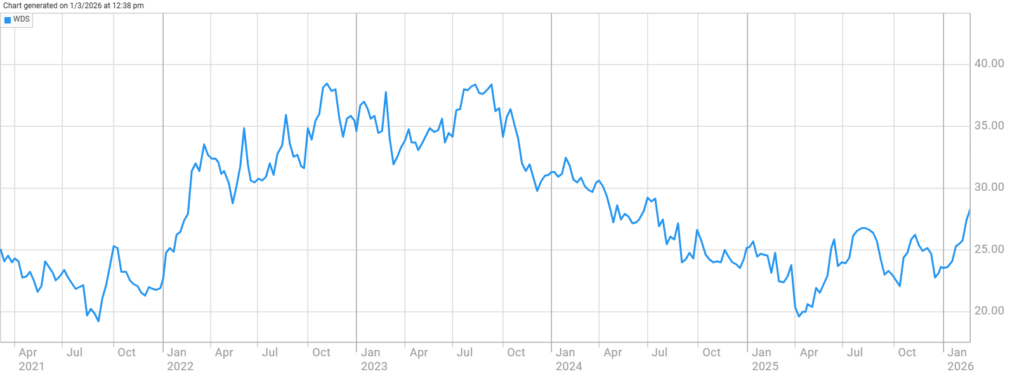
Woodside Energy’s share price over the past five years has moved through several distinct cycles, influenced by changing commodity prices, project developments, and changing market perception. The stock surged in 2022, delivering an annual return of about 68% owing to LNG prices and completion of the BHP petroleum merger. Performance then flattened in 2023, with only a marginal decline, before a sharper drop of around 21% in 2024 as energy prices eased. More recently, the shares have found a floor and begun to recover, posting a modest gain in 2025 and a stronger double-digit rise so far in 2026, reflecting improved production, resilient cash flows, and continued capital discipline. Taken together, the five‑year pattern highlights both volatility and resilience, with returns closely linked to global LNG trends and the market’s perception of Woodside’s execution on its growth strategy.
Financial Statement Metrics
Woodside Energy’s 2025 income statement reported record production, solid operational execution, and earnings resilience despite sluggish commodity prices. The company achieved its highest-ever output of 198.8 million barrels of oil equivalent, supported by strong asset performance. Underlying net profit after tax declined by 8% to USD $2.6 billion, or USD $1.39 per share, while operating cash flow surged 85% to USD $3.7 billion. Woodside also announced a final dividend of USD 0.59, representing an 11% increase and maintaining its 80% payout ratio, with the share price rising 2% over the period. In short, net profit declined; however, other metrics in their books seem extremely healthy, with solid cash flow and increasing dividends, showcasing the company’s positive outlook for the coming years. The 8% NP loss can be attributed to R&D and spending on new energy.
Read More

Peer Valuation
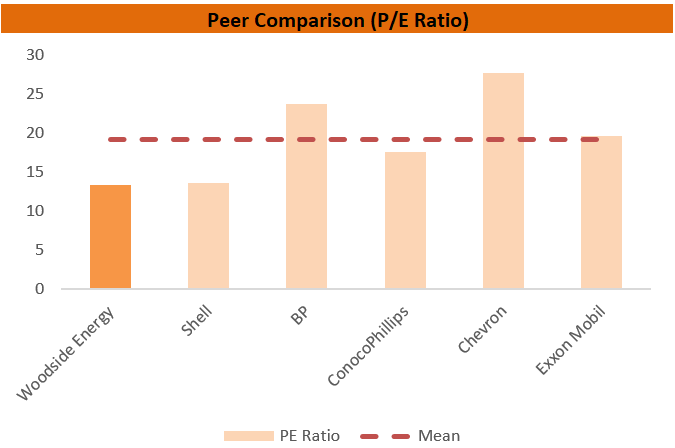
From Woodside Energy’s standpoint, the peer comparison charts show that the company trades at a valuation discount on both earnings and cash-flow metrics. Its P/E ratio of about 13x sits below the peer average of roughly 19x and well under Chevron (28x), BP (24x), and ExxonMobil (19x), while broadly matching Shell (13x). On an EV/EBITDA basis, Woodside trades near 5.5x, also below the peer mean of around 6.6x at a slight premium to Shell and BP (both near 4x), broadly comparable to ConocoPhillips (5.5x), and significantly lower than Chevron (9.5–10x) and Exxon (10.5x). Taken together, the data indicates that the market values Woodside at a moderate discount to the wider peer group, particularly relative to the U.S. majors.

An Outlook for 2026
Woodside Energy heads into 2026 with solid momentum after achieving record output and high operational reliability in 2025. The Scarborough Energy Project is now 94% complete and remains on schedule for the first LNG in the fourth quarter of 2026, making it the company’s principal source of near-term growth. Ongoing contributions from other major developments are expected to drive their cash flow and broaden their asset base. Finally analyising that the company seems underpriced given the current market conditions. Taken together, these factors point to an extremely positive coming year for the business, placing Woodside Energy on our watchlist.
Disclaimer
The Investor Standard provides general information for education and research only. It is NOT personal advice, a recommendation, or an offer to buy/sell any security. This content has been prepared without taking into account your objectives, financial situation or needs. Past performance is not indicative of future results. Before acting on any information, consider its appropriateness and seek independent advice from a licensed financial adviser.