

In a highly unusual move for the corporate debt market, Alphabet, Google’s parent company, came to market in February with a 100-year sterling bond, raising £1.4 billion at a coupon of 6.125%. Proceeds are to support Alphabet’s accelerating AI capital expenditure program. Issued in the UK market with a £100,000 minimum denomination, the instrument was restricted to institutional participants, pension funds, hedge funds, and sovereign wealth managers among them, keeping retail investors in the dark. The demand was emphatic, with the order book reportedly oversubscribed approximately tenfold, showcasing the depth of institutional appetite for long-duration, investment-grade paper from a name of Alphabet’s standing.
Why this issue is extremely rare
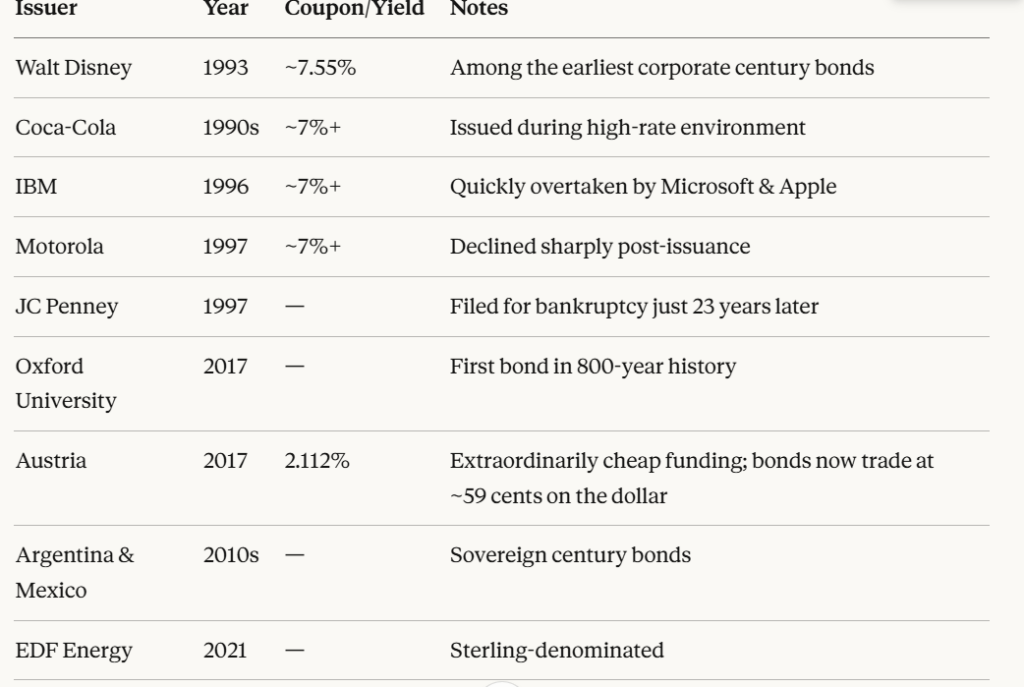
Companies rarely issue ultra‑long‑dated bonds because neither corporations nor their typical investors are truly permanent entities. A retail investor buying a hypothetical 100‑year Google bond today is definitely not going to be alive when it matures, let alone in a position to actively use the principal repayment. For institutions with genuinely long time horizons, such as endowments, foundations, or sovereigns that are expected to exist for many generations, century bonds are a more natural fit, aligning with their intergenerational investment and funding objectives. Corporate century bonds do appear from time to time, but they remain relatively rare, and history shows that some high‑profile issues have produced mixed outcomes for both issuers and bondholders.
Past issues regarding century bonds
It’s simple bond mechanics!!!
Century bonds embed unusually high risk because their extreme maturities magnify both credit and interest‑rate exposure. Even modest moves in yields can trigger large double‑digit price swings due to very long duration, making these instruments far more volatile than standard long‑term debt. Credit shocks are similarly amplified: Petrobras’s 2115-century bond, for example, slumped toward 70 cents on the dollar within months of issuance as Brazil and the company were hit by rating downgrades, despite strong initial demand. Sovereign cases can be harsher; Argentina’s 2117 bond defaulted in 2020 and had to be swept into a sweeping restructuring only a few years after coming to market. Liquidity is another concern, as century bonds typically trade thinly, making it difficult to exit positions during periods of stress. On top of that, many are structured with call options, introducing reinvestment risk and an additional layer of uncertainty for investors.
Does this issue instill confidence in Google investors?
“They’re making a statement and saying, ‘Hey, listen, we’re still going to be around here in 100 years,'” Jason Moser said. “As a Google shareholder myself, I feel like it’s a confidence booster.” (Senior Analyst – Motley Fool)
For Alphabet, issuing a 100‑year bond is less about raising needed cash and more about signaling long‑term institutional stability. With a balance sheet in excellent health and cash reserves far exceeding the £1 billion raised, the deal wasn’t driven by short‑term funding needs. Instead, it allowed Alphabet to secure fixed-rate capital for decades at a known cost, supporting its multi-decade AI infrastructure expansion without diluting shareholders or drawing on existing liquidity. The nearly ten times oversubscription underscores investor confidence in Alphabet’s longevity, and the 6.125% coupon, while above recent corporate norms, may ultimately prove inexpensive if AI‑driven growth compounds as expected. By issuing debt that will mature in 2126, Alphabet aligns itself with sovereigns and century-old institutions, sending a clear signal that it intends not just to navigate the coming technological era, but to shape it.
Disclaimer
The Investor Standard provides general information for education and research only. It is NOT personal advice, a recommendation, or an offer to buy/sell any security. This content has been prepared without taking into account your objectives, financial situation or needs. Past performance is not indicative of future results. Before acting on any information, consider its appropriateness and seek independent advice from a licensed financial adviser.