

Western governments are accelerating efforts to secure supply chains for critical minerals, and Australia has become a central player in that strategy. A new agreement between the United States and Lynas Rare Earths highlights how geopolitical competition is reshaping the global rare earths market.
The US Department of Defense has agreed to purchase nearly $140 million worth of rare earth oxides from Lynas over the next four years. The agreement sets a floor price of US$110 per kilogram, providing the Australian producer with pricing stability while helping the United States diversify its supply of strategically important minerals.
The deal strengthens Lynas’ position as one of the most important non-Chinese suppliers of rare earths used across defence, advanced manufacturing and clean energy technologies.
A Strategic Supply Agreement
Under the binding letter of intent, the Pentagon will purchase both light and heavy rare earth oxides produced by Lynas.
The agreed floor price sits well above the company’s recent realised prices. Lynas achieved an average price of US$74 per kilogram for neodymium-praseodymium (NdPr) during 2025 and just US$49 per kilogram in 2024.
A guaranteed price floor gives producers greater confidence to expand production and invest in processing capacity, a critical step in building supply chains outside China.
Lynas managing director Amanda Lacaze said the agreement strengthens access to materials that sit at the core of modern industrial technology.
Through this agreement, the US defence industrial base will continue to have access to light and heavy rare earth oxides that are essential for modern manufacturing.
Amanda Lacaze
Rare Earths at the Centre of Geopolitics
Rare earth elements play a key role in advanced technologies. Manufacturers use them to produce high-performance magnets that power electric vehicle motors, fighter jets, wind turbines, lasers and missile systems.
China dominates this supply chain. The country controls roughly 70% of global rare earth mining and more than 80% of processing capacity.
That dominance has raised concerns in Western capitals for years. Beijing has previously restricted exports of rare earth materials during geopolitical disputes, including temporary curbs placed on shipments to Japan.
In response, the United States, Japan and Australia have ramped up efforts to build alternative supply chains.
The Lynas agreement forms part of that broader strategy.
Mining analyst Rahul Anand from Morgan Stanley said the US and Japanese supply deals reinforce Lynas’ strategic position.
They highlight the company’s role as a core supplier of rare earth materials outside China.
Japan Also Locks in Long-Term Supply
The US deal follows a similar agreement signed last week with Japanese buyer Japan Australia Rare Earths (JARE).
Under that arrangement, JARE will purchase at least 5,000 tonnes of NdPr annually until 2038, also with a floor price of US$110 per kilogram.
Together, the two agreements provide long-term demand certainty for Lynas while helping Western economies reduce reliance on Chinese processing.
Breaking China’s Monopoly in Heavy Rare Earths
Lynas has already begun to erode China’s dominance in several areas of the rare earth supply chain.
In 2025, the company started producing heavy rare earth elements such as terbium and dysprosium at its processing facility in Malaysia.
These metals play a crucial role in high-temperature magnets used in defence systems and electric vehicles. Until recently, China held an effective monopoly on their production.
Developing new refining capacity outside China remains a major challenge, however. Processing rare earths requires complex chemical separation techniques and significant capital investment.
Expansion Plans and Processing Capacity
The Pentagon agreement may also influence Lynas’ future expansion strategy.
The company previously considered building a heavy rare earth refinery in Texas, designed to process terbium and dysprosium within the United States. Those plans stalled after disagreements over funding.
The new offtake arrangement modifies the earlier partnership between Lynas and the US Department of Defense, leaving open the possibility that American processing capacity could still expand in the future.
Meanwhile, Lynas continues to operate a vertically integrated supply chain. The company mines rare earth ore at Mount Weld in Western Australia and processes it at facilities in Kalgoorlie and Malaysia.
Read More

Prices Rebound as Governments Secure Supply
Rare earth prices have rebounded sharply this year after several years of weakness.
The market rallied above US$120 per kilogram as Western governments accelerated efforts to secure supply chains independent of China.
Governments are also exploring the creation of strategic stockpiles of critical minerals, similar to energy reserves used to stabilise oil markets.
Australia and the United States took a further step toward that goal last year when they announced a $4.6 billion critical minerals partnership aimed at financing new mines, processing plants and refining capacity.
Investors Rediscover Rare Earths
The renewed strategic focus has also attracted investor attention.
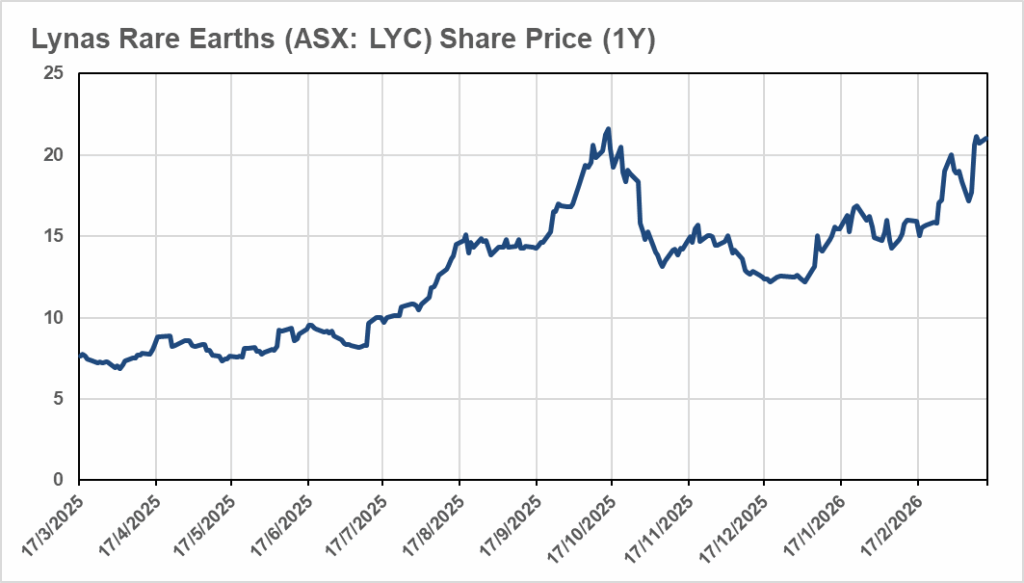
Shares in Lynas have surged more than 180% over the past year, lifting the company’s market value above $21 billion and cementing its position as one of Australia’s most strategically important mining companies.
For investors, the rare earths sector now sits at the intersection of geopolitics, defence spending and the global energy transition.
As governments push to secure supply chains and reduce reliance on China, companies capable of producing and refining these materials outside Beijing’s orbit may find themselves in a powerful position for years to come.