

A Historic Reopening of the IPO Window
After a long period of subpar issuance, the U.S. IPO market is staging a strong comeback in 2026, fueled by three headline-grabbing listings: SpaceX, OpenAI, and Anthropic. Market observers suggest these offerings could trigger one of the largest waves of public listings in U.S. history, despite all three companies still operating at a loss. Their lofty private valuations and rapid revenue expansion have nevertheless rekindled investor enthusiasm for high-growth technology plays. Between 2022 and 2024, IPO volumes declined significantly, with only a tentative pickup in 2025. However, sentiment for 2026 has shifted markedly, as a new wave of AI-focused heavyweights has indicated plans to enter the public markets.
The Scale: Over $100 Billion in Potential Proceeds
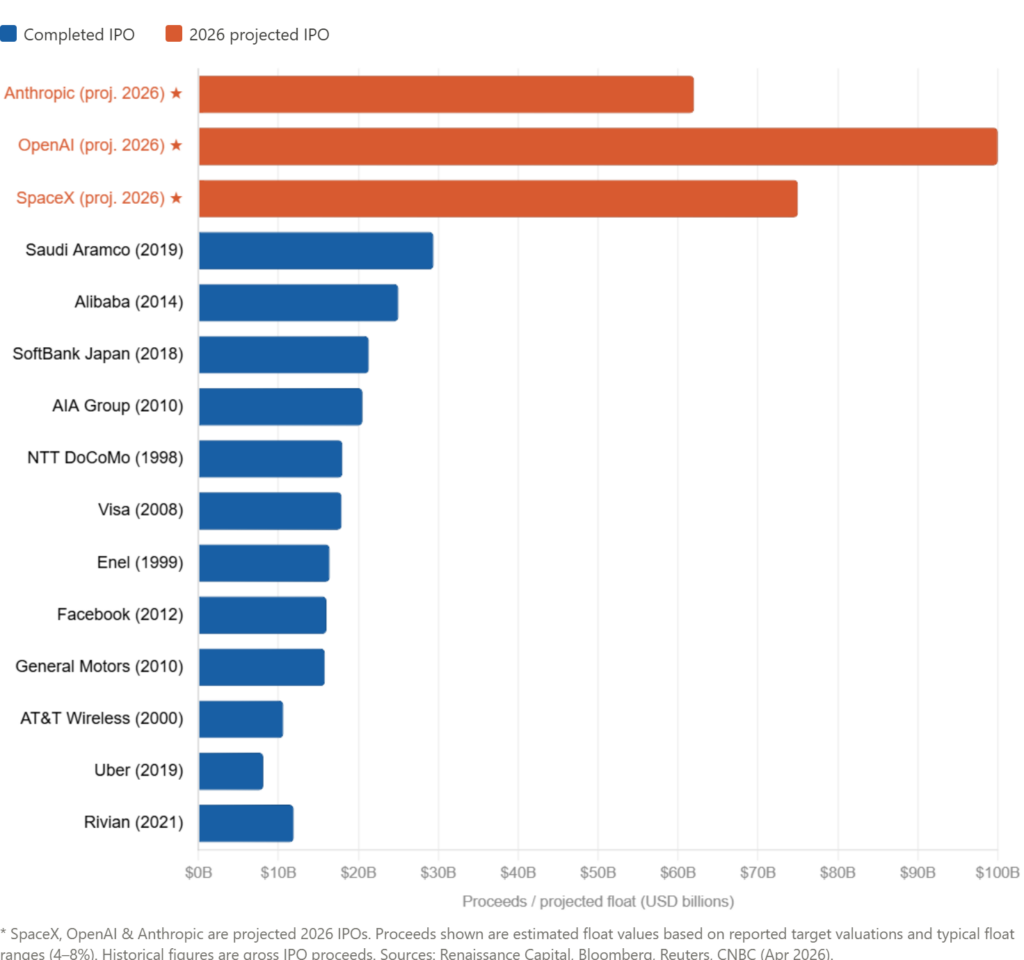
The combined valuations of SpaceX, OpenAI, and Anthropic are without precedent. Estimates suggest SpaceX could target a valuation of $1.75 trillion, while OpenAI may seek around $1 trillion, and Anthropic has already reached roughly $380 billion. Even with relatively modest public float percentages, these offerings could collectively raise well over $100 billion. At more typical float levels, industry giants project the trio might need to raise between $432–$576 billion, an amount that would surpass the total capital raised by all U.S. IPOs between 2016 and 2025.
Why These IPOs Matter
These companies sit at the heart of two of the decade’s most transformative technological shifts. SpaceX is rapidly expanding Starlink while reinforcing its dominance in commercial launch services, while OpenAI is leading the generative-AI wave through ChatGPT and accelerating enterprise adoption of AI solutions. At the same time, Anthropic has emerged as a major contender in frontier model development, supported by substantial late-stage funding. Together, their potential listings mark a pivotal moment for the AI investment narrative, suggesting these IPOs could rank among the most significant liquidity events in venture capital history, unlocking returns after years of constrained exits and compressed valuations.
A Liquidity Shockwave
The implications extend well beyond the companies themselves. A successful run of listings could revive the broader IPO pipeline, prompting many delayed tech unicorns to finally enter public markets. At the same time, index-fund mechanics introduce added complexity: given their scale, eventual inclusion in benchmarks such as the S&P 500 would require passive funds to rebalance, potentially creating volatility across mega-cap technology stocks. Conversely, the sheer size of these offerings could absorb a significant share of available capital, crowding out smaller IPOs and delaying liquidity opportunities for other startups.
A Defining Year for Public Markets
The IPO market’s rebound is far from broad-based, instead being driven by a small group of exceptionally large, era-defining companies. Whether this marks the beginning of a sustained reopening or simply a one-off liquidity surge will depend on how these listings perform and how investors absorb their unprecedented scale. What is already evident, however, is that SpaceX, OpenAI, and Anthropic have fundamentally reset expectations for the IPO landscape, and 2026 may ultimately be remembered as the year public markets were redefined.
Disclaimer
The Investor Standard provides general information for education and research only. It is NOT personal advice, a recommendation, or an offer to buy/sell any security. This content has been prepared without taking into account your objectives, financial situation or needs. Past performance is not indicative of future results. Before acting on any information, consider its appropriateness and seek independent advice from a licensed financial adviser.