


Amazon at $270: A Great Opportunity from a numbers perspective
Amazon trading at a forward P/E in the mid-20s is an uncommon occurrence by historical standards. Recent data suggests its forward multiple has ranged between roughly 26–31x in 2026, significantly below the 40–50x levels often seen in earlier growth cycles. This multiple compression is happening even as revenue growth begins to re-accelerate, largely driven by Amazon Web Services, increased investment in AI infrastructure, and the continued expansion of its enterprise software offerings. When a company’s valuation multiple declines while its growth trajectory strengthens, it often creates one of the more attractive entry points for long-term investors within a market cycle.
AWS: The Engine Behind the Thesis
Amazon Web Services remains Amazon’s most profitable business, and recent results point to renewed momentum. In Q1 2026, AWS revenue rose 28% year over year, its fastest growth in more than three years. While operating income reached $14.2 billion, reflecting margin expansion as AI-related workloads scale. This trend appears sustainable rather than temporary, with analysts at Morgan Stanley forecasting AWS growth of over 20% in 2026, supported by significant data centre buildouts and strong demand for generative AI infrastructure.
AWS at $600B ARR by 2036
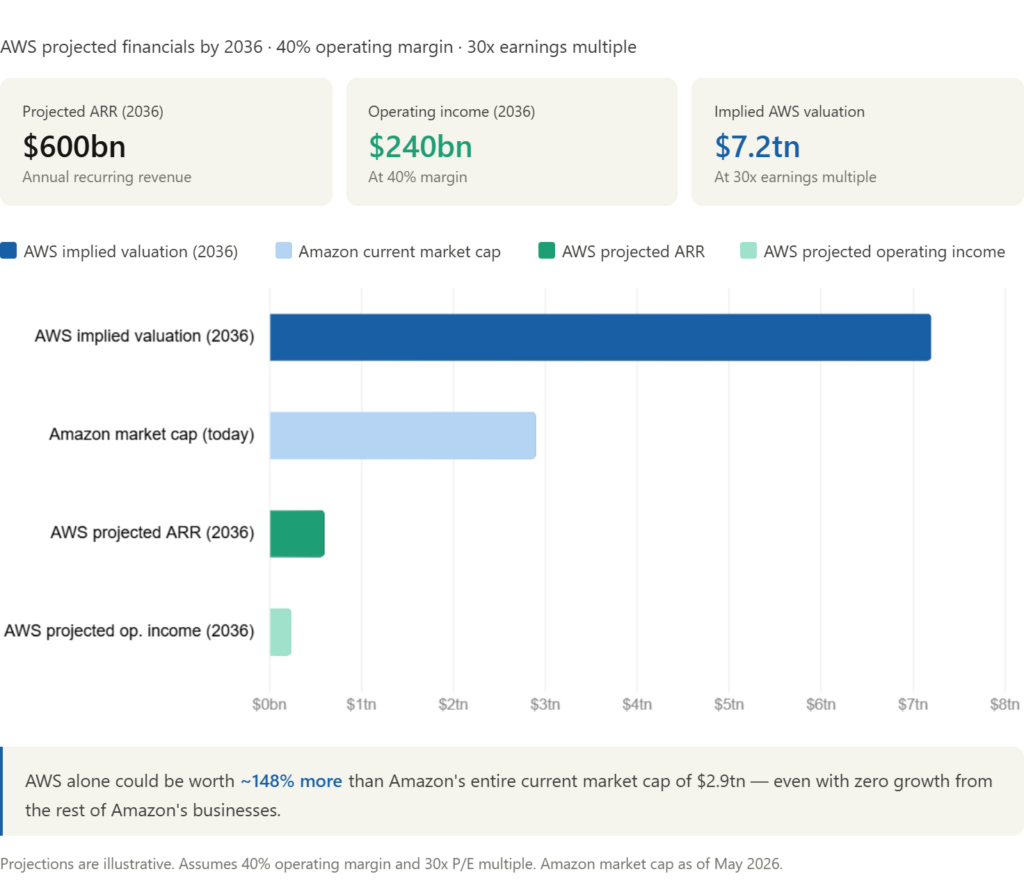
If Amazon Web Services were to reach $600 billion in annual recurring revenue by 2036, a credible outcome given sustained hyperscaler demand, accelerating AI adoption, and its vertically integrated silicon strategy, the implied valuation would be extraordinary. Assuming a 40% operating margin, consistent with mature cloud and software businesses, and applying a 30x earnings multiple for a dominant, high-moat platform, AWS would generate roughly $240 billion in operating income and support a valuation of about $7.2 trillion.
This suggests AWS alone could be worth nearly 200% more than Amazon’s current market capitalisation of around $2.9 trillion. Put differently, AWS on its own could rival or even outperform benchmarks like the S&P 500, even if the rest of Amazon’s businesses delivered no further growth.
Everything Else Is Pure Upside
If Amazon Web Services alone can justify a valuation multiple of Amazon’s current market cap, then the rest of the business effectively becomes “free upside.” Its e-commerce division remains the backbone of global online retail, underpinned by a logistics network few competitors can match. Meanwhile, Amazon’s advertising arm is among the fastest-growing in the world, with margins comparable to leaders like Meta Platforms and Alphabet Inc.
Subscriptions, led by Prime, continue to expand internationally, driving higher average revenue per user and deeper ecosystem lock-in. At the same time, advances in robotics and automation are turning Amazon’s warehouse systems and AI-driven logistics into durable competitive advantages. Looking further ahead, initiatives such as Project Kuiper and its connectivity ambitions are positioning the company for a new frontier in cloud-to-space infrastructure. Taken together, each of these segments has the potential to scale into a Fortune 100–level business in its own right.
Why This Setup Is Rare
A business combining accelerating revenue growth, rising cloud margins, and multi-trillion-dollar optionality, while trading on a forward P/E near historical lows, is rarely valued like a mature, slow-growth retailer. Yet that is precisely how Amazon is being priced in the $250–$270 range.
Final Takeaway
Amazon at around $270 can be framed as a long-term opportunity, given that Amazon Web Services alone has the potential to support a multi-trillion-dollar valuation over the next decade. The rest of the business,spanning e-commerce, advertising, Prime subscriptions, robotics, and satellite initiatives—effectively represents additional upside layered onto an already compelling cloud-driven thesis.
If AWS continues to execute on its current trajectory, long-term investors may not need the company’s other segments to outperform benchmarks like the S&P 500. However, if those businesses also deliver strong growth, the overall return potential could be significantly amplified.
Disclaimer
The Investor Standard provides general information for education and research only. It is NOT personal advice, a recommendation, or an offer to buy/sell any security. This content has been prepared without taking into account your objectives, financial situation or needs. Past performance is not indicative of future results. Before acting on any information, consider its appropriateness and seek independent advice from a licensed financial adviser.