

Australia’s listed technology sector endured a bruising 2025 and a volatile start to 2026. High quality names such as Xero, WiseTech Global, Technology One, NextDC and Megaport suffered drawdowns ranging from 20% to more than 50%, despite largely resilient earnings and revenue growth.
For investors, the question is no longer what broke. The debate is whether this was a necessary valuation reset, or the market mispricing durable compounders amid macro stress.
Sector fundamentals remain intact. Earnings growth across ASX technology exceeded 25% in FY25, and margins remain elevated by global standards. Markets, however, have imposed a new rulebook. Free cash flow discipline now matters more than top line momentum, particularly while rates remain restrictive.
Performance snapshot, the numbers that matter
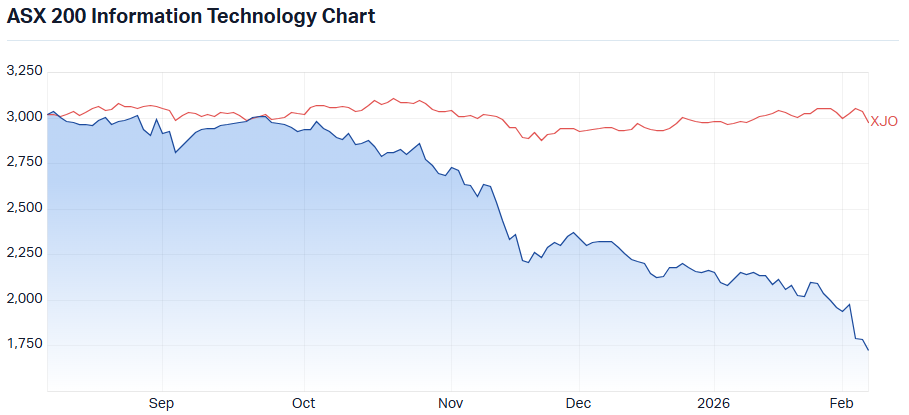
The ASX Information Technology index fell between 15% and 20% during calendar 2025, materially underperforming the ASX 200’s commodity driven gains. Selling intensified into early February 2026 following renewed rate fears.
Selected ASX tech performance overview
| Company | 2025 CY Return | Peak to Trough Drawdown | FY25 Revenue Growth | EBITDA or FCF Margin | Feb 2026 Price | FY26F P/E |
|---|---|---|---|---|---|---|
| Xero (XRO) | -31% | ~55% | +21% | FCF ~27% | $81.76 | ~45x |
| WiseTech (WTC) | -45% | ~50% | +14% | ~53% | ~$70 | ~60x |
| Technology One (TNE) | -9% | ~38% | +18% | ~30% | $23.37 | ~50x |
| NextDC (NXT) | -25% | ~35% | Capacity ramp | Negative FCF | ~$14 | N/A |
| Megaport (MP1) | -15% | ~40% | Modest recovery | Improving | N/A | Elevated |
| ASX IT Index | -15 to -20% | N/A | +26% | 40 to 50% | N/A | ~40x |
Despite different narratives, a common theme emerged. Valuation compression, not earnings collapse, drove most declines.
Why the sector struggled
Macro and valuation pressure led the decline
The primary driver was macro. The RBA’s February 2026 guidance reinforced a higher for longer stance, with policy rates hovering between 3.85% and 4.10%. Growth stocks trading above 40 times forward earnings faced unavoidable multiple compression.
Higher discount rates materially reduced the present value of long dated cash flows. For many SaaS models, this alone justified 20% to 30% valuation resets.
Currency effects compounded the issue. The Australian dollar strengthened during late 2025, diluting earnings from offshore markets that account for more than half of sector revenues.
Economic momentum also slowed. GDP growth drifted toward 1.5% to 2%, while unemployment edged above 4%. Small business spending weakened, hitting Xero’s core customer base.
Company specific execution issues amplified losses
Xero disappointed with slower subscriber growth, now tracking in the high single digits in mature markets. Earnings missed consensus by a wide margin, and competitive intensity in payments and AI tooling added uncertainty.
WiseTech’s sell off reflected governance risk rather than demand weakness. Ongoing ASIC scrutiny, director interviews and regulatory overhang prompted analysts to trim earnings forecasts and investors to demand a higher risk premium.
Technology One suffered its sharpest single day decline in decades after missing profit expectations. The transition costs of its SaaS shift weighed on margins, even though long term ARR growth remains solid.
Infrastructure names faced a different challenge. NextDC and Megaport continued heavy investment while free cash flow stayed negative. Hyperscaler capex reviews slowed sentiment, even as long term demand remains strong.
Global contagion, US tech still sets the tone
The US tech complex dominated global flows through 2025. The Nasdaq 100 gained over 20% for the year, driven largely by the Magnificent Seven. That concentration created fragility.
By early 2026, cracks emerged. Several US leaders corrected 10% to 15% post earnings. Recession probabilities rose, and AI capex enthusiasm moderated.
Australian tech remains tightly correlated with US sentiment. ETF flows, passive selling and earnings reactions in Nvidia or Microsoft routinely moved ASX names, even without local news.
Despite similar earnings growth rates, ASX tech traded at higher forward multiples than US peers. That gap narrowed sharply as rates stayed restrictive.
The local cycle matters more than many expected
Australia’s economy remains stuck in a late cycle stall. Government spending and migration support activity, but private investment and consumption lag. The RBA remains focused on inflation risk. Rate cuts are now unlikely before late 2026 unless data improves materially.
Technology stocks suffer disproportionately in this environment. Recurring revenue models rely on consistent demand, yet SME volatility increased throughout 2025. Unlike banks, tech companies do not benefit from higher rates. This explains why quality businesses still derated sharply.
Catalysts that could drive recovery
Near term signals to watch
RBA easing would be the most powerful trigger. Even modest cuts could unlock a 15% to 25% sector rerating. Resolution of regulatory probes, particularly at WiseTech, would remove a major overhang.
Earnings stabilisation also matters. Xero subscriber acceleration and margin stabilisation at Technology One would rebuild confidence.
Structural tailwinds remain intact
AI adoption is progressing cautiously, which suits Australian software models. Government digitisation, cybersecurity demand and cloud migration continue to support long term growth. WiseTech’s post acquisition integration phase offers operational leverage if execution improves.
Investment outlook
The sector now trades at a rare disconnect. Earnings grew around 26% while prices fell closer to 20%. That creates opportunity. Selective accumulation on weakness makes sense, particularly in businesses with strong cash generation and defensible moats.
Volatility will persist. Recovery depends on both domestic policy and US tech stabilisation. This was not a broken sector. It was a repricing.