


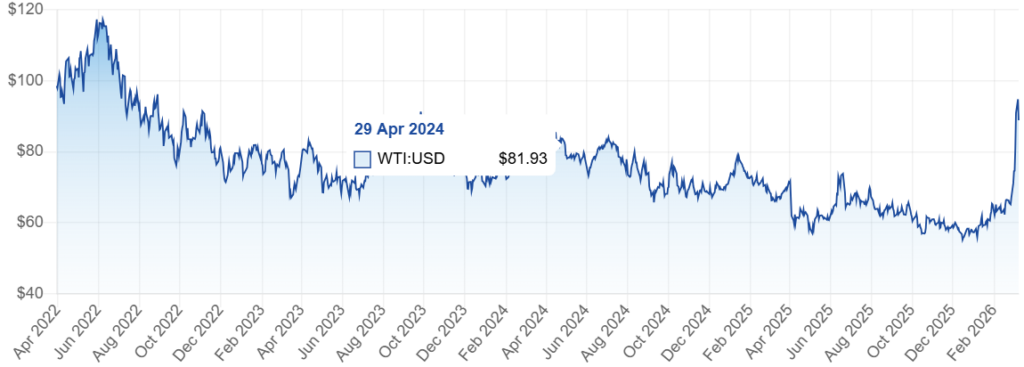
Brent crude surged as much as 25–30% intraday to between US$110 and $115 per barrel, its highest level since 2022. After a weekend of open conflict involving Iran and US-Israeli strikes on energy infrastructure, accompanied by threats to target oil refineries. The flashpoint sparked fears of prolonged disruption through the Strait of Hormuz, the critical chokepoint through which roughly one-fifth of global oil flows pass, and with it, a sort of stagflation: a toxic mix of rising inflation and slowing economic growth. When markets opened, the reaction from Asia was immediate and severe; the Nikkei shed 6.6% and the Kospi fell 6.5%, while Australia’s S&P/ASX 200 posted its own steep early losses, as investors across the globe moved swiftly to price in the mounting policy and growth headwinds unleashed by the energy shock.
How oil prices affect equities?
The S&P/ASX 200 followed suit, closing down 2.85% and erasing roughly A$90 billion in market capitalisation, with the intraday trough briefly approaching A$130 billion before a partial recovery. The damage was concentrated in macro-cyclicals: Materials and Financials bore the brunt, with BHP off 5.1% and CBA down 1.8%. The sole exception was Energy, where upstream producers rallied as the market priced in near-term windfall gains from elevated spot prices. All this caused a mass selloff in the market.
Key drivers of the ASX selloff:
Australia’s share market slump reflected a combination of global and domestic pressures: escalating US tariff threats from President Trump toward China, Canada, and Mexico triggered a broad risk‑off move, weighing heavily on Australia’s export‑dependent economy, particularly its resource sector. Wall Street weakness added further downside, as sharp declines in the Nasdaq and S&P 500, driven by recession fears and tech-sector selling—flowed directly into ASX trading, dragging financials and miners lower. At the same time, concerns over China’s slowing growth undermined sentiment toward major iron‑ore producers such as BHP, Rio Tinto, and Fortescue, while falling commodity prices, especially iron ore, compounded losses in the materials-heavy ASX 200. These macro shocks were amplified by deteriorating investor sentiment, rising volatility, and uncertainty around US economic policy, interest‑rate direction, and geopolitical instability, ultimately prompting investors to rotate out of equities and into safer assets.
What to Watch Out for Next
Market direction from here will hinge on a handful of key catalysts. The clearest upside trigger would be a credible de-escalation between Iran, the US, and Israel or a restoration of secure transit through the Strait of Hormuz, which would compress the risk premium currently embedded in crude. Equally important will be how the RBA and Fed interpret the shock: upcoming inflation data will show whether they look through the energy spike as temporary or lean into a “higher‑for‑longer” stance, exacerbating existing growth headwinds for equities. The risk-off move has also bled into bulk commodities, with softer iron ore prices dragging ASX‑listed miners and prompting fresh questions around the durability of Chinese demand. In combination, these three drivers—geopolitics, central bank signaling, and commodity sentiment—will dictate how quickly markets can rebase and whether recent volatility proves a wobble or the start of a more protracted drawdown.
Disclaimer
The Investor Standard provides general information for education and research only. It is NOT personal advice, a recommendation, or an offer to buy/sell any security. This content has been prepared without taking into account your objectives, financial situation or needs. Past performance is not indicative of future results. Before acting on any information, consider its appropriateness and seek independent advice from a licensed financial adviser.