


A Turning Point in European Medicine
Cambridge-based Flok Health has reached a major milestone, securing an oversubscribed $12.5 million Series A funding round led by AlbionVC, with support from Eka Ventures, Form Ventures, and Mercia Ventures. While the raise is significant in its own right, the bigger story is what the company has built. Flok Health has developed what is believed to be Europe’s first AI system capable of diagnosing, treating, and discharging patients without direct human oversight. In an industry where innovation often arrives in small, gradual steps, this represents a major leap forward.
Co-founders Finn Stevenson and Ric da Silva set out to do more than create another healthcare app. Their vision was to build an AI-powered clinician, one capable of managing patient care from start to finish, and they are now bringing that vision closer to reality.
The Vision: AI That Heals, Not Just Predicts
Most healthcare AI systems are designed to support clinicians by analysing medical images, identifying potential issues, or suggesting treatment options. Flok Health takes a much broader approach. Rather than simply assisting healthcare professionals, its platform is designed to manage the entire physiotherapy journey from start to finish. The system can assess patients using motion-tracking technology and biomechanical analysis to identify musculoskeletal conditions, create personalised treatment plans that adapt as recovery progresses, and monitor outcomes to determine when a patient has successfully completed their rehabilitation program.
What makes Flok particularly notable is this end-to-end capability. The goal is not to replace physiotherapists but to expand access to quality care by helping bridge the gap between growing patient demand and limited clinical resources.
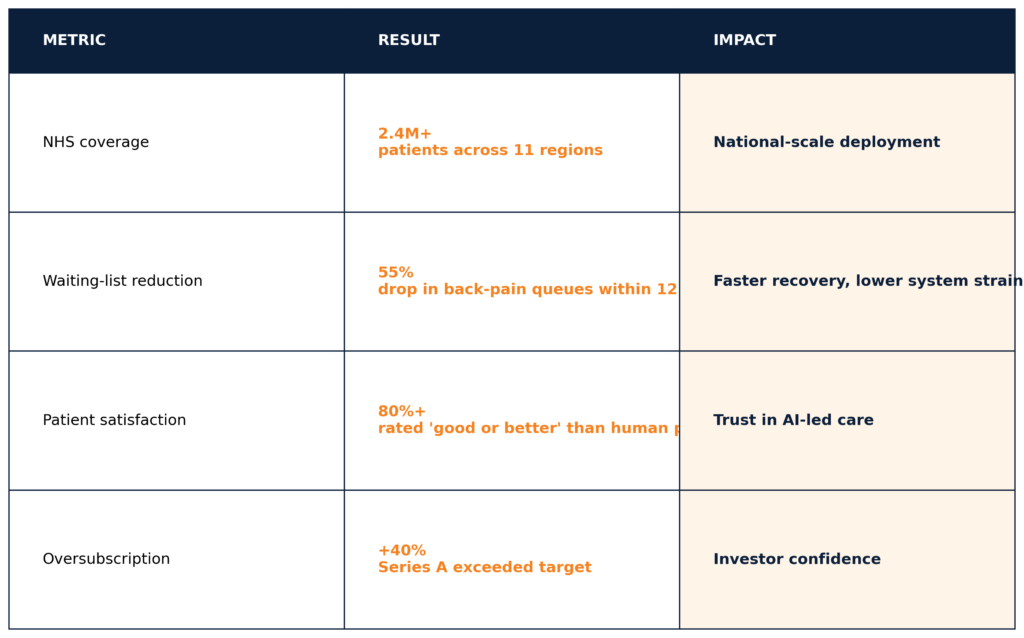
The Numbers Behind the Breakthrough
Cambridge Precision Meets Clinical AI
At the heart of Flok’s platform is a combination of computer vision, machine learning, and clinical data analysis. The system can assess a patient’s posture, movement patterns, and muscle function in real time, comparing those insights against data gathered from millions of physiotherapy interactions. One of its key strengths is a biomechanical AI engine that can identify movement issues and potential injuries with a level of accuracy approaching that of experienced clinicians. The platform also continuously adapts treatment plans as patients progress, ensuring exercises remain appropriate and effective throughout the recovery process.
To support safe clinical use, Flok has been built to meet the rigorous standards required by healthcare regulators, including the NHS and MHRA. This positions the company well beyond the realm of consumer wellness apps. Instead, it is developing a regulated medical AI platform designed to deliver healthcare at scale.
Founders with a Mission
Finn Stevenson – The Systems Engineer
With a background in engineering and robotics from Cambridge, Finn Stevenson approached healthcare through the lens of complex systems. His vision was to build AI that could understand the human body as a constantly changing, interconnected system rather than simply analysing isolated data points.
Ric da Silva – The Clinical Mind
As a physiotherapist who later moved into technology, Ric da Silva brought deep clinical expertise to the company. He played a key role in ensuring the platform remained grounded in real-world patient care, translating years of physiotherapy knowledge into algorithms that could guide treatment decisions safely and effectively.
Together, Stevenson and da Silva combined technical innovation with clinical insight. The result is a platform designed not just to automate healthcare processes but to deliver a patient experience that feels closer to interacting with a clinician than using traditional software.
The Impact: From Waiting Rooms to Living Rooms
Flok Health’s rollout across the NHS is already beginning to change how patients access and experience physiotherapy. Instead of waiting months for treatment, many patients can start their recovery journey within days. The platform also helps deliver a more consistent standard of care, ensuring patients receive the same level of support regardless of their location.
By automating routine physiotherapy pathways, Flok allows healthcare professionals to spend more time focusing on patients with complex needs, where human expertise is most valuable. At the same time, patients benefit from real-time feedback, personalised guidance, and clear progress tracking, giving them a more active role in their recovery.
If adopted more widely, this approach has the potential to reduce pressure on the NHS while improving patient outcomes, a combination that is rarely achieved in healthcare, where cost savings and quality of care often compete with one another.
Conclusion
Flok Health’s $12.5 million Series A represents more than a successful funding round which highlights the growing role AI can play in improving real-world healthcare outcomes. By combining advanced engineering with a deep understanding of patient care, founders Finn Stevenson and Ric da Silva have built a platform that goes beyond prediction and analysis to actively support recovery and treatment.
At a time when healthcare systems around the world are facing rising demand, staff shortages, and growing waiting lists, Flok offers a glimpse into a different future, one where high-quality care is more accessible, scalable, and responsive to patient needs. While human clinicians will always play a vital role, AI has the potential to expand access to care and help bridge capacity gaps across the healthcare system.
As AI continues to move from assisting clinicians to delivering parts of the care pathway itself, Flok Health is emerging as one of the companies helping define what that future could look like.