
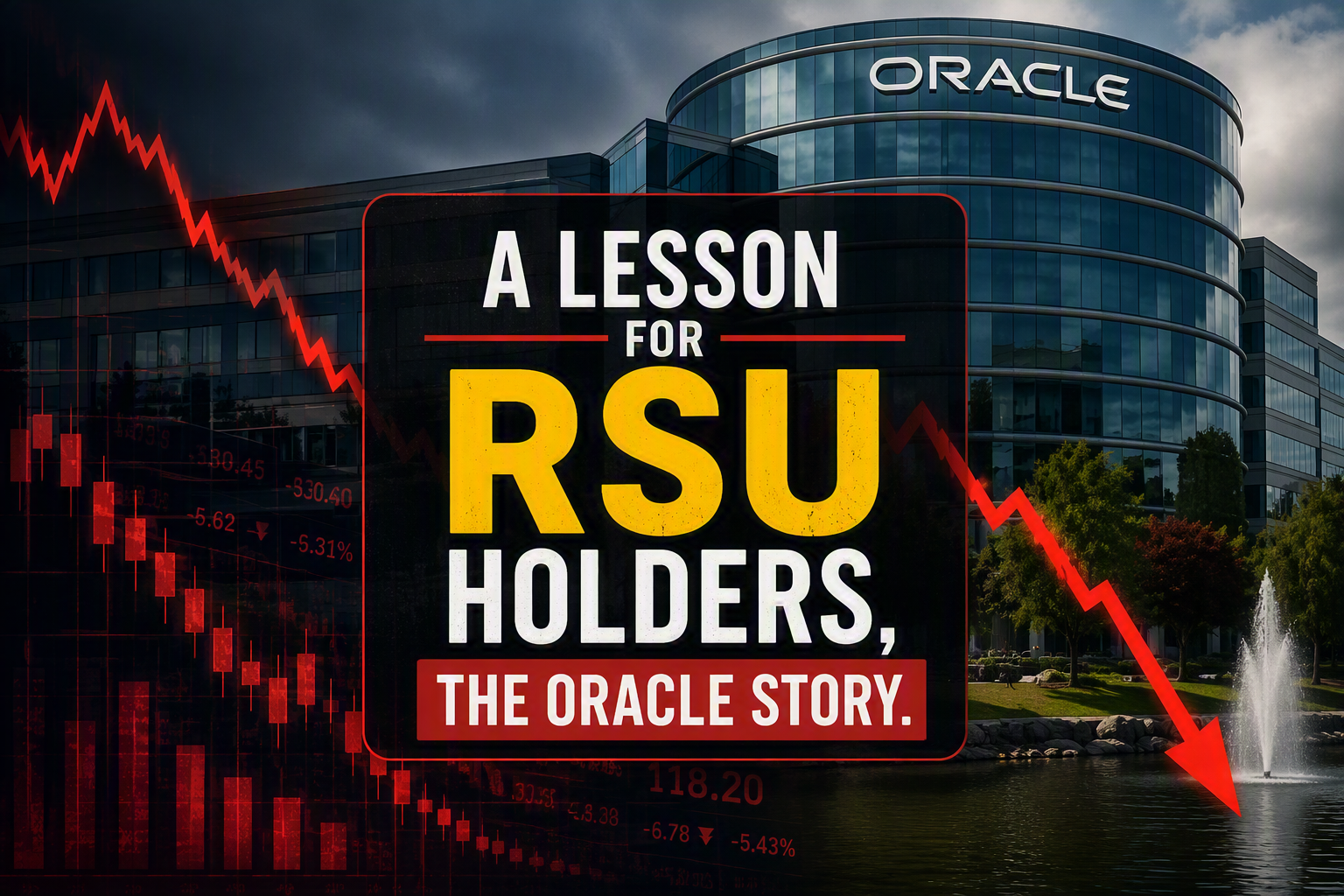
A falling share price is painful for any investor. For employees paid with Restricted Stock Units (RSUs), the consequences can be much worse. A market decline can leave them paying tax on value that no longer exists. The experience of Oracle employees exposes a structural weakness in India’s RSU tax system. If Oracle (NYSE: ORCL) shares were worth about $330 when the RSUs vested but later dropped to $118, the tax bill would still be based on the higher price. Tax is locked in at vesting, while the share price continues to move. Employees bear the market risk, but the tax liability remains unchanged. For many employees, the share price decline is only part of the problem. The bigger issue is paying tax on wealth that has since vanished. What began as equity compensation can quickly become a significant financial burden.
Understanding How RSUs Taxation Works in India (similar for many countries)
RSUs are generally taxed at two different stages. The first tax event occurs when the shares vest. The second happens when they are eventually sold.
The first stage is the vesting date. At this point, the fair market value (FMV) of the shares is treated as salary income. It is taxed as a perquisite at the employee’s applicable income tax rate.
Consider an employee receiving 100 vested shares. If Oracle stock is trading at $330, the taxable value is $33,000. The employee owes tax on that amount, even without selling a single share. Employers usually collect the tax by withholding shares or deducting it through payroll.
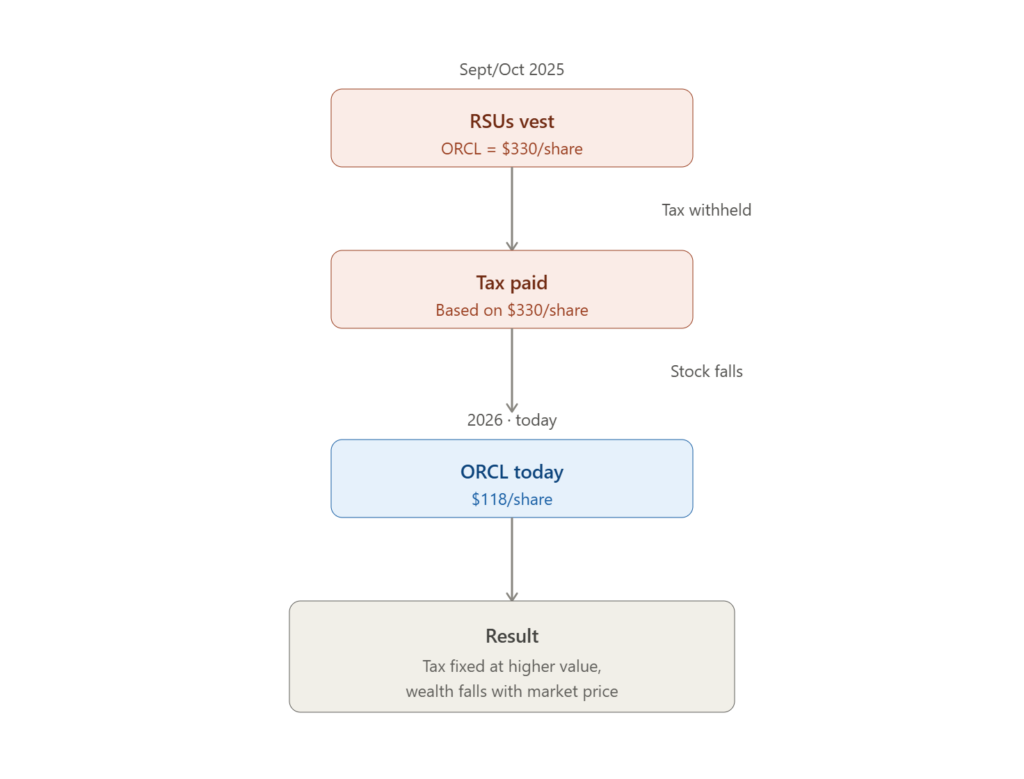
The second stage comes when the shares are sold. Capital gains tax applies only to the difference between the sale price and the FMV that was already taxed at vesting. This prevents the same income from being taxed twice. The problem emerges when the share price falls after vesting. The income tax bill remains fixed at the higher vesting value, even if the shares are worth far less by the time they are sold.
The Wealth Destruction Problem
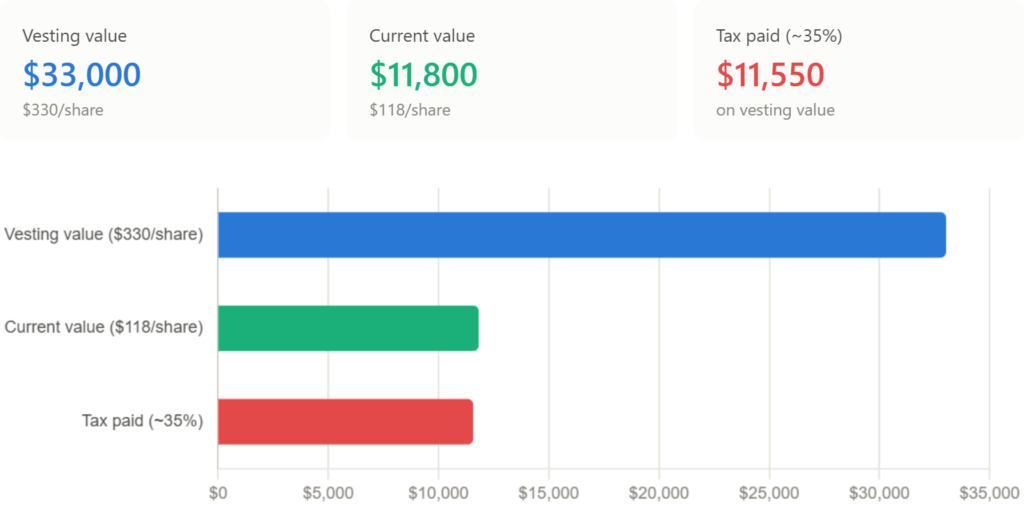
Imagine an Oracle employee whose RSUs vested when ORCL traded at approximately $330.
| Item | Value |
|---|---|
| Shares vested | 100 |
| FMV at vesting | $330 |
| Taxable value | $33,000 |
| Assumed tax rate | 35% |
| Tax paid | $11,550 |
| Current share price | $118 |
| Current portfolio value | $11,800 |
Why Employees Feel More Pain Than Investors
An investor who bought Oracle shares at $330 and watched them fall to $118 would record a significant loss. However, no tax would be due unless the investment had been sold at a profit.
RSU recipients face a very different outcome. Tax authorities treat vested shares as employment income rather than an investment. As a result, tax is triggered as soon as the shares vest. The liability is calculated using the share price on that date. Any subsequent decline in the stock does not reduce the tax bill.
This creates a clear imbalance. The government collects tax on the higher vesting value, while the employee absorbs the market loss. The result can be especially painful. Employees lose wealth as the share price falls, yet remain liable for a tax bill based on value that has already disappeared.
The Psychological Impact
The financial cost is only part of the story. The emotional impact can be just as significant. Many employees see RSUs as a long-term wealth-building tool rather than a cash bonus. They hold the shares because they believe in the company. Others avoid frequent trading, expect the stock to appreciate, or face restrictions on when they can sell.
When the share price later collapses, the outcome can feel deeply unfair. The tax liability was triggered automatically at vesting, even though no cash was received from selling the shares. Employees are left with a shrinking investment and a tax bill based on a value that has since disappeared.
Many describe the situation as being taxed on paper wealth that never became real. By the time the shares are sold, much of that value may have already evaporated.
Lessons for Employees Receiving RSUs
Oracle’s experience offers several important lessons for employees who receive a significant portion of their compensation through RSUs. While no one can predict where a company’s share price will go, the tax implications are far more certain.
The first lesson is diversification. Holding too much employer stock creates concentration risk. Both an employee’s income and personal wealth become tied to the same company. If the business struggles, both can suffer at the same time.
The second lesson is understanding the tax event. Many employees focus on when they plan to sell. In reality, the first tax liability arises when the shares vest. Delaying a sale does not postpone that obligation.
A clear selling strategy can also reduce risk. Some employees sell part of their vested shares immediately. The proceeds can cover taxes, lower concentration risk, and lock in part of the value. Others choose to hold, but only after making a deliberate investment decision rather than simply doing nothing. Ultimately, the focus should be on after-tax wealth rather than the number of shares owned. The more useful question is not, “How many shares do I have?” Instead, it is, “What is my after-tax exposure if this stock loses half its value?”
Conclusion
Oracle’s share price decline may have grabbed the headlines, but the bigger story for many employees is the tax treatment of RSUs.
When the shares vested at about $330, employees were taxed on that value as employment income. If the stock later fell to $118, the market loss was theirs alone. The tax bill, however, did not change.
The episode highlights one of the biggest risks of equity compensation. Tax is based on a single point in time, while wealth depends on what the market does next. The tax liability is immediate and unavoidable. The value of the shares is anything but.
For employees receiving stock-based compensation, understanding these rules is just as important as understanding the business behind the stock. In many cases, managing the tax risk can matter as much as picking the right investment.
Disclaimer
The Investor Standard provides general information for education and research only. It is NOT personal advice, a recommendation, or an offer to buy/sell any security. This content has been prepared without taking into account your objectives, financial situation or needs. Past performance is not indicative of future results. Before acting on any information, consider its appropriateness and seek independent advice from a licensed financial adviser