

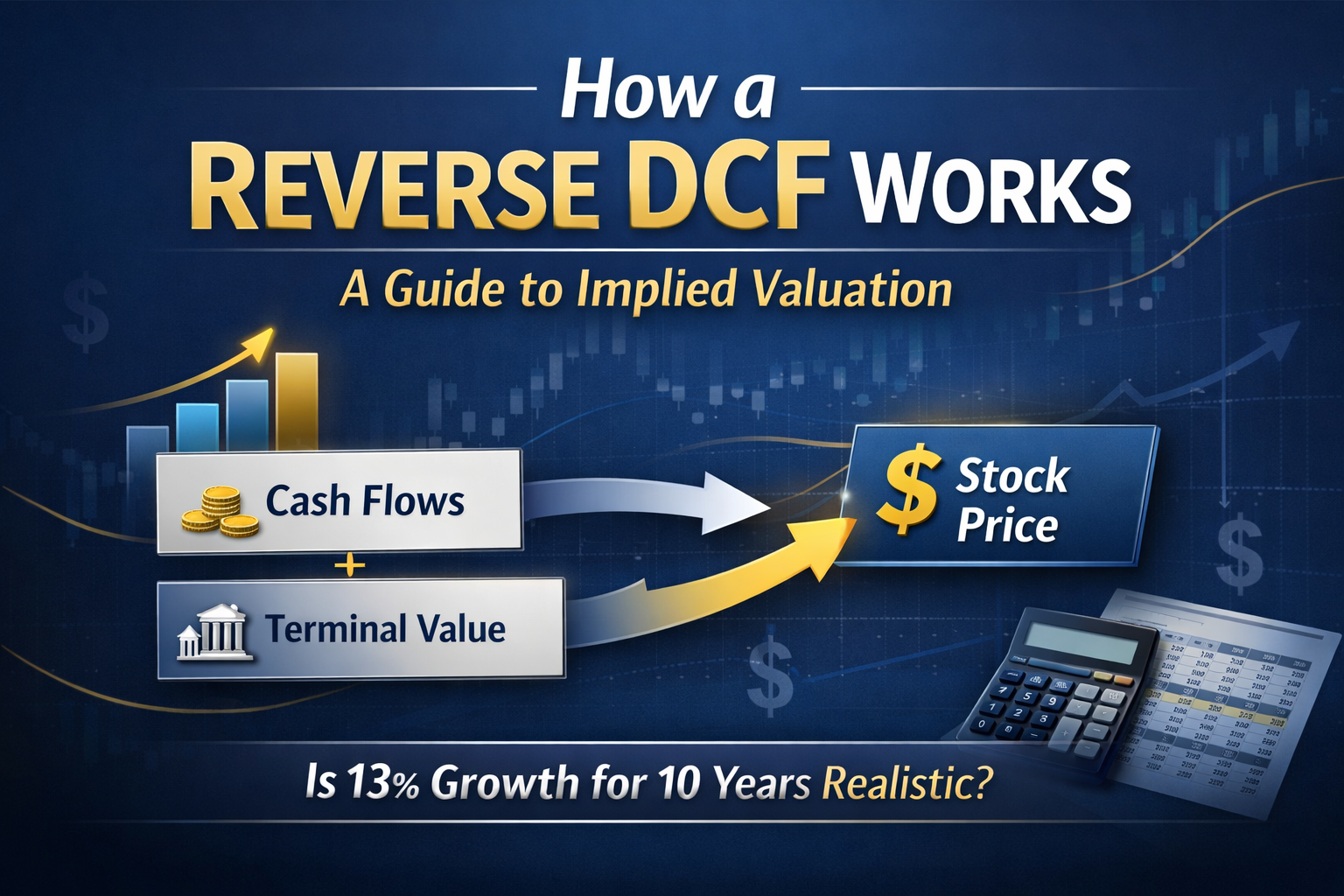
A Reverse Discounted Cash Flow (Reverse DCF) analysis is one of the most insightful valuation techniques because it approaches the problem from the opposite direction of a traditional DCF. Rather than projecting future cash flows to estimate intrinsic value, a reverse DCF begins with the company’s current market valuation and works backward to identify the growth assumptions required to justify that price. Put simply, it seeks to answer a critical question: What level of future performance is already being priced in by the market?
This framework is particularly valuable in today’s equity markets, where many high-growth companies trade at valuations that appear difficult to reconcile using conventional valuation metrics. By translating market prices into explicit growth expectations, a reverse DCF allows investors to move beyond market narratives and better understand the assumptions underpinning a stock’s valuation.
The Logic Behind a Reverse DCF
A traditional DCF requires analysts to make long-term forecasts for revenue growth, profit margins, reinvestment needs, and free cash flow—inputs that are inherently uncertain and highly sensitive to small changes in assumptions. As a result, even modest adjustments can lead to significantly different valuation outcomes. A reverse DCF addresses this challenge by starting with an observable fact: the company’s current market value.
Rather than asking, “What is this business worth?”, a reverse DCF asks a different set of questions:
- What level of growth is the market currently pricing in?
- How much margin expansion is implied?
- What reinvestment assumptions are necessary to sustain that growth?
- What long-term valuation assumptions support the current share price?
By reframing the analysis in this way, investors shift their focus from predicting the future to assessing whether the expectations embedded in the market price are realistic and achievable.
The Core Mechanics of a Reverse DCF
A reverse DCF uses the same underlying framework as a traditional discounted cash flow model, but it solves for a different variable. Rather than estimating intrinsic value based on forecast assumptions, the model works backward from the current market valuation to determine the growth rate, margin profile, or reinvestment level required to justify that valuation.
The process typically involves four key steps:
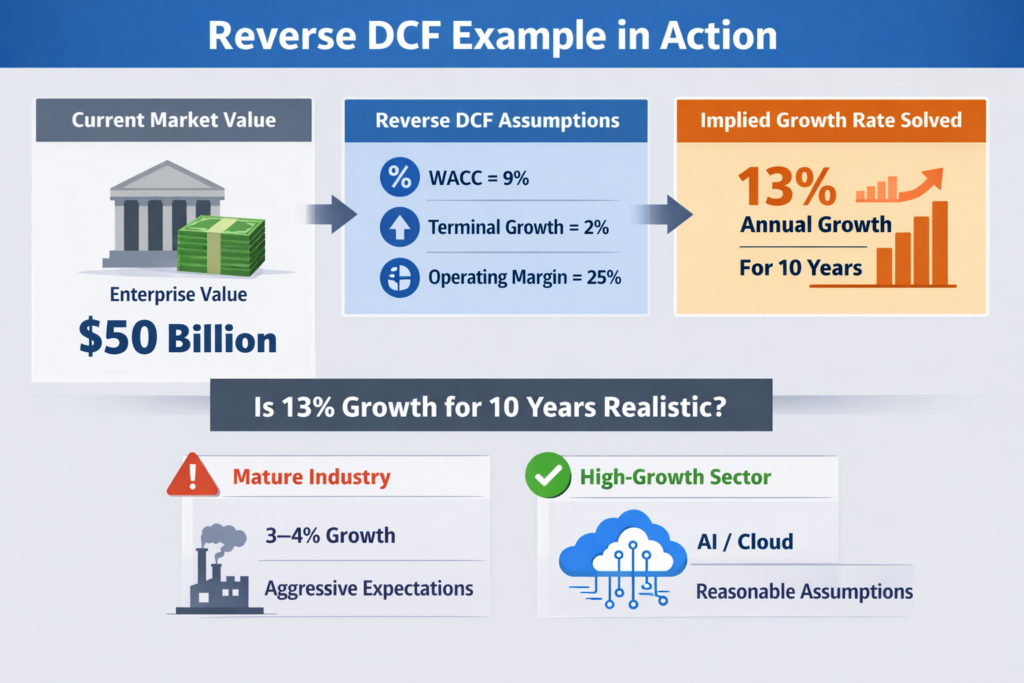
Step 1: Start with the current enterprise value
The analysis begins with the company’s market capitalisation and adjusts for net debt to calculate enterprise value (EV). This serves as the benchmark that the DCF model must ultimately reconcile.
Step 2: Fix the core assumptions
Several inputs are generally held constant, including:
- The discount rate (WACC)
- Tax rate
- Long-term margin assumptions
- Terminal growth rate
These variables provide the foundation for the analysis and allow the focus to remain on the key unknown.
Step 3: Solve for the implied variable
The model then calculates the level of performance required to support the current valuation. This is often expressed as:
- Revenue growth
- Free cash flow growth
- Operating margin expansion
The assumptions are adjusted iteratively until the present value of projected cash flows matches the company’s current enterprise value.
Step 4: Assess the market’s expectations
Once the implied growth or profitability assumptions have been identified, the real analysis begins. Investors can then ask:
- Is this level of growth achievable?
- Is it realistic given industry conditions and competitive dynamics?
- Does it depend on significant market share gains, pricing power, or margin expansion?
- Does it exceed the company’s historical performance or peer benchmarks?
This is where the reverse DCF becomes especially valuable. Rather than serving as a purely mathematical exercise, it provides a framework for evaluating whether the expectations embedded in a stock’s price are justified by the underlying business reality.
Why are investors chasing reverse DCF?
A reverse DCF offers several advantages that make it a valuable tool for investors evaluating market expectations.
A. It reduces the illusion of precision
Traditional DCF models can create a misleading sense of certainty, as small changes in assumptions often produce dramatically different valuations. A reverse DCF takes a more grounded approach by focusing on what the current market price implies, rather than attempting to predict the future with precision.
B. It provides insight into market expectations
By translating valuation into implied growth assumptions, a reverse DCF helps investors understand prevailing market sentiment. If the model implies exceptionally high growth rates, the stock may already be priced for near-perfect execution. Conversely, modest implied expectations could indicate that the market is underappreciating the company’s long-term potential.
C. It enables more meaningful comparisons
Two companies may trade at similar valuations, yet the expectations embedded in their share prices can be vastly different. A reverse DCF helps reveal which company is being valued more aggressively and which may offer a more attractive risk-reward profile.
D. It strengthens investment decision-making
A reverse DCF provides a clear framework for testing an investment thesis against market expectations. For example:
- A bullish investor might conclude: “The market is pricing in 8% long-term growth, but we believe the business can sustainably achieve 12%.”
- A bearish investor might argue: “The current valuation assumes 20% annual growth for the next decade, which appears difficult to achieve given industry competition and market maturity.”
In this way, the reverse DCF shifts the discussion from whether a stock is simply “cheap” or “expensive” to whether the market’s expectations are too optimistic or too conservative.
The Strategic Value of Reverse DCFs
Reverse DCFs redirect attention away from valuation outcomes and toward the underlying assumptions driving them. They compel analysts to clearly define what conditions must hold for a stock’s current price to be justified. This makes them especially useful for:
- Equity research
- Portfolio construction
- Risk management
- Investment committee discussions
- Scenario analysis
By making expectations explicit, reverse DCFs enable investors to move beyond stories and focus on fundamental drivers of value.