

- Structure: Open-Ended vs Closed-Ended Vehicles
- Pricing: NAV Discipline vs Discount Volatility
- Management Style: Passive Efficiency vs Active Conviction
- Income and Tax Treatment
- Transparency and Governance
- Historical Performance Patterns on the ASX
- When ETFs May Suit Investors
- When LICs May Play a Role
- Behavioural Considerations
- Final Thoughts: Building with Both
Both LICs and ETFs offer diversified exposure on the ASX. On the surface, they look similar. In practice, they behave very differently.
Understanding those structural differences is critical. Pricing mechanics, fee drag, tax treatment and discount risk can materially change long-term returns.
This guide breaks down LICs vs ETFs Australia in a clear, evergreen format for serious portfolio builders.
Structure: Open-Ended vs Closed-Ended Vehicles
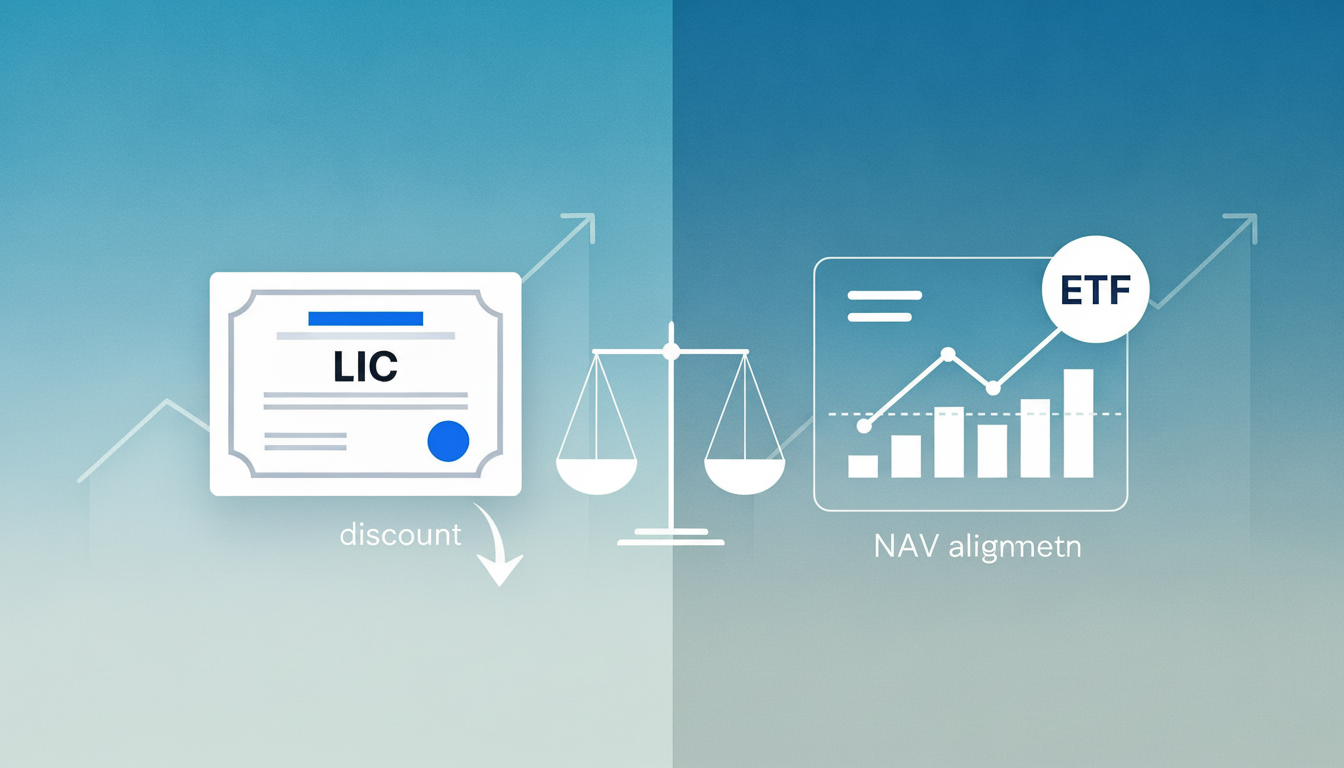
The core distinction starts with structure. Exchange-traded funds operate as open-ended unit trusts. Units are created or redeemed as investor demand changes. Market makers arbitrage any gap between price and net asset value, keeping ETF prices tightly aligned with the value of underlying holdings.
Listed investment companies operate differently. LICs are closed-ended companies listed on the ASX. They raise capital through IPOs, placements or rights issues. After listing, the number of shares on issue does not automatically adjust to demand.
As a result, LIC share prices can trade above or below their net tangible assets. Supply and sentiment drive pricing. This structural difference shapes everything that follows.
Pricing: NAV Discipline vs Discount Volatility
ETFs are designed to track their net asset value closely. In most market conditions, the gap between ETF price and NAV sits within 0.5% to 1%. Investors receive the portfolio return, less fees. Nothing more. Nothing less.
LICs introduce an additional layer of risk and opportunity. Because supply is fixed, prices frequently trade at discounts or premiums to pre-tax NTA. Discounts of 5% to 15% are common. Some extend beyond 20% in weak cycles. Buying at a discount can enhance returns if it narrows. However, widening discounts can erode gains even when the portfolio performs well. In LICs, you are not only backing the assets. You are also backing market sentiment toward the vehicle itself.
Management Style: Passive Efficiency vs Active Conviction
Most ETFs are passive. They track indices such as the S&P/ASX 200, MSCI World or Nasdaq 100. Fees are typically low, often between 0.05% and 0.25% per annum. That cost advantage compounds meaningfully over time. Active ETFs exist, but transparency and cost control remain central.
LICs, by contrast, are overwhelmingly active. Portfolios are often concentrated, holding 20 to 60 stocks. Managers pursue outperformance through stock selection, sector tilts or access to less liquid assets. This introduces potential alpha. It also introduces manager risk.
Fees reflect that ambition. Management fees commonly sit between 1% and 2%, sometimes with performance fees layered on top. Beating the index after those costs requires genuine skill.
Income and Tax Treatment
Income treatment is one of the most misunderstood differences in LICs vs ETFs Australia.
ETFs distribute underlying income and realised gains as they occur. Payments can fluctuate depending on portfolio turnover and market conditions. In weaker years, distributions can fall.
LICs operate as companies. They can retain earnings in profit reserves and smooth dividend payments across years. This makes LIC dividends appear more stable. Retirees often value this predictability. However, smoothing does not create new income. It redistributes timing.
Tax treatment also differs. ETFs generally pass through capital gains and franking credits transparently. LICs may retain capital gains internally, creating deferred tax positions that investors must understand.
Neither structure is inherently superior. The suitability depends on income needs and tax circumstances.
Transparency and Governance
ETFs typically publish holdings daily or monthly. Investors can see exactly what they own. Pricing is mechanical. NAV calculation is formula-driven.
LICs provide NTA updates monthly and disclose top holdings periodically. Boards play an active role in capital management decisions, including buybacks, tender offers or new capital raisings. Strong boards can narrow discounts through buybacks. Poor capital allocation can widen them. Governance quality matters more in LICs.
Historical Performance Patterns on the ASX
Over long periods, low-cost index ETFs have outperformed the median Australian equity LIC on a shareholder return basis. The reason is not necessarily poor stock selection. It is fee drag and persistent discounts. A broad ASX 300 ETF returning around 9% to 10% annually over a decade, with fees near 0.10%, compounds efficiently.
A typical LIC might deliver similar underlying portfolio returns, but higher fees and an average discount reduce the investor’s realised outcome. That gap compounds over time. Elite LICs have outperformed, particularly when purchased at meaningful discounts and supported by disciplined capital management.
However, selecting those managers consistently is challenging. For most investors, cost and structure matter more than marketing.
When ETFs May Suit Investors
ETFs are well suited as core holdings. They provide broad market exposure at minimal cost. Pricing is transparent. Discount risk is largely absent. For investors building long-term diversified portfolios, ETFs simplify implementation and reduce behavioural errors. They work particularly well in accumulation phases.
When LICs May Play a Role
LICs can complement ETF cores. They may suit investors seeking:
• Active stock selection
• Concentrated portfolios
• Franked dividend smoothing
• Access to niche or less liquid assets
Discount opportunities can provide entry points. However, monitoring NTA trends, discount levels and capital management decisions is essential. LIC investing requires engagement.

Behavioural Considerations
Closed-ended structures can protect managers from forced selling during market stress. This can support long-term positioning. ETFs, while structurally robust, are easier to trade. That liquidity can encourage short-term timing mistakes.
Final Thoughts: Building with Both
The debate around LICs vs ETFs Australia does not require a binary answer. ETFs offer low-cost, reliable beta exposure. LICs offer active management and potential discount upside.
Many portfolios blend both. A common framework allocates core exposure to diversified ETFs, with smaller satellite allocations to carefully selected LICs trading at attractive discounts. Fees, discount discipline and governance quality should guide decisions.
In the long run, structure and cost compound just as powerfully as stock selection.