
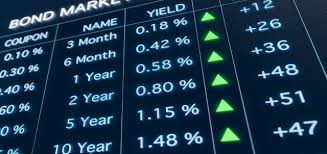
Few indicators are watched more closely in finance than bond yields.
They influence mortgage rates, borrowing costs, government debt servicing, equity valuations, and the broader cost of money throughout the economy.
Central banks monitor them closely.
Investors obsess over them.
Governments depend on them.
Yet for many outside financial markets, bond yields remain poorly understood.
That is a mistake.
Bond yields are among the clearest real-time indicators of what markets think about inflation, growth, interest rates, and risk.
What is a bond yield?
At its simplest, a bond yield is the return a bondholder earns from a bond.
Because prices fluctuate in secondary markets while coupon payments remain fixed, yields move constantly.
Since bond prices are the ones that fluctuate, there’s an inverse relationship.
- Prices fall, yields rise.
- Prices rise, yields fall.
This inverse relationship is fundamental to understanding why markets watch yields so closely.
What Bond Yields Actually Signal
Inflation Expectations
Bond yields are one of the clearest indicators of inflation expectations.
Investors lending money over long periods care about purchasing power—in other words, the real return they earn after inflation.
If inflation is expected to rise, the future value of fixed interest payments becomes less attractive.
As a result, investors may sell existing bonds and reallocate capital into assets that better hedge against inflation, causing bond prices to fall and yields to rise.
To make bonds more attractive, governments issuing new new bonds on the primary market must adjust to prevailing market yields by offering higher coupons or issuing bonds at a discount, as investors demand compensation for the reduced purchasing power caused by higher expected inflation.
Governments issuing new bonds must then adjust to prevailing market conditions by offering higher yields by either offering higher coupons or discounting the price to attract investors.
In this sense, rising bond yields can reflect market expectations that inflation will remain elevated.
Interest Rate Expectations
Bond markets continuously price expectations around central bank policy.
Central banks directly influence short-term interest rates, which affect the yields newly issued bonds are likely to offer.
If investors expect central banks to hike rates, existing bonds with lower fixed coupons become less attractive, causing prices to fall and yields to rise.
Conversely, if markets expect rates to be cut, existing bonds with higher fixed coupons become more attractive, pushing prices higher and yields lower.
This is why bond markets are often described as a real-time forecasting mechanism for monetary policy and interest rate descisions.
Economic Growth
Bond yields can also reflect expectations about economic growth.
When the economy is stronger, businesses and investors borrow more to invest and expand, consumers spend more confidently, and overall demand for capital increases.
Higher growth can also increase inflationary pressure, making central banks more likely to raise interest rates.
As a result, investors may demand higher yields in anticipation of stronger economic activity and tighter monetary policy.
Conversely, falling bond yields can reflect expectations of weaker growth, slowing demand, or even recession risk.
An example of this is the 10-year and 2-year U.S Treasury yields before the GFC which peaked at ~5.5% and ~5.3% respectively and then plummeting to ~2.0% and ~0.6% respectively. This is as investors flocked to bonds to protect their capital as it’s a risk-free asset causing prices to jump and yields to fall.
Risk
Bond yields also reflect perceptions of credit risk.
Not all borrowers are viewed equally.
Governments with strong fiscal positions and stable institutions are able to borrow at lower yields because those assets are seen as risk-free assets.
This acts as a benchmark as investors ask “why would I invest in this asset that has greater risk?” and the answer is generally for a greater return.
The difference between government bond yields and equity returns is called the Equity Risk Premium.
The difference between government bond yields and corporate bond yields is the credit spread.
Investors demand higher yields from companies with weaker balance sheets or greater default risk as compensation for the increased chance of not being repaid.
Why Bond Yields Matter Beyond Bond Investors
Mortgage & Borrowing Costs
Bond yields do not just matter to bond investors.
They influence borrowing costs throughout the broader economy.
Mortgage rates, business loans, and other forms of long-term borrowing are often priced relative to government bond yields, particularly the 10-year government bond.
As yields rise, borrowing becomes more expensive.
Since the bond yield acts as the risk-free benchmark, lenders ask “why lend to a person or business with a default risk when I can lend to the government with no default risk?”
Similarly, higher yields also generally correlate with higher rates from central banks.
For households, that can mean higher mortgage repayments.
For businesses, it can mean a higher cost of financing expansion, acquisitions, or day-to-day operations.
Government Debt Servicing
Governments themselves are not immune.
Rising yields increase the cost of borrowing for governments issuing new debt or refinancing existing obligations.
For highly indebted governments, even modest increases in yields can materially increase debt servicing costs, placing greater pressure on budgets.
This can crowd out other spending priorities such as infrastructure, healthcare, defence, or social services as more tax revenue is redirected toward servicing debt.
Equity Valuations
Bond yields also influence stock markets.
Investors constantly compare the risk-free return available from government bonds against the higher-risk return offered by equities.
As bond yields rise, equities become less attractive on a relative basis unless expected returns also increase.
Higher yields also increase the discount rate used in valuation models such as DCF analysis, reducing the present value of future earnings.
This is why growth stocks, whose valuations rely heavily on future cash flows, are often particularly sensitive to rising yields.
The difference between yields and equity returns is called the Equity Risk Premium.
The Yield Curve: What Bond Markets Think About The Future
Bond markets do not merely reflect current conditions.
They constantly price expectations about the future.
One of the clearest ways this can be observed is through the yield curve.
The yield curve compares bond yields across different maturities, from short-term bonds to longer-dated bonds.
Under normal conditions, longer-term bonds typically offer higher yields than shorter-term bonds.
This is because investors demand additional compensation for lending money over longer periods due to inflation uncertainty, duration risk, and the opportunity cost of locking up capital.
This creates an upward-sloping yield curve.
However, when investors expect weaker growth, recession, or future interest rate cuts, shorter-term yields can rise above longer-term yields.
This creates an inverted yield curve.
Historically, inverted yield curves have often preceded recessions, as markets begin pricing slower growth and looser monetary policy ahead.
In this sense, the yield curve acts as one of the bond market’s clearest forward-looking economic signals.
The Market’s Economic Scoreboard
Bond yields are far more than a technical metric for bond traders.
They are a real-time reflection of what markets think about inflation, interest rates, economic growth, and risk.
They influence mortgage repayments, business borrowing costs, government debt servicing, equity valuations, and even recession expectations.
In many ways, bond markets act as one of the economy’s most honest signals.
While stock markets often reflect optimism, bond markets tend to reflect discipline.
Understanding bond yields is not just useful for investors.
It is essential to understanding how the broader economy and financial markets function.