

Generation Development Group told the market on Thursday that it manages more money than it did a year ago. That is all a funds-under-management update actually says. The GDG share price rose by around a third the same day. No revenue line, no profit line, no guidance number was in the release. The gap between what was disclosed and how hard the stock moved is the story.
Market Context
Generation Development Group (ASX:GDG), the wealth manager behind investment bond provider Generation Life, managed-accounts platform Evidentia and research house Lonsec, released its FY26 funds-under-management update on 23 July 2026, covering the year to 30 June. Group FUM reached $46.4 billion, up 36 per cent on the prior year. Generation Life added record June-quarter sales inflows of $442 million to reach $5.95 billion in FUM, helped by a new mandate as retirement-solutions provider for Colonial First State. Evidentia, the larger of the two platforms, closed the year at $40.5 billion in FUM on $3.5 billion of net inflows, including the transition of Xplore Wealth’s book of assets. Management also confirmed it had finished integrating the Evidentia and Lonsec managed-account businesses, the operational item that had hung over the stock since the $320 million Evidentia acquisition was struck in early 2025 (Financial Standard, 23 Jul 2026; TipRanks company announcement, 22-23 Jul 2026).
What the release did not contain was a profit number. GDG’s FY26 statutory and underlying results, including revenue, EBITDA and NPAT, are due with the full-year result on 27 August. Thursday’s document was, in the words of one wire service summary, “a flows-and-FUM trading report rather than a full profit result”.
The market did not treat it that way. GDG shares, which had closed at $3.58 on 14 July and traded in a $3.29 to $3.54 band the week before the update, jumped as much as 31.7 to 32.8 per cent intraday on 23 July, reported variously at around $4.43 (a reading flagged by at least one outlet as an intraday snapshot rather than a confirmed closing print, so treat the exact top-tick with some caution) (Kalkine, 23 Jul 2026; market-mover data referenced 23 Jul 2026). At the top of that move, GDG’s market capitalisation rose from roughly $1.51 billion to close to $1.9 billion in a single session, an increase in market value of somewhere near $350 million triggered by a document with no earnings figure in it.
The thesis
Start with why a re-rating of this size was even plausible. GDG had fallen hard before Thursday: shares traded near $7.40 to $7.46 in October 2025 and were down almost 30 per cent over the year to mid-July, even before the latest leg down to $3.29. Some of that fall reflects genuine integration risk around the Evidentia deal and uncertainty over Division 296, the extra 15 per cent tax on superannuation balances above $3 million that took effect from 1 July 2026. Thursday’s update removed both overhangs at once: the integration is done, and management framed Division 296 and the 2026 Federal Budget’s changes to capital gains, discretionary trusts and negative gearing as a “clear structural positive” for investment bonds, the product Generation Life sells (Grant Hackett, GDG chief executive, quoted in Financial Standard, 23 Jul 2026). A stock near a two-year low, on a business that had just confirmed both its execution risk and its regulatory risk had resolved in its favour, was arguably underpriced going into Thursday, not fairly priced.
What the GDG share price move may be missing
Run the numbers against the two ASX-listed platforms investors most naturally compare GDG with, HUB24 and Netwealth, and the re-rating looks less like enthusiasm and more like catch-up. At its pre-update market cap of $1.51 billion against $46.4 billion of FUM, GDG traded at roughly 3.3 cents of market value per dollar of funds under management. HUB24, which reported record FY26 net inflows of $18.9 billion and funds under administration of $164.3 billion on 21 July 2026, carries a market cap near $6.5 billion, about 4.0 cents per dollar of FUA. Netwealth, which posted record FUA of $135.7 billion for the same period, carries a market cap near $7.5 billion, about 5.5 cents per dollar, though it also trades on a demanding trailing earnings multiple near 90 times. At Thursday’s roughly $1.9 billion post-rally market cap, GDG sits at about 4.0 cents per dollar of FUM, almost exactly where HUB24 trades (Fool.com.au and Kalkine/Investor Daily reporting, 15-23 Jul 2026). Praemium, the smaller third platform on about 0.4 cents per dollar of its $77.9 billion FUA, shows how wide this range actually is, and is a reminder that market-cap-to-FUM is a rough yardstick, not a like-for-like multiple: the three businesses differ in margin, growth rate and product mix, and GDG’s own mix is not identical to either peer.
That comparison cuts against the instinct to call a 33 per cent single-day move an overreaction. It does not answer the harder question. GDG’s most recently confirmed profit numbers are six months old: revenue of $88.4 million for the half to 31 December 2025, up 34 per cent on pcp, and underlying net profit after tax of $20.1 million, up 63 per cent, with cash of $83.8 million at that date. Statutory FY25 profit, by contrast, was a much smaller $6.9 million, weighed down by the absence of a prior-year one-off gain and acquisition-related costs, a reminder that GDG’s statutory and underlying earnings do not always move together. Thursday’s update said nothing about whether 36 per cent FUM growth is converting to profit anywhere near that 63 per cent underlying NPAT pace. That is what the 27 August result will show, and it is the number this re-rating is really betting on.
The numbers
| Metric | Value | Why it matters |
|---|---|---|
| Share price reaction | +31.7% to +32.8% intraday, 23 Jul 2026, from a $3.58 close on 14 Jul | An unusually large move for a flows-only update, not a profit beat |
| FY26 group FUM | $46.4bn, up 36% on FY25 (23 Jul 2026) | Headline growth figure driving the re-rating |
| Generation Life FUM / inflows | $5.95bn FUM (+35%), record $442m June-quarter sales inflows | Investment bonds arm, direct beneficiary of Division 296 tailwind |
| Evidentia FUM / inflows | $40.5bn FUM; $3.5bn net inflows including Xplore Wealth transition | Largest single contributor to group FUM |
| Market capitalisation | ~$1.51bn (14 Jul) to ~$1.9bn (23 Jul, intraday) | ~$350m of market value added on a non-profit update |
| HY26 revenue / underlying NPAT (last confirmed) |
$88.4m (+34% yoy) / $20.1m (+63% yoy), six months to 31 Dec 2025 | Most recent verified profit data; FY26 full result due 27 Aug 2026 |
| FY25 statutory NPAT | $6.9m, down on pcp (one-off gain absent, acquisition costs) | Shows statutory and underlying earnings can diverge sharply |
| Market cap / FUM (GDG vs peers) |
GDG ~4.0c post-rally vs HUB24 ~4.0c, Netwealth ~5.5c, Praemium ~0.4c | Core valuation cross-check; rough proxy, not a like-for-like multiple |
Sources: Financial Standard, 23 July 2026; TipRanks company announcement summary, 22–23 July 2026; Kalkine, 14 and 23 July 2026; Market Index company data and director transactions, accessed 24 July 2026; Fool.com.au and Investor Daily, 15–23 July 2026. Market-cap/FUM figures and peer comparisons are The Investor Standard calculations from cited inputs, not reported company or consensus figures. The 23 July share price move is reported as intraday reading in the cited source. An independently confirmed official closing print was not separately located.
Valuation
GDG has not yet reported FY26 revenue, EBITDA or NPAT; that detail is due on 27 August 2026. A complete DCF or earnings-multiple model is not possible on Thursday’s release alone, so the check below uses the market-cap-to-FUM ratios GDG’s closest ASX-listed peers trade on, re-based off the confirmed FY26 FUM figure of $46.4 billion, rather than a discounted cash flow. Analyst coverage also looks thin: one data provider lists a Buy rating and a $5.50 target from a single source, while Market Index notes the stock is “not covered by a major broker, or data from most recent compilation was omitted due to not meeting QA guidelines”. Read that target as a weak, single-source data point, not a settled consensus.
| Scenario | Key assumptions | Indicative value |
|---|---|---|
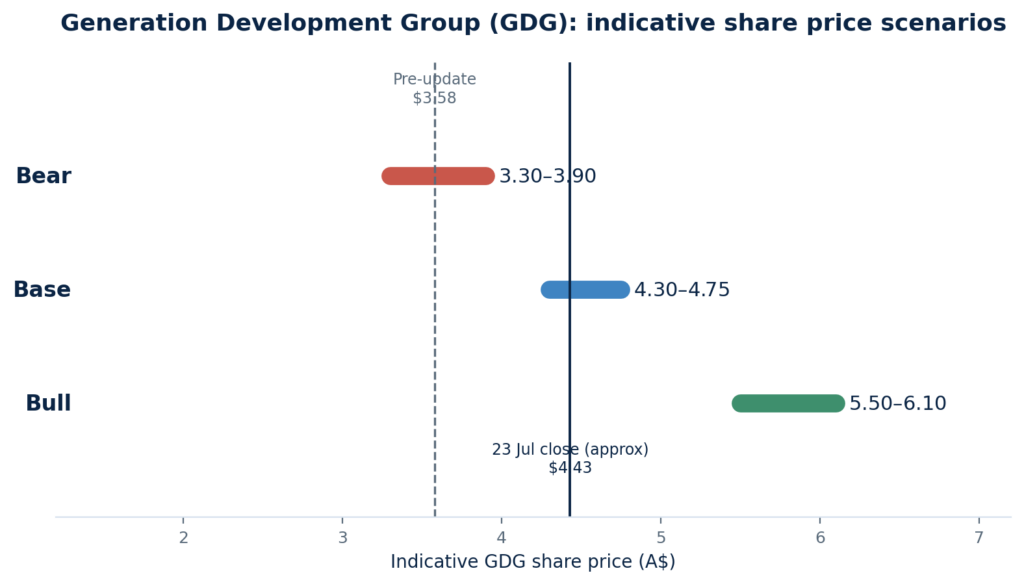
| Bear | 27 August result shows FY26 profit growth lagging FUM growth due to integration and amortisation costs; market-cap/FUM multiple reverts toward the pre-update level near 3.3 cents. | ~$3.30–3.90 |
| Base | Profit growth broadly tracks the HY26 underlying NPAT trend; multiple holds near HUB24 parity at roughly 3.9–4.3 cents per dollar of FUM. | ~$4.30–4.75 |
| Bull | Margin expansion from the completed Evidentia/Lonsec integration plus a visible Division 296 inflow boost; multiple re-rates toward Netwealth at roughly 5.0–5.5 cents. | ~$5.50–6.10 |
Indicative values are The Investor Standard’s estimates based on a market-cap/FUM sanity check and stated assumptions, using GDG’s implied share count from its 14 July 2026 market capitalisation and price. They are scenario illustrations, not price targets or advice, and should be read alongside the caution above on GDG’s thin analyst coverage.
Catalysts
Near-term
The FY26 full-year result on 27 August is the immediate test: it will show whether revenue, EBITDA and NPAT grew anywhere near the 36 per cent FUM pace, and whether the HY26 underlying-NPAT growth rate of 63 per cent held into the second half. Any early broker notes initiating or updating coverage after that result will also matter, given how thin independent coverage currently looks.
Medium-term
Division 296 and the 2026 Federal Budget’s changes to capital gains, trusts and negative gearing are flagged by management to lift investment-bond demand “over several years from FY27”, not immediately, so the real test of that tailwind is FY27 inflow data, not this update. Continued net inflows at Evidentia and further mandate wins similar to the Colonial First State appointment would support the growth case; a slowdown in either would undercut it quickly.
Risks
The single biggest risk is a straightforward one: a funds update is not a profit update, and the market has now priced in a profit outcome it has not seen. If the 27 August result shows margin pressure from integration costs, amortisation of the Evidentia intangibles, or slower-than-expected fee realisation on the newly transitioned FUM, the re-rating could reverse quickly. GDG’s statutory FY25 NPAT of $6.9 million, far below its underlying profit trajectory, shows how large the gap between statutory and underlying results can be for this business. Coverage is thin, which cuts both ways: less scrutiny before the move, but also less of a broker floor under the stock if sentiment turns. FUM-linked revenue is also market-sensitive; a broader equity market drawdown would hit fee income independent of net flows.
Investory Takeaway
The headline here, a 33 per cent share-price jump on a funds-flow report, is easy to read as a market getting ahead of itself. Measured against HUB24 and Netwealth on a market-cap-to-FUM basis, it looks more like GDG catching up to where a comparable platform business already trades, after a year in which the stock had been marked down for integration risk and regulatory uncertainty that Thursday’s update resolved. Whether that catch-up was earned will not be known until 27 August, when GDG reports the first FY26 profit numbers the market can actually check the flow story against. Until then, this is a re-rating built on a promise, not a beat.