


A Different Kind of Wearable Goes Public
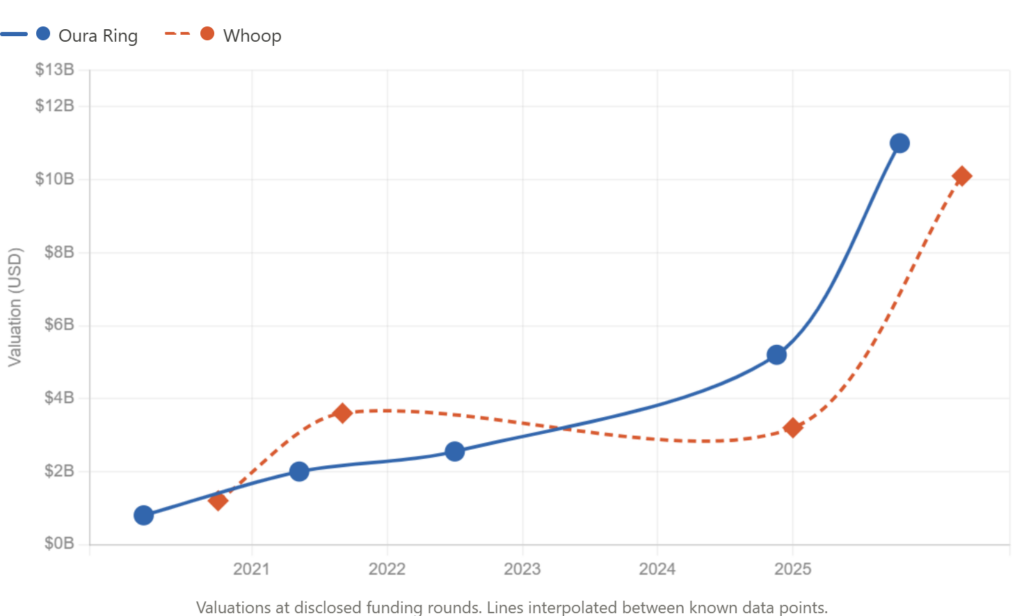
ŌURA’s decision to pursue an IPO at an $11 billion valuation represents a pivotal moment for the consumer health technology sector. Far more than a traditional hardware company entering public markets, ŌURA has demonstrated exceptional commercial momentum, generating approximately $1 billion in revenue during 2025. Perhaps even more striking is the fact that half of all Oura Rings ever sold were shipped within the past year, highlighting the rapid acceleration in consumer demand for health-monitoring technology that extends well beyond conventional fitness tracking.
- A Different Kind of Wearable Goes Public
- From Activity Tracking to Nervous‑System Monitoring
- The Business Model: Recurring Revenue Meets Daily Utility
- WHOOP: The Parallel Giant
- Why This Isn’t Fitbit or Garmin All Over Again
- The Rise of the Health‑Intelligence Market
- The Beginning of a New Consumer Health Era
The trend is not isolated. WHOOP, currently valued at around $10 billion and indicating that its Series G funding round is likely to be its last before going public, appears poised to follow a similar path. Together, these companies are helping to define an entirely new category within consumer technology. Rather than focusing primarily on steps, calories, or surface-level activity metrics, their platforms are designed to monitor and interpret deeper physiological signals, including recovery, sleep quality, nervous system stress, hormonal cycles, and overall readiness.
This shift signals a broader evolution in how consumers engage with personal health data. Unlike earlier generations of wearables, which largely centred on fitness tracking, companies such as ŌURA and WHOOP are building products around continuous health intelligence, transforming complex biometric information into actionable insights. As a result, they are not simply competing with traditional wearable manufacturers; they are helping to create a new consumer market where understanding and optimising human performance becomes the primary value proposition.
From Activity Tracking to Nervous‑System Monitoring
The first generation of wearable devices, including Fitbit, Garmin, and Jawbone, were primarily designed to measure external activity. Their focus was on metrics such as steps taken, distance traveled, and calories burned. While these insights provided a useful snapshot of physical activity, they were largely descriptive, telling users what they had done rather than what was happening inside their bodies.
ŌURA and WHOOP have fundamentally changed that approach. Instead of concentrating on activity alone, they focus on how the body responds to stress, exercise, sleep, and recovery. Their platforms are built around continuous physiological monitoring, providing a deeper understanding of health and performance.ŌURA’s smart ring, for example, continuously tracks key biometric indicators including heart rate variability (HRV), a widely used measure of nervous system balance; resting heart rate; body temperature trends; sleep quality and stages; and broader circadian and hormonal patterns. These data points are then analysed to generate personalised insights into recovery, readiness, and overall physiological well-being.
The value proposition is significantly different from traditional fitness tracking. Rather than simply reporting that a user walked 8,000 steps, the platform seeks to answer more meaningful questions: Is the body under excessive stress? Has recovery been sufficient? Is the user prepared for peak performance? Could early signs of illness be emerging before symptoms become noticeable?
This evolution, from measuring behaviour to interpreting physiology, is what distinguishes ŌURA from earlier generations of wearable technology. Its IPO reflects not just the success of a product, but the growing demand for health intelligence platforms that help individuals understand and optimise their biological performance in real time.
The Business Model: Recurring Revenue Meets Daily Utility
ŌURA’s growth story extends well beyond hardware sales. The company has developed a subscription-driven ecosystem in which users pay for ongoing access to health insights, long-term trend analysis, and personalised recommendations. This approach transforms the Oura Ring from a one-time hardware purchase into a recurring engagement platform that generates continuous value for users.
The model offers several important advantages. First, subscription revenue provides a more predictable and stable earnings base than hardware sales alone. Second, the software layer carries significantly higher margins, allowing the company to generate greater profitability as its subscriber base expands. Third, and perhaps most importantly, the platform benefits from a powerful data network effect.
As more users join the ecosystem and generate biometric data, ŌURA is able to refine and improve its algorithms, enhancing the accuracy and relevance of its health insights. Improved insights increase user engagement and retention, which in turn generates even more data for the platform. This self-reinforcing cycle creates a growing competitive advantage over time.
For this reason, many investors view ŌURA not as a wearable device manufacturer but as a long-term health intelligence platform. The hardware serves as the entry point, while the real value lies in the software, data, and predictive capabilities that become increasingly powerful as the ecosystem scales.
WHOOP: The Parallel Giant
WHOOP’s growth trajectory closely parallels that of ŌURA. With a valuation of approximately $10 billion, widespread adoption among elite athletes, and management indicating that its Series G funding round is expected to be its last as a private company, WHOOP appears well positioned for a future public listing.
While ŌURA has built its reputation around holistic health monitoring and lifestyle optimisation, WHOOP has established itself as a leader in performance and recovery analytics. Its platform is centred on metrics such as strain, recovery, sleep quality, and heart-rate variability (HRV), making it particularly popular among professional athletes, military personnel, and high-performance organisations seeking to optimise physical readiness and performance.
Together, ŌURA and WHOOP are defining a new segment within the wearable technology market. Rather than focusing solely on fitness tracking or competing directly with traditional smartwatches, they occupy a space between consumer wellness products and medical-grade monitoring systems. This emerging category is built around continuous physiological intelligence, offering users deeper insights into health, recovery, and performance than legacy wearable devices have traditionally been able to provide.
Why This Isn’t Fitbit or Garmin All Over Again
Fitbit and Garmin were built for an era in which consumers primarily wanted to measure their physical activity. Steps taken, distance travelled, and calories burned were the core metrics that defined the first generation of wearable technology. Today, however, consumer expectations have evolved. Users are increasingly seeking deeper insights into their health, recovery, and overall physiological state rather than simply tracking movement.
This shift has created a significant opportunity for companies such as ŌURA and WHOOP. Their platforms focus on internal biological signals rather than external activity metrics, providing users with a clearer understanding of how their bodies are functioning beneath the surface. Rather than presenting raw data alone, they translate complex physiological information into actionable insights that can influence daily decisions around sleep, exercise, stress management, and recovery.
Their appeal is further strengthened by integration with broader health and wellness ecosystems, including fertility tracking, sleep optimisation, stress monitoring, and athletic performance programs. As users increasingly rely on these insights to guide everyday behaviour, the products become deeply embedded in their routines. Many subscribers report feeling less informed or less prepared without access to their daily readiness and recovery scores, creating a level of engagement that extends well beyond traditional fitness tracking.
This is a key reason why ŌURA and WHOOP command valuations far greater than those achieved by earlier wearable companies at comparable stages of development. Their value proposition is not centred on hardware alone. Instead, they are selling continuous health intelligence and self-awareness which is transforming wearable devices from simple tracking tools into platforms that help users better understand and optimise their own biology.
The Rise of the Health‑Intelligence Market
The broader trend is becoming increasingly clear: consumers are moving beyond traditional fitness tracking and toward a deeper understanding of their physiology. Rather than simply measuring activity levels, people are seeking tools that help interpret what is happening inside their bodies and provide actionable insights to improve health, recovery, and performance.
Several powerful forces are driving this shift. Rising levels of stress, burnout, and mental fatigue have increased demand for technologies that can monitor wellbeing in real time. At the same time, consumers are placing greater emphasis on proactive health management, preferring to identify potential issues early rather than relying solely on reactive medical care. Advances in artificial intelligence have further accelerated this trend by enabling highly personalised analysis and recommendations at scale, transforming raw biometric data into meaningful health insights.
ŌURA’s IPO represents one of the first major public-market validations of this emerging category. The company’s growth suggests that demand for physiological intelligence is not only real but also sustainable and still in the early stages of development. An eventual public listing by WHOOP would further reinforce the strength of this trend, signalling that the shift from activity tracking to health intelligence is not a temporary phenomenon but a fundamental change in how consumers engage with their health and wellbeing.
The Beginning of a New Consumer Health Era
ŌURA’s IPO represents far more than a traditional liquidity event. It signals a broader transformation in the wearable technology industry and offers a glimpse into what the next generation of health monitoring may look like. The future of wearables is unlikely to be defined by step counts, calorie estimates, or basic activity tracking. Instead, it will increasingly revolve around deeper physiological insights, including nervous system monitoring, recovery analytics, hormonal and circadian pattern recognition, and predictive health intelligence.
Consumer expectations have evolved accordingly. People no longer want technology that simply records what happened yesterday; they want tools that help them understand how their bodies are functioning today and what they may experience tomorrow. Whether it is identifying early signs of fatigue, recognising elevated stress levels, optimising recovery, or detecting potential health issues before symptoms emerge, the focus has shifted toward anticipation rather than observation.
Companies such as ŌURA and WHOOP are at the forefront of this transition. By combining advanced biometric sensors, artificial intelligence, and personalised health insights, they are creating platforms designed to help users better understand and optimise their physical and mental wellbeing. The strong investor interest surrounding these businesses suggests that the market is beginning to recognise the long-term potential of health intelligence as a distinct and rapidly growing category within consumer technology.