

Most investors believe that a handful of good picks is the key to beating the market.
After all, it seems simple enough. Buy great businesses, hold them for the long term, and let compounding do the rest.
Stories of investors who turned relatively small investments in companies like Apple, Amazon and Nvidia into life-changing fortunes have only reinforced that belief.
But those stories create a misleading picture of how the stock market actually works.
While stock markets have historically delivered strong long-term returns, the average individual stock hasn’t.
Decades of research show that most individual stocks fail to beat the market, many lose money altogether, and a surprising number suffer catastrophic declines from which they never recover.
That raises an uncomfortable question, if the stock market continues to rise over time, how can most of the companies within it fail to keep up?
The answer lies in one of the market’s least understood characteristics: a small number of exceptional companies generate a disproportionate share of long-term wealth.
The Market’s Biggest Winners Do Most Of The Heavy Lifting
At first glance, it seems impossible, if most individual stocks underperform the market, how can the market itself continue to generate strong long-term returns?
The answer lies in the distribution of returns.
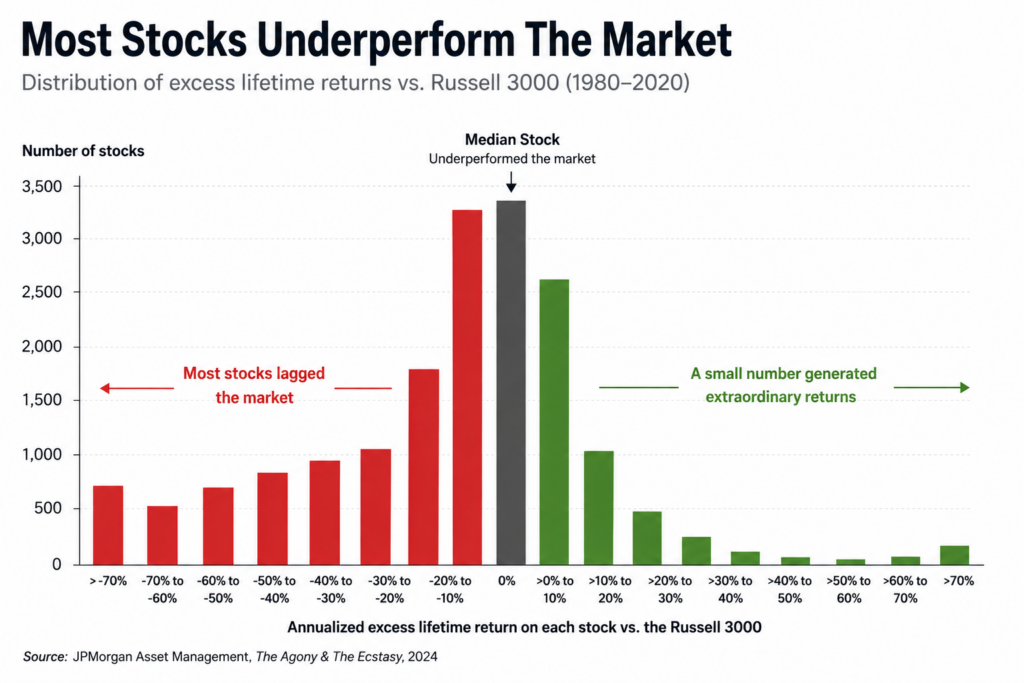
Unlike many things in finance, individual stock returns do not follow a neat bell curve. Instead, they’re skewed positively, a relatively small number of extraordinary companies generate an outsized share of the market’s total return and wealth, while the majority deliver average or below-average returns.
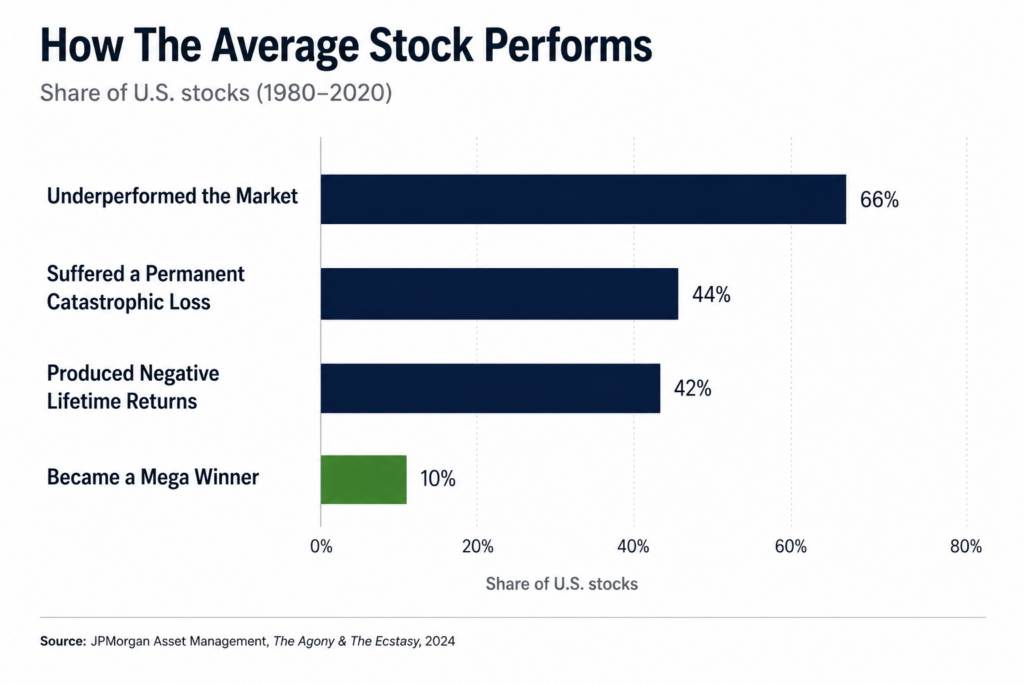
Research covering US stocks between 1980 and 2020 found that around 66% of stocks underperformed the market, 42% produced negative lifetime returns, and only around 10% became the exceptional long-term winners that outperformed the market by more than 500%.
Those rare winners include huge names like Apple, Microsoft, Amazon and Nvidia.
Their extraordinary gains are large enough to offset the disappointing performance of hundreds or even thousands of other stocks.
In other words, the stock market’s long-term returns are driven by a surprisingly small group of exceptional businesses.
For investors trying to build their own portfolio of a relatively small number of individual stocks, that creates a difficult challenge.
It’s not enough to simply avoid bad companies, you also need to successfully identify the handful of future winners that will generate most of the market’s gains.
The Odds Are Worse Than They Appear
The implication is uncomfortable for anyone building a concentrated portfolio.
When investors buy five or ten individual stocks, they often believe they only need to identify a few high-quality businesses and hold them for the long term. However, the data suggest the challenge is far greater.
Because only a relatively small number of companies generate most of the market’s long-term wealth, investors are not simply trying to avoid poor performers, they’re trying to identify tomorrow’s biggest winners before everyone else.
Missing just a handful of those companies can have a dramatic impact on long-term returns as most stocks fail to beat the market.
Research has found that even professional active fund managers struggle with this challenge. Despite employing teams of analysts, building complex financial models and conducting extensive due diligence, fewer than half of actively managed US equity funds have historically outperformed a simple S&P 500 index fund over long investment horizons, even before accounting for the additional fees many investors pay.
The difficulty is that success is often only obvious in hindsight.
Today’s market leaders look like obvious investments because investors already know how the story ends.
Twenty years ago, however, it was far less clear that companies like Apple, Amazon or Nvidia would become some of the most valuable businesses in history.
Finding the next generation of winners before the market does remains one of investing’s hardest challenges.