


Most people think debt is simple. The more a government borrows, the closer it gets to bankruptcy. After all, that’s how debt works for households and businesses.
Governments don’t follow the same rules.
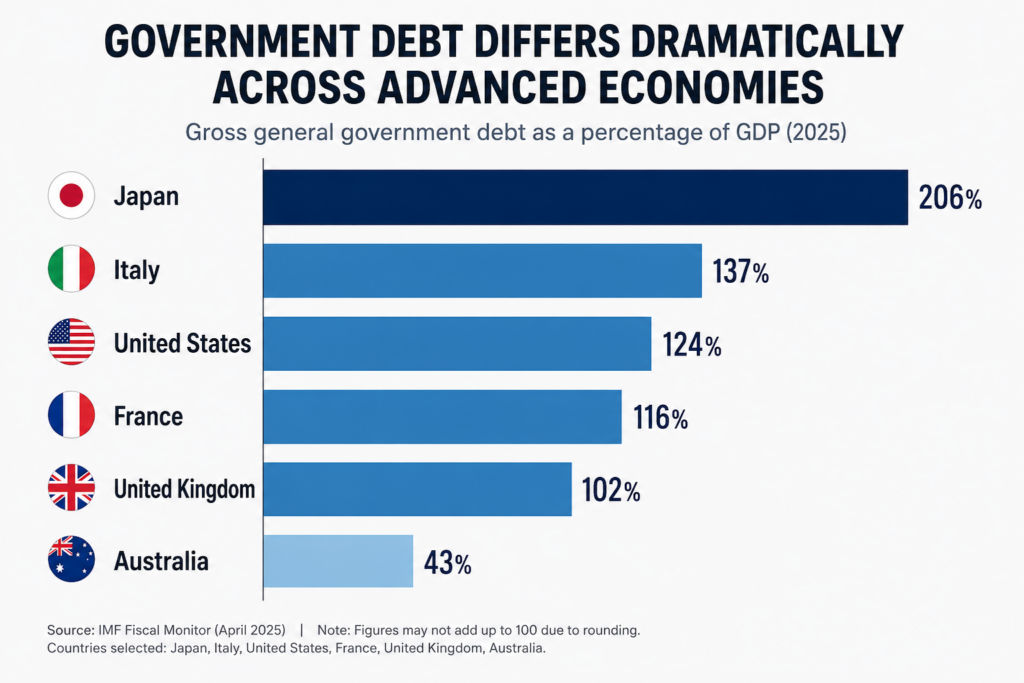
Japan’s debt double its economy. The US owes $40T, more than its annual GDP. Meanwhile, countries with far less debt, such as Greece during the European debt crisis, have faced soaring borrowing costs and the prospect of default.
If debt alone doesn’t determine whether a country is in trouble, what does?
Understanding why some governments can borrow for decades while others rapidly lose the confidence of investors is one of the most important concepts in economics.
Debt Isn’t Necessarily Bad
Government debt, by itself, says very little. A country with debt equal to 40% of GDP can find itself in financial distress, while another with debt exceeding 200% of GDP may continue borrowing without difficulty. The difference lies not in the amount of debt, but in whether investors believe it can be sustained.
When governments borrow money, they promise to make regular interest payments and eventually refinance the principal by issuing new debt. Investors purchasing government bonds care less about whether the debt will ever disappear or even shrink and more about whether those obligations can continue to be met.
Ultimately, debt sustainability comes down to a simple question: can the government continue servicing its debt without losing the confidence of investors?
Several factors determine the answer, including economic growth, interest rates, inflation, government budget balance and institutional credibility. Together, these influence whether markets are willing to keep lending at affordable interest rates.
When confidence remains strong, governments can refinance debt for decades with little difficulty. For example, France hasn’t balanced its budget since the 70’s and the UK and US not since 2000. When confidence begins to erode, borrowing costs rise, interest expenses increase and the fiscal position can deteriorate rapidly.
Debt crises, therefore, are rarely caused by the absolute size of the debt itself. More often, they occur because investors lose confidence in a government’s ability to manage it.
What Makes Debt Sustainable?
Whether investors are willing to keep lending to a government depends on several closely related factors. None is decisive on its own, but together they determine whether debt remains manageable or begins to spiral.
Economic Growth
Economic growth is perhaps the most important. As an economy expands, government tax revenues generally increase while the size of existing debt becomes smaller relative to national income. A country with rising incomes can therefore sustain a much larger debt burden than one whose economy is stagnating.
Markets care far more about debt-to-gdp ratios than nominal debt figures.
Interest Rates
Interest rates are equally critical. Governments finance themselves by issuing bonds, and higher interest rates mean higher borrowing costs. If those costs rise faster than government revenues, an increasing share of the budget must be devoted to servicing debt rather than funding public services or investment.
Inflation also plays a complicated role. Moderate inflation can reduce the real value of existing debt, making it easier for governments to repay obligations with money that is worth slightly less than when the debt was issued. However, persistently high inflation can have the opposite effect by undermining confidence in the currency and prompting investors to demand higher interest rates as compensation.
Fiscal Position
Finally, investors pay close attention to a government’s broader fiscal position. Countries that consistently run large budget deficits must continually issue new debt to finance spending, increasing their reliance on financial markets. While this is not necessarily a problem in the short term, persistent deficits can eventually raise doubts about whether debt will continue growing faster than the economy itself.
Taken together, these factors shape a country’s borrowing costs. When growth is strong, inflation is stable and fiscal policy appears credible, governments can often sustain surprisingly large debts. When those conditions begin to deteriorate, investor confidence can weaken rapidly, causing borrowing costs to rise and making the debt burden progressively harder to manage.
Why Japan Has Avoided A Debt Crisis
Japan looks like the exception that disproves the rule. Government debt exceeds 200% of GDP, the highest among developed economies, yet the country has continued borrowing at remarkably low interest rates for decades without experiencing the kind of sovereign debt crisis many economists once predicted.
The reason is that Japan scores well on many of the factors that underpin investor confidence.
Unlike many countries, the vast majority of Japanese government debt is held domestically by ageing households, banks, pension funds and the BoJ itself. This means the government relies less on foreign investors, who can quickly withdraw capital during periods of uncertainty. Domestic investors have historically been willing to accept lower returns in exchange for the perceived safety of Japanese government bonds.
Japan has also benefited from decades of exceptionally low inflation and interest rates. For much of the past thirty years, weak economic growth, persistent deflation and targeted YCC and QE programs kept borrowing costs close to zero. As a result, despite its enormous debt burden, the government’s interest payments remained surprisingly manageable.
Strong institutions have also played an important role. Japan has a stable political system, an independent central bank and a long history of honouring its financial obligations. These characteristics reinforce investor confidence, allowing the government to refinance maturing debt at relatively low cost.
However, these advantages are beginning to face new challenges. Inflation has returned after decades of near-zero price growth, forcing the Bank of Japan to gradually raise interest rates. As borrowing costs increase, so too does the cost of servicing one of the world’s largest public debt burdens. While Japan is far from an imminent fiscal crisis, the environment that made its extraordinary debt levels sustainable is becoming less favourable.
Why Greece Was Different
Japan demonstrates that high debt alone does not automatically lead to a fiscal crisis. Greece shows the opposite: countries can lose market confidence long before debt reaches Japanese levels.
During the European debt crisis, investors became increasingly concerned about Greece’s ability to repay its obligations. As confidence deteriorated, government bond yields rose sharply, making it far more expensive for the government to refinance existing debt or issue new bonds. Rising borrowing costs placed even greater strain on the country’s finances, further undermining confidence and creating a self-reinforcing cycle.
Unlike Japan, Greece lacked several important advantages. It could not issue debt in a currency controlled by its own central bank, nor could it independently conduct monetary policy as a member of the eurozone both were controlled by the ECB. It also relied more heavily on international investors, who were far quicker to withdraw capital as concerns mounted.
The result was a sovereign debt crisis that ultimately required multiple international bailout packages and years of painful fiscal reforms.
The comparison between Japan and Greece illustrates that debt sustainability depends not only on how much a government owes, but also on the confidence of investors, the strength of its institutions and the broader economic environment.
Is Debt Bad?
Government debt is often presented as though there is a single number beyond which a country inevitably runs into trouble. In reality, no such threshold exists.
Debt becomes dangerous not simply because it is large, but because investors begin to doubt a government’s ability to service it sustainably. Economic growth, interest rates, inflation, fiscal discipline and institutional credibility all shape that judgement.
This explains why countries with similar debt burdens can experience dramatically different outcomes. Japan has sustained debt exceeding 200% of GDP for decades, while Greece entered a sovereign debt crisis with substantially less. The difference was not merely the amount borrowed, but the confidence that markets had in each country’s ability to manage its finances.
Ultimately, government debt is built on trust. As long as investors believe a government can continue meeting its obligations, high debt levels may remain manageable for years. When that confidence begins to fade, however, borrowing costs can rise rapidly and transform a manageable fiscal position into a crisis.