


Introduction
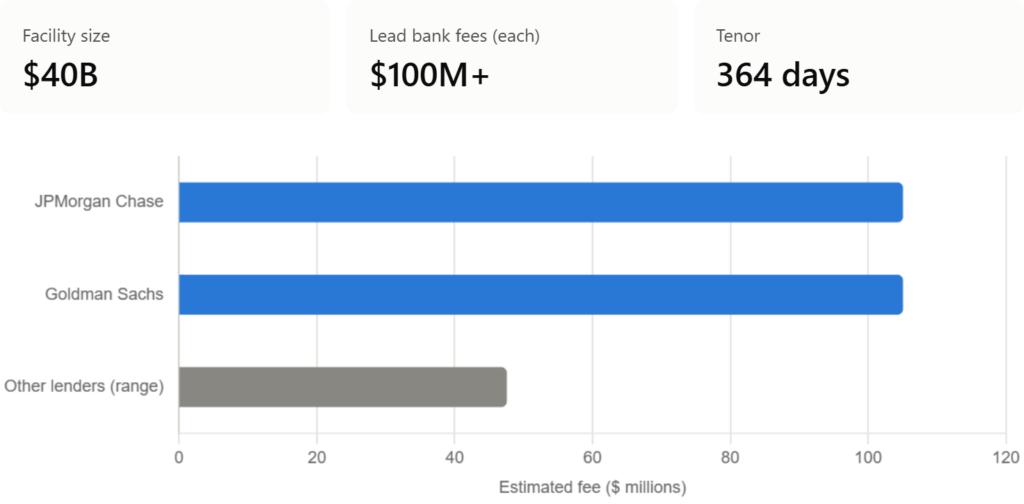
The rapid expansion of generative artificial intelligence is transforming global capital markets, and SoftBank’s recently syndicated $40 billion bridge loan is a clear reflection of that shift. The deal has attracted widespread attention not only for its record-breaking size but also for the exceptional fees generated for the banks involved. JPMorgan Chase and Goldman Sachs are each expected to earn more than $100 million for underwriting the financing, while other participating lenders are projected to receive between $25 million and $70 million. Together, these figures make the transaction one of the most profitable financing deals for investment banks in recent years, underscoring Wall Street’s growing role in funding the next wave of AI-driven innovation.
Structure and Purpose of the Loan
The bridge loan was originally arranged in March as a 364-day unsecured financing facility backed by JPMorgan Chase, Goldman Sachs, Mizuho Bank, Sumitomo Mitsui Banking Corp. (SMBC), and Mitsubishi UFJ Financial Group (MUFG). Intended as a short-term funding solution, the facility gives SoftBank immediate access to capital while it works on securing more permanent financing.
A large share of the funding is being deployed to support founder Masayoshi Son’s bold investment in OpenAI. SoftBank has committed an additional $30 billion to the AI company, taking its total investment to around $65 billion. The move reflects Son’s conviction that artificial intelligence will become one of the defining technologies of the coming decades, creating significant value across the global economy.
The financing also extends beyond OpenAI itself, supporting the broader build-out of AI infrastructure. A key focus is the Stargate project, a proposed $500 billion initiative to develop next-generation data centers capable of powering future AI models. Building this infrastructure requires enormous capital commitments, with spending concentrated on advanced semiconductors, large-scale data centers, cloud computing capacity, and the energy needed to operate them.
A Windfall for Investment Banks
The financing also represents a lucrative opportunity for the banks underwriting the deal. Investment banks generate fees by structuring, underwriting, and syndicating large debt facilities to other lenders. In this transaction, JPMorgan Chase and Goldman Sachs took the lead in arranging and marketing the loan, with each expected to earn more than $100 million in fees.
For banks operating in an environment where merger activity and capital markets can be unpredictable, transactions of this scale provide a valuable and relatively resilient source of revenue. Strong demand from institutional investors to participate in the syndicate also highlights the market’s appetite for AI-related opportunities, despite the sizeable credit risks involved.
The successful syndication of the bridge loan reinforces the confidence investors have in the long-term growth of artificial intelligence. It demonstrates that capital remains readily available for transformative AI projects, while also allowing investment banks to earn substantial advisory and underwriting fees by connecting investors with some of the industry’s largest financing opportunities.
Credit Risks and Rising Leverage
Despite attracting strong demand from lenders, the financing is not without its risks. Credit rating agencies, including S&P Global, have raised concerns about the growing debt burden on SoftBank’s balance sheet. The company already carries substantial leverage and has a long history of making large, high-conviction investments in pursuit of outsized long-term returns.
The bridge loan is priced at around 250 basis points above the Secured Overnight Financing Rate (SOFR), reflecting the level of risk lenders associate with the transaction. While the higher margin offers an attractive return for participating banks, it also means SoftBank will face higher borrowing costs at a time when global interest rates remain relatively high.
Perhaps the biggest risk lies in the company’s increasing exposure to OpenAI. With an estimated $65 billion committed to the AI leader, a significant portion of SoftBank’s future returns now depends on the success of a single investment. Although OpenAI is widely viewed as one of the strongest players in generative AI, the sector is evolving rapidly and remains highly competitive, with regulatory changes, technological disruption, and commercial execution all capable of influencing future outcomes.
Dependence on Future Liquidity Events
Another key question is how SoftBank plans to repay the bridge loan. Because the facility is intended as short-term financing, the company will need to secure more permanent funding before it matures. Analysts believe this could come through asset sales, fresh capital raising, or potentially a future initial public offering (IPO) of OpenAI.
If OpenAI eventually lists on the public market at a much higher valuation, SoftBank could unlock significant gains that strengthen its balance sheet and provide the liquidity needed to reduce its debt. However, the timing and success of any IPO remain uncertain. Should market conditions weaken or expected funding opportunities fail to materialize, refinancing the loan could become more difficult and potentially more expensive.
The situation highlights the broader nature of investing in AI. While the potential rewards can be enormous, much of the investment case depends on future growth, widespread adoption, and continued increases in company valuations. Until those expectations become reality, investors are effectively betting on what the industry could become rather than what it is today.
Conclusion
SoftBank’s $40 billion bridge loan is a clear reflection of the extraordinary amount of capital now being directed toward artificial intelligence. The financing not only deepens the company’s commitment to OpenAI but also helps fund the large-scale infrastructure needed to power the next generation of AI technologies. For JPMorgan Chase, Goldman Sachs, and the other banks involved, the transaction represents a highly lucrative opportunity, generating substantial fee income while reinforcing Wall Street’s central role in financing the AI revolution.
At the same time, the deal serves as a reminder that ambitious investments come with meaningful risks. SoftBank is taking on additional leverage while concentrating an increasingly large share of its capital in a single company, making its future financial performance more closely tied to OpenAI’s success. Whether the company can comfortably repay or refinance the loan will depend not only on OpenAI’s growth but also on broader conditions across the AI industry and capital markets. As investment in artificial intelligence continues to accelerate, this landmark financing is likely to become a model for the next wave of mega-deals shaping the future of technology.