

For the better part of three years, there has been one rule in AI investing: Spend more.
Investors largely rewarded Microsoft, Amazon, Alphabet and Meta for pouring tens of billions into data centres, specialised chips and computing infrastructure. The assumption was simple: whoever built the largest AI infrastructure would ultimately emerge as the winner in the end.
Meta’s latest earnings, however, suggest that this mindset may be starting to change.
Despite reporting strong revenue growth, the company raised its capital expenditure guidance once again, sending its shares sharply lower after hours. For the first time since the AI spending boom began, investors appear to be asking not whether companies should invest in AI, but whether there is a limit to how much they should spend.
AI Spending Is Betting Hundreds of Billions
Markets have become accustomed to eye-watering AI investment announcements, but the scale of spending now being contemplated is without precedent.
Meta expects capital expenditure of around US$137.5 billion this year, with analysts forecasting even larger commitments in 2027. Deutsche Bank recently estimated spending could reach US$215 billion, while Raymond James has projected as high as US$280 billion.
At the upper end of analyst forecasts, Meta alone could spend the equivalent of hundreds of billions of dollars each year on AI infrastructure.
Such figures would have been almost unimaginable only a few years ago. Building frontier AI models now requires vast networks of specialised chips, data centres, power infrastructure and engineering talent, turning artificial intelligence into one of the most capital-intensive industries in history.
The investment case has always been straightforward: spend today to dominate tomorrow. What investors are increasingly questioning is not the need to invest, but whether the eventual returns will justify commitments of this magnitude.
The Cost Of Winning
For years, investors largely ignored the financial cost of AI investment. As long as revenue continued to grow and management promised future returns, soaring capital expenditure was viewed as a necessary price of staying competitive in the arms race.
That trade-off is becoming increasingly difficult to overlook.
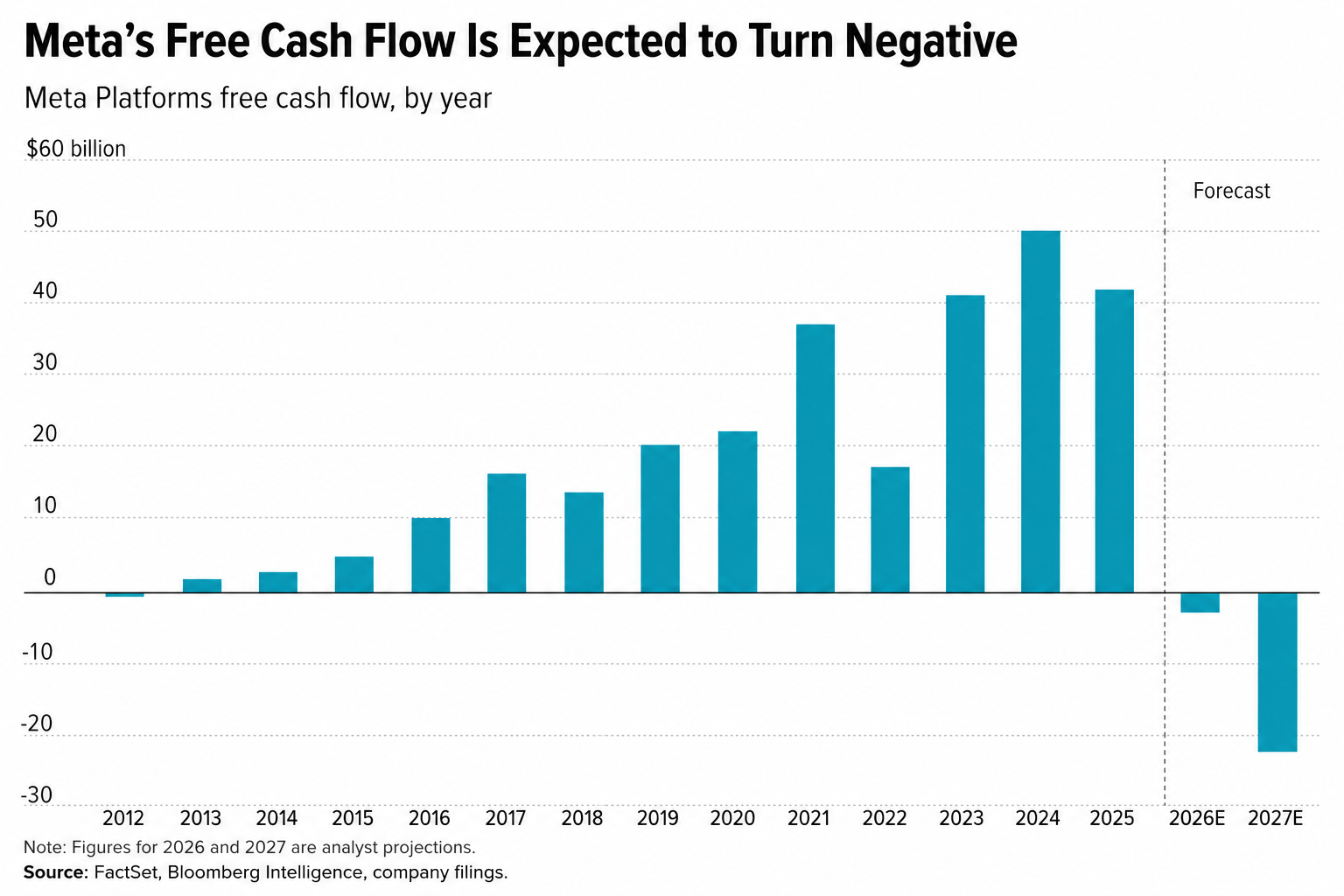
Analysts now expect Meta’s free cash flow to turn negative in the second half of 2026 for the first time since its IPO in 2012. Rather than being funded entirely through internally generated cash, a growing share of the company’s AI ambitions may need to be financed through borrowing.
The shift is significant. Free cash flow is ultimately what funds dividends, share buybacks, acquisitions and future investment. It represents the cash a business has available after paying its operating expenses and investing in long-term assets. When that cash flow disappears, even temporarily, management has fewer options and becomes increasingly reliant on external financing.
Meta’s AI strategy has not yet become unprofitable. Its core advertising business continues to generate billions of dollars in earnings each quarter. But the scale of investment now required means even one of the world’s most profitable companies is approaching the limits of what it can comfortably fund from its own balance sheet.
The market’s reaction suggests investors are beginning to pay closer attention to cash generation than capital expenditure alone.
AI Spending Is Reshaping Meta’s Balance Sheet
For most of its history, Meta’s financial strength rested on a simple formula: generate enormous cash flows, hold substantial cash reserves and carry very little debt. That is beginning to change.
Since 2022, the company has issued tens of billions of dollars in new borrowings, including one of the largest corporate bond offerings in its history. At the same time, long-term lease obligations and commitments linked to new AI data centres have continued to grow as Meta accelerates investment in computing infrastructure.
Taken together, these obligations mean the company is financing a growing share of its AI ambitions beyond its own internally generated cash.
None of this suggests Meta is facing financial distress. The company remains highly profitable and retains one of the strongest balance sheets in corporate America.
The significance lies elsewhere.
For the first time, artificial intelligence is materially changing the way one of the world’s largest technology companies finances itself. Rather than simply investing excess cash, Meta is increasingly relying on external capital to support one of the most ambitious investment programmes in corporate history.
A Test For The Entire AI Industry
Meta is unlikely to be the last technology company facing questions over the cost of AI.
Microsoft, Amazon and Alphabet have all committed tens of billions of dollars towards expanding AI infrastructure, with each company racing to build larger data centres, acquire advanced semiconductors and increase computing capacity. Collectively, the four companies are expected to spend well over US$300 billion on capital expenditure this year alone.
So far, investors have largely accepted these commitments as the price of remaining competitive in an industry undergoing rapid technological change. The prevailing view has been that falling behind in AI poses a greater long-term risk than overspending today.
That assumption may now be facing its first serious test.
As AI investment continues to accelerate, markets are beginning to shift their attention from how much companies are spending to what those investments are ultimately delivering. While enthusiasm for artificial intelligence remains strong, investors increasingly want evidence that rising capital expenditure will translate into sustainable earnings growth, stronger cash flows and attractive long-term returns.
History suggests this is a natural progression. Every major technological revolution has required enormous upfront investment, from railways and telecommunications to the internet itself. Many of those investments transformed the global economy, but not every company that spent aggressively ultimately generated attractive returns for shareholders.
Artificial intelligence is unlikely to be any different. The technology may reshape industries and create enormous economic value over the coming decades. The remaining question is whether today’s extraordinary levels of investment will generate returns sufficient to justify the capital now being committed.