


In the latest instalment of The Investor Standard’s CEO & Executive Interviews series, our analyst Peter Boyd sat down with Sarah Horton, co-founder of Elme Health, for a conversation that began with her move from investment banking into healthcare, but quickly evolved into something broader: whether the current Australian healthcare system remains structurally designed to react to illness rather than prevent it.
Horton’s move from finance into preventive healthcare may appear unconventional at first glance. But her logic is surprisingly coherent. After years as an investment banker, the catalyst was not professional burnout or a sudden career reinvention, but a far more personal shift.
Having children, she said, fundamentally changed how she thought about health.
That shift ultimately became the foundation for Elme Health.
From Finance to Preventive Healthcare
Horton’s move into healthcare was not the kind of abrupt career pivot that often gets framed as a dramatic reinvention. In many ways, it was a gradual shift in perspective.
Having spent years in institutional finance, including senior roles in investment banking, her professional background was built around strategic thinking, client relationships, capital allocation and long-term decision-making. But it was a personal change, rather than a professional one, that altered how she thought about health.
Having children, she said, fundamentally shifted her mindset.
“I genuinely started thinking differently about my own health. I wanted to understand what was going on beneath the surface before something actually goes wrong.”
That idea, seeking visibility before symptoms emerge, prevention rather than responding once issues appear became the starting point.
Horton is careful not to frame this as an indictment of the current healthcare system. In fact, she repeatedly describes Australia’s healthcare system as exceptional. Even high-quality systems in her view, are often structurally built to intervene once issues are present, rather than earlier in the health journey when prevention may still be possible.
What Is Elme?
Elme is not a traditional GP clinic, nor is it just a diagnostics provider or a wellness platform.
At its core, Horton describes it as a preventive healthcare membership built around continuity of care, proactive testing and earlier intervention.
The model is designed around a relatively simple idea: understanding health risks before they become visible illnesses.
That includes a combination of advanced health assessments, biomarker testing, personalised oversight and ongoing engagement with clinicians, rather than the episodic appointment-based model many patients are more familiar with.
At Elme, continuity is a key differentiator.
“One of the key differences with Elme is that continuity.”
Many preventive health offerings focus heavily on one-off testing or diagnostics. Elme’s thesis appears broader: that health outcomes improve not simply through access to more information, but through sustained oversight, interpretation and action over time.
In that sense, Elme is not trying to become another health testing business. It’s attempting to position itself as a proactive model of healthcare delivery, identifying health risks before they become materially more serious concerns.
The Reactive Healthcare Problem
Horton is careful not to position her critique as an attack on Australia’s healthcare system.
In fact, she describes it as exceptional.
But her broader argument is that even strong healthcare systems remain structurally geared toward intervention rather than prevention.
“The Australian healthcare system is exceptional,” Horton said. “But it is very much geared to respond once issues have emerged.”
That distinction is at the heart of Elme’s thesis and Horton’s thinking.
The argument is not that healthcare fails at treatment. In many cases, modern medicine performs remarkably well once illness is identified. The question Horton raises is whether the system is designed to engage early enough for patients seeking a more proactive understanding of long-term health risks before symptoms emerge.
The spending also reflects the structural imbalance. “In 2018–19, public health expenditure was only 2.0% of total health expenditure, with a target to increase to 5% by 2030.”
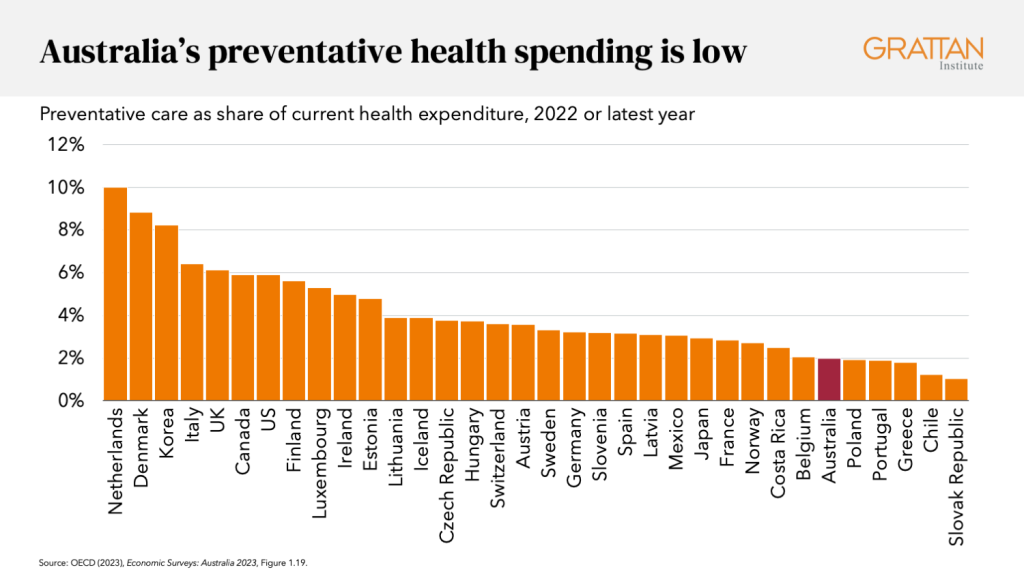
That helps explain the appeal of preventive healthcare models, particularly among more engaged consumers increasingly interested in understanding biomarkers, cardiovascular risk, metabolic health and longer-term disease indicators earlier in life.
For Horton, the underlying logic is relatively straightforward.
“The data is quite clearly there,” she said, “that early detection can lead to better patient outcomes.”
One of the clearest illustrations of why early detection matters can be seen in cancer outcomes. Patients diagnosed with colon cancer at stage 1 are almost 9 times more likely to survive compared to those at stage 4.
Her argument is not that traditional healthcare fails patients. Rather, it is that even strong systems remain primarily structured around responding once issues become visible, creating space for more proactive models of care focused on earlier insight and continuity.
In Horton’s view, a system built solely around reacting once illness appears leaves a meaningful gap between routine healthcare and genuine long-term prevention.
Building Elme
Elme did not begin as a purely abstract business concept or a top-down attempt to capitalise on a healthcare trend.
In many ways, it began far more personally.
Horton’s eventual co-founder, Dr Michela Sorensen, was initially her doctor, a relationship that gave her direct exposure to a more preventive and continuity-driven model of care.
That experience helped shape the business that would eventually become Elme.
Rather than emerging from a purely commercial thesis, the company appears to have grown from a shared belief that there was room for a more proactive approach to healthcare delivery.
That said, moving from institutional finance into building a healthcare business is not a straightforward transition.
Healthcare is fundamentally different from banking. It is more operationally complex, more trust-dependent and far less forgiving when execution falls short.
But some of the skills Horton developed in finance arguably translate well.
Building long-term client relationships, thinking strategically and executing with discipline are not qualities exclusive to financial markets. In many ways, they are equally relevant when building a business centred around long-term health outcomes and consumer trust.
Elme remains early in its journey.
“We’re sort of at the starting line.”
But the ambition is clear.
“Our aim is really to be the gold standard of preventive health.”
Premium Healthcare or a Broader Structural Shift?
The more commercially interesting question around businesses like Elme is not whether preventive healthcare is conceptually attractive.
Few would argue against earlier detection, stronger continuity of care or better long-term health visibility.
The more relevant question is whether those services remain concentrated among highly engaged, premium-paying consumers, or whether preventive healthcare becomes a far more meaningful part of mainstream healthcare over time.
Preventive healthcare, particularly in its more personalised form, naturally appeals to consumers willing to invest earlier in their long-term wellbeing rather than rely solely on traditional appointment-based care.
But Horton’s broader thesis appears to be that this is not simply a niche wellness trend.
Her argument is that consumer expectations around healthcare are changing.
Patients increasingly want greater visibility, stronger continuity and a more proactive understanding of their health, rather than waiting until issues become serious enough to demand intervention.
If that behavioural shift continues, businesses like Elme may represent more than a premium healthcare offering. They may instead reflect a broader evolution in how healthcare is delivered and consumed and a shift towards proactive, continuity-driven healthcare.
The Investor Standard View
Sarah Horton’s thesis is not that traditional healthcare is broken.
It is that even exceptional healthcare systems are often structurally optimised to respond once illness emerges, rather than helping patients engage earlier in a more proactive way.
That distinction matters.
Elme is ultimately betting that preventive healthcare becomes a more meaningful category over time, driven by consumers who want greater visibility, continuity and ownership over their long-term health outcomes.
Whether that model remains concentrated among premium users or broadens more meaningfully remains to be seen.
But Horton’s argument is compelling: if earlier detection leads to better outcomes, then the gap between routine healthcare and genuine prevention may represent a meaningful opportunity.
For now, Elme remains early in its journey.
But the ambition is clear.
As Horton put it, the goal is to become
“The gold standard of preventive health.”