

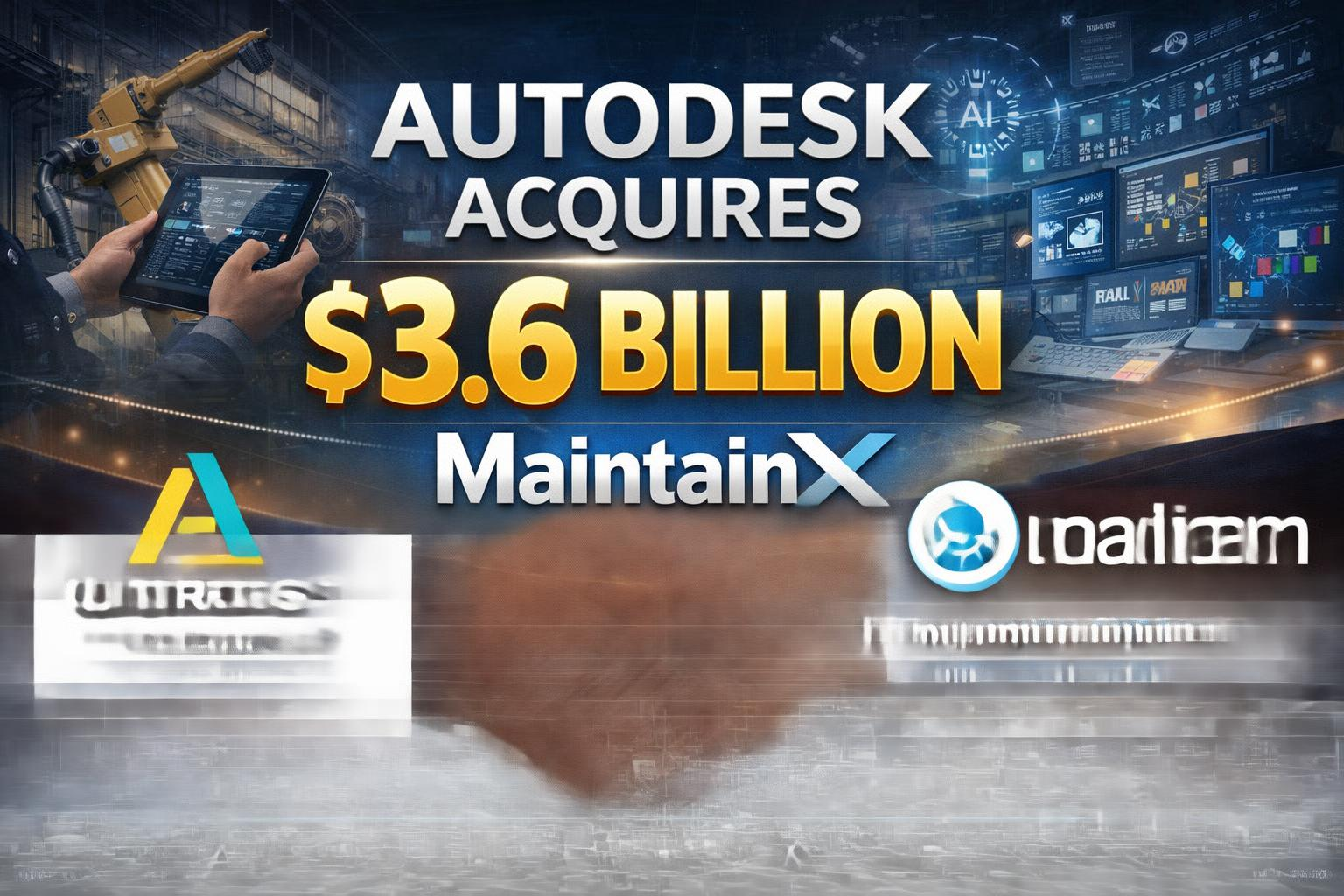
Autodesk’s Largest Deal Yet
Autodesk has entered into a definitive agreement to acquire MaintainX in an all-cash transaction valued at approximately $3.6 billion, making it the largest acquisition in the company’s history. The deal represents a significant strategic expansion beyond Autodesk’s traditional focus on design, engineering, and construction software, positioning the company more deeply within the rapidly growing operational technology market, where AI-powered workflows, predictive maintenance, and real-time asset management are becoming increasingly important.
Following completion of the transaction, MaintainX will serve as the foundation of Autodesk’s newly established Operations Solutions division. The new business unit is intended to connect the digital and physical worlds by extending Autodesk’s capabilities beyond the design and construction phases and into the ongoing operation and maintenance of critical assets. Chief Executive Officer Andrew Anagnost has described this convergence of digital design and real-world operations as the next major evolution in intelligent infrastructure, enabling organisations to manage assets more efficiently throughout their entire lifecycle.
From Startup to Strategic Asset
Founded in San Francisco in 2018, MaintainX has grown rapidly from a specialised maintenance-management platform into a leading provider of operational intelligence software. Its cloud-based and mobile-first solutions help organisations manage work orders, monitor asset performance, streamline maintenance activities, and improve operational efficiency across industrial environments.
The company’s growth has been particularly impressive. MaintainX is expected to exceed $135 million in annualised recurring revenue (ARR) by 2026, reflecting strong demand for digital maintenance and asset-management solutions. In July 2025, the company raised $150 million in a Series D funding round that valued the business at $2.5 billion, attracting support from prominent investors including Bessemer Venture Partners, Bain Capital Ventures, and D.E. Shaw Ventures.
Commenting on the transaction, founder and CEO Chris Turlica highlighted the strategic alignment between the two companies, describing the acquisition as an opportunity to better connect the teams responsible for designing, operating, and maintaining critical assets. The deal reflects a shared vision of integrating design intelligence with operational execution, creating a more seamless lifecycle approach to infrastructure and asset management.
Connecting Design, Data, and Operations
Autodesk has built its reputation on digital design and construction modeling, from AutoCAD to Revit and Fusion 360. But as infrastructure and manufacturing industries undergo rapid digitization, the next frontier is bridging the gap between design intent and real-world operational performance.The MaintainX acquisition advances that vision on three fronts: AI-driven automation for maintenance and asset management; real-time operational data that enriches Autodesk’s existing design and simulation tools; and broader cross-industry reach across manufacturing, facilities management, and energy.
CEO Andrew Anagnost framed the deal as a way to “connect digital and physical operations through AI-powered workflows,” giving customers visibility into how assets perform well beyond the construction or deployment phase. The move signals a strategic pivot: Autodesk is no longer just a design-software vendor but a full-lifecycle technology platform.
Financial and Market Implications
The $3.6 billion price tag makes MaintainX Autodesk’s largest acquisition to date, surpassing earlier deals like PlanGrid and Innovyze. Analysts see it less as a financial bet and more as a strategic repositioning, one that puts Autodesk in direct competition with established enterprise asset management platforms like IBM Maximo and SAP EAM.
On the financial side, MaintainX’s subscription-based revenue model is a natural fit with Autodesk’s own pivot toward recurring revenue, adding further stability to its long-term earnings profile. The deal also expands Autodesk’s footprint in industrial and facilities management, sectors poised for significant growth as organizations accelerate the digitization of maintenance and sustainability operations.
Building the Future of Intelligent Operations
Autodesk’s acquisition of MaintainX is more than its largest transaction to date which reflects a broader shift in the future of industrial software. As factories, infrastructure networks, and critical assets become increasingly connected through sensors, automation, and real-time data, organisations are seeking integrated platforms that can manage the entire asset lifecycle, from initial design through ongoing operation and maintenance.
By combining Autodesk’s leadership in design and engineering software with MaintainX’s expertise in operational intelligence and asset management, the company is creating a unified digital ecosystem that connects the people who design assets with those responsible for operating and maintaining them. This convergence has the potential to improve efficiency, reduce downtime, enhance predictive maintenance capabilities, and unlock greater value from operational data.
The transaction also positions Autodesk at the intersection of several powerful long-term trends, including artificial intelligence, industrial automation, digital twins, and smart infrastructure. As organisations increasingly adopt data-driven approaches to managing physical assets, the ability to seamlessly integrate design intelligence with operational execution could become a significant competitive advantage.
With a purchase price of $3.6 billion, the acquisition showcases Autodesk’s ambition to expand beyond its traditional software markets and establish itself as a leading platform across the full lifecycle of infrastructure and industrial assets. In doing so, the company is positioning itself to play a central role in reshaping how manufacturing facilities, buildings, and critical infrastructure are managed in an increasingly digital world.