
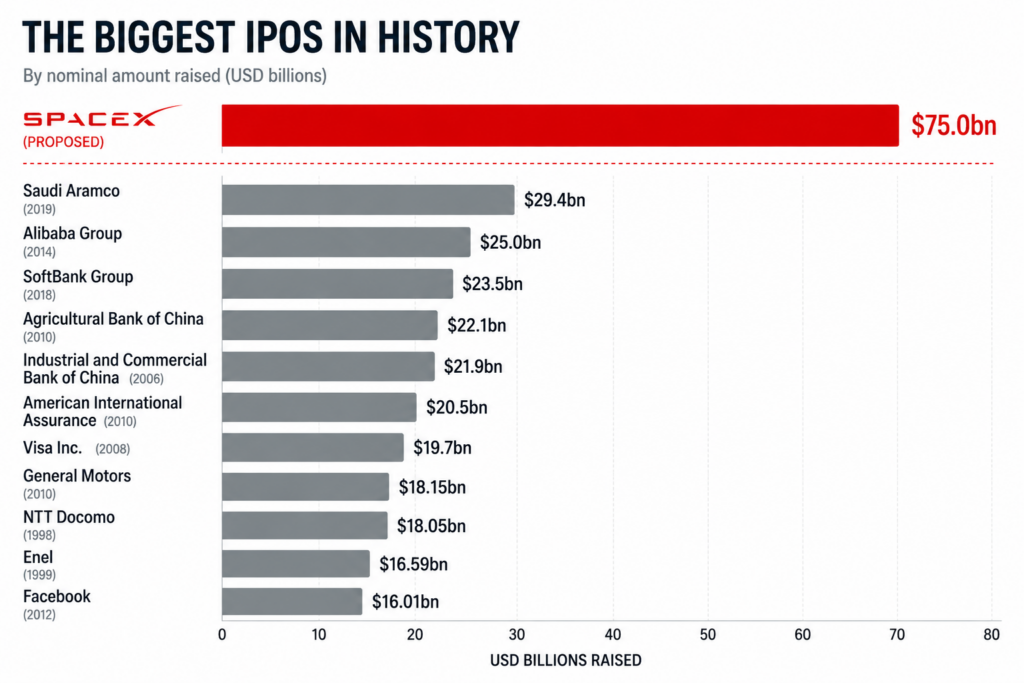
SpaceX upcoming IPO is already expected to be the largest in history.
At a proposed valuation of US$1.75 trillion and an expected raise of US$75 billion, the listing would far surpasses Saudi Aramco’s record-breaking IPO in 2020 and instantly becoming one of the worlds most valuable companies.
Yet the most remarkable aspect of the offering may not be its size.
It is the way SpaceX is conducting the IPO itself.
Rather than following the traditional Wall Street playbook, the company has chosen a highly unconventional approach. Instead of announcing a price range and refining the valuation through investor meetings, SpaceX has effectively told investors exactly what the company is worth and invited them to either participate and purchase shares or walk away.
In many ways, the offering reflects a simple reality: Elon Musk believes SpaceX no longer needs Wall Street’s approval.
Breaking The Traditional IPO Playbook
Most IPOs follow a familiar process.
A company and its underwriters establish an indicative valuation range, typically spanning several dollars per share. Management then embarks on a roadshow, meeting institutional investors and gathering feedback on willingness to participate then the final offering price is determined shortly before trading begins.
The process serves two purposes. It helps companies maximise proceeds and allows investors to influence pricing through market feedback.
SpaceX has largely ignored this convention.
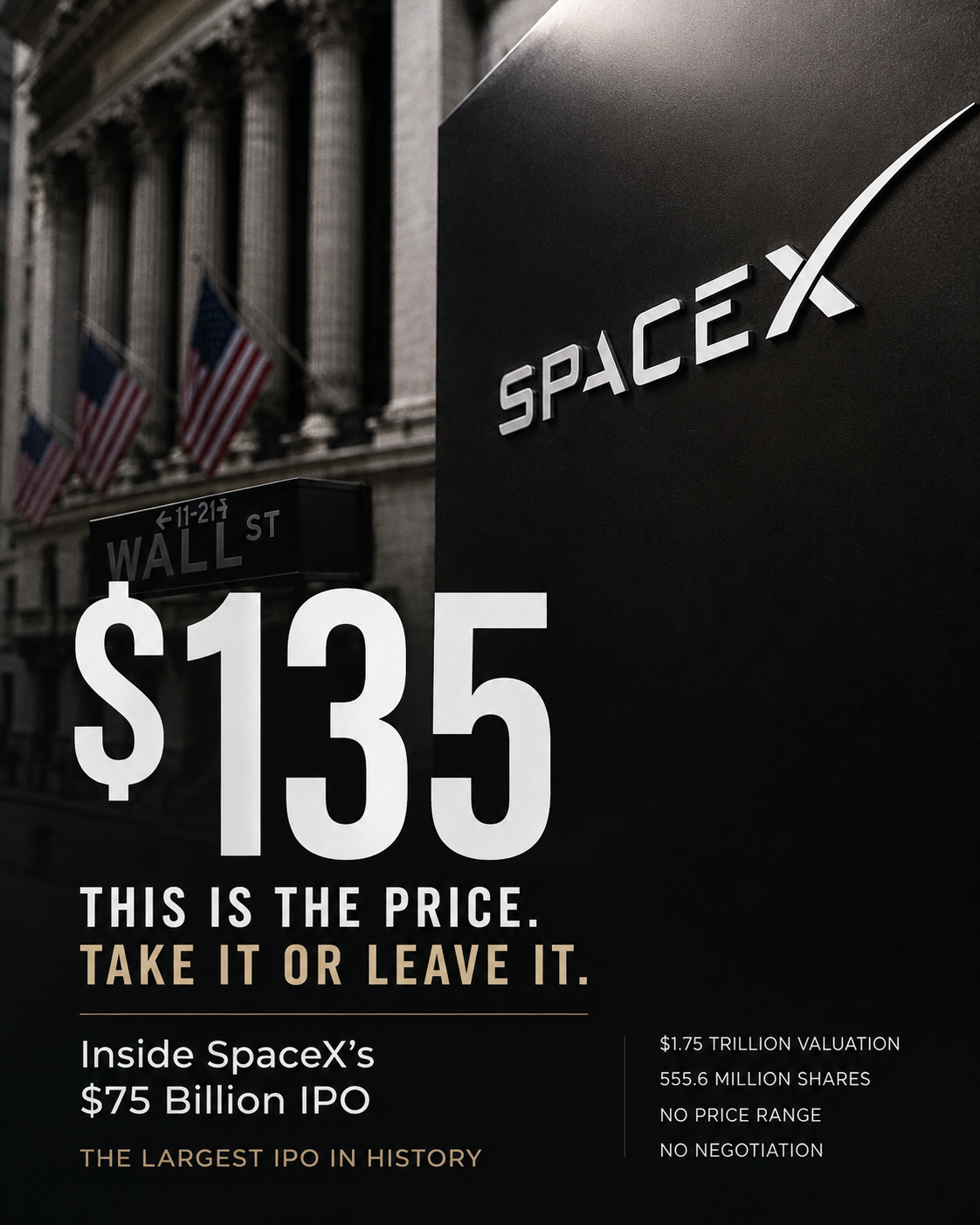
The company announced plans to sell 555.6 million shares at a fixed price of US$135 per share, implying proceeds of approximately US$75 billion and a valuation of about US$1.75 trillion.
Rather than asking investors what they think the company is worth, SpaceX is just telling them.
The message is simple: this is the price, take it or leave it.
How Can SpaceX Do This?
The answer is investor demand.
Unlike most companies approaching public markets, SpaceX has already spent years raising private capital. During that time, it has built a reputation as one of the world’s most sought-after private companies.
Management reportedly believes demand is sufficiently strong that traditional price discovery is not needed.
In effect, SpaceX is not seeking investor approval, it’s acting like a company granting investors access.
This confidence has been reinforced by a remarkable rise in valuation.
In 2015, SpaceX was valued at approximately US$12 billion.
By 2020, that figure had risen to US$36 billion.
In 2022, it reached US$125 billion.
A secondary share sale in December 2025 valued the company at roughly US$800 billion.
Now, just six months later, SpaceX is seeking a valuation of about US$1.75 trillion.
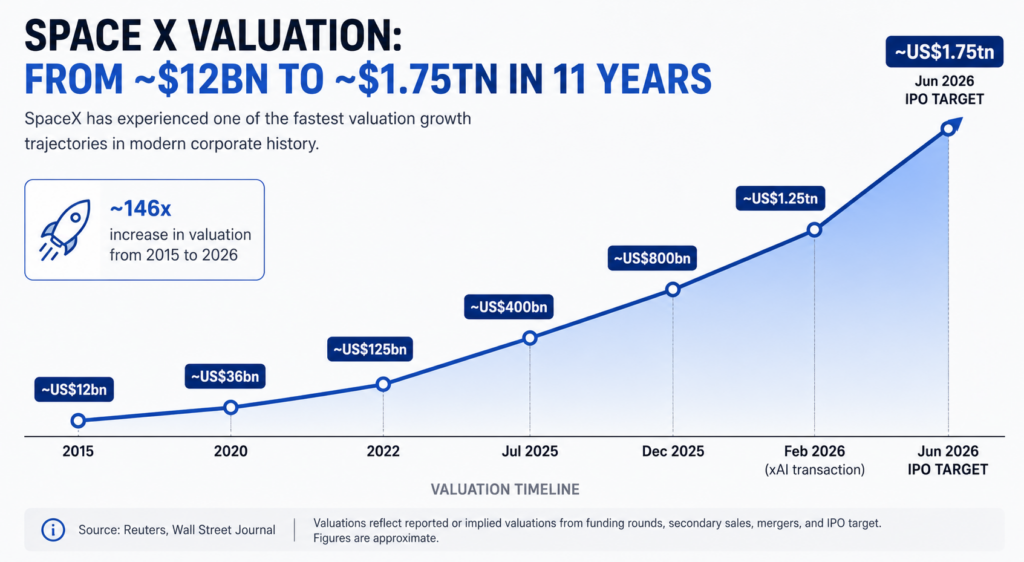
Few companies in modern history have experienced such a rapid increase in value.
The Valuation Debate
The aggressive pricing strategy inevitably raises questions about valuation.
SpaceX generated approximately US$18.7 billion in revenue during 2025 while reporting a net loss of roughly US$4.9 billion.
At a US$1.75 trillion valuation, the company is trading at a 94x EV/R multiple.
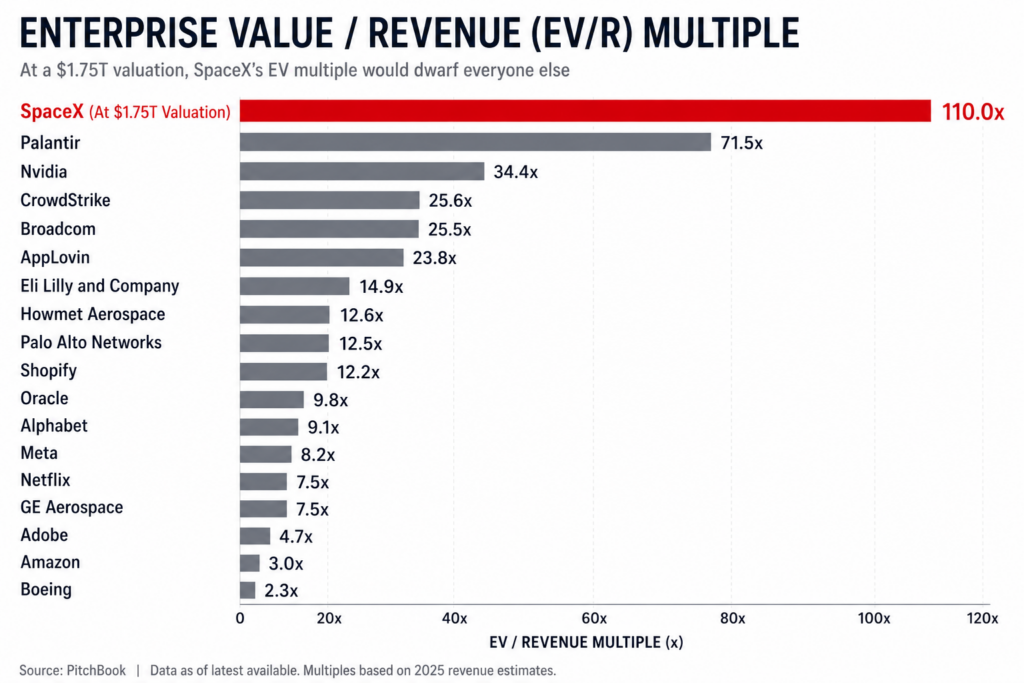
For comparison, Tesla traded at approximately 17x at the end of 2025, while the broader S&P 500 trades at only a fraction of that multiple.
Traditional valuation metrics therefore offer little support for the proposed price.
Supporters argue that such comparisons miss the point.
They view SpaceX not as a rocket company, but as a platform with exposure to satellite communications, launch services, AI infrastructure and potentially exposure to future industries that do not yet exist.
Critics counter that investors are paying today for growth that may take decades to materialise.
A Sign Of Changing Capital Markets
Regardless of whether the valuation proves justified, the offering highlights a broader shift occurring across markets.
Historically, Wall Street played a central role in determining the price of shares and value of companies entering public markets.
Today, some of the world’s largest private firms have access to so much private capital and investor demand that they can effectively dictate their own terms.
SpaceX’s IPO may therefore be remembered for more than its record-breaking size.
It may mark the moment when one of the world’s most valuable private companies demonstrated that it no longer needed Wall Street to tell it what it was worth.