
For almost 3 years, the AI industry has been judged on one metric above all others: capability.
Which model is the smartest, has the highest benchmark is highest, has the most advanced tech?
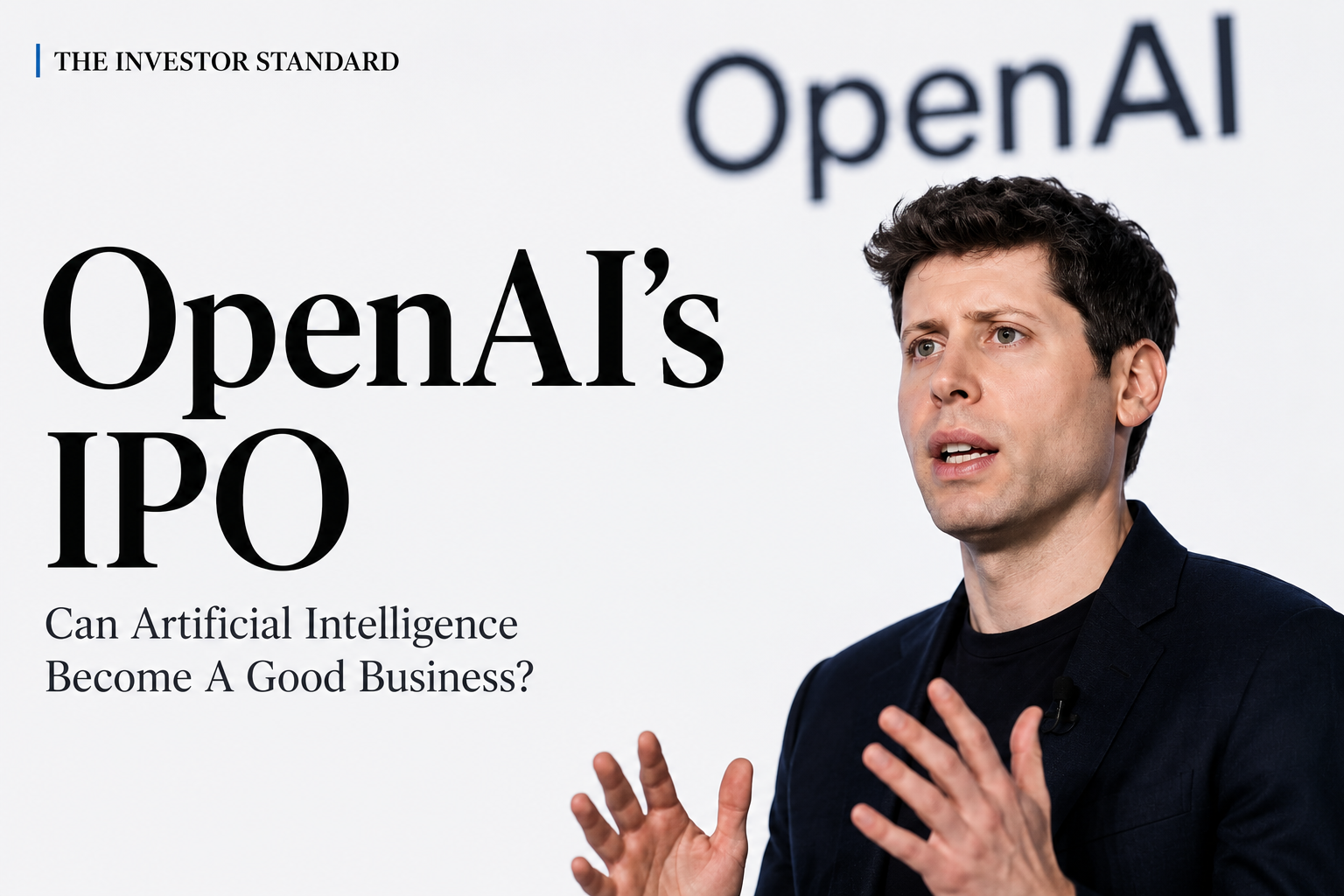
OpenAI’s decision to confidentially file for an IPO may change that.
When the company behind ChatGPT eventually enters public markets, investors will be less interested in benchmark scores and more interested in a much simpler question:
Can AI actually become a good business?
The IPO may determine not only OpenAI’s future, but the future of the entire AI industry
The Fastest Growing Technology Platform In History
It is difficult to overstate the impact OpenAI’s had on the industry.
Before the launch of ChatGPT in November 2022, generative AI was largely confined to research labs and tech enthusiasts. Within months, ChatGPT became one of the fastest-growing consumer applications in history, reaching 100 million users faster than any major consumer platform before it.
The launch triggered an investment boom unlike anything Silicon Valley had seen for many years.
Microsoft committed tens of billions of dollars to OpenAI. Amazon backed Anthropic. Nvidia’s share prices boomed becoming one of the world’s most valuable companies. Meta and Google accelerated spending on their own AI initiatives.
What followed was effectively an AI arms race.
The winners would not simply build better products. They would build larger models, acquire more computing power and secure access to the infrastructure required to train and deploy increasingly sophisticated systems.
The result has been extraordinary growth.
But growth alone is not what public markets ultimately reward.
Revenue Is Growing, So Are The Costs
Traditional software businesses enjoy a simple economic advantage. Once the product is built, serving an additional customer costs very little.
AI is different.
Every prompt submitted to ChatGPT requires computing power, every image generated consumes resources, every conversation has a cost attached to it.
Unlike conventional SAAS, AI services incur significant expenses each time customers use their products.
This creates a challenge.
While revenues have expanded rapidly across the industry, spending has often expanded just as quickly, eating up profits.
OpenAI recently completed what has been reported as the largest funding round in Silicon Valley history, raising approximately US$122 billion from investors including SoftBank, Nvidia and Amazon.
That capital is not sitting idle.
It is being deployed into data centres, GPUs, networking infrastructure and long-term computing commitments that stretch years into the future.
The scale is unprecedented.
The Infrastructure Arms Race
Today’s leading AI companies increasingly resemble infrastructure businesses rather than software businesses.
OpenAI, Anthropic, Google, Meta and xAI are all engaged in a race to secure the computing capacity required to train and run advanced models.
That race is extraordinarily expensive.
Training frontier AI systems now requires thousands of specialised chips, vast quantities of power and increasingly complex data-centre infrastructure.
As a result, success in AI is no longer determined solely by research talent, it’s also determined by access to capital.
The companies able to spend the most may gain an advantage. The problem is that spending alone does not guarantee profitability.
Public investors have seen this story before.
Rapid growth is exciting. Massive capital expenditure is less exciting when it fails to translate into sustainable returns.
What Happens When Growth Slows?
Private markets have largely rewarded AI companies for growth. Public markets tend to be less forgiving.
As long as revenues double every year, investors are often willing to overlook losses. Eventually, however, growth slow down.
When that happens, attention shifts.
Questions about users become questions about margins and returns.
Innovation become questions about cash flow and commercialisation
Market share become questions about costs and profitability.
OpenAI may eventually face these questions on a scale few companies have ever experienced.
According to forecasts previously shared with investors, the company is expected to burn cash at levels that would exceed almost any public company in history.
That may be justified if AI becomes one of the most important technologies of the century.
But it also raises an uncomfortable possibility:
What if AI proves more valuable to society than it is profitable for the companies building it?
The IPO Is Bigger Than OpenAI
OpenAI’s eventual public listing is not simply another technology IPO.
It may become the first true test of whether modern artificial intelligence can evolve from a technological breakthrough into a sustainable economic model.
For years, investors have funded AI on the assumption that future profits will justify today’s spending.
Soon, they may have the opportunity to decide whether that assumption still holds.
The question facing OpenAI is therefore much larger than whether ChatGPT remains the leading chatbot.
It is whether the economics of artificial intelligence can ultimately match its promise.
And when OpenAI finally enters public markets, investors will deliver their verdict.