

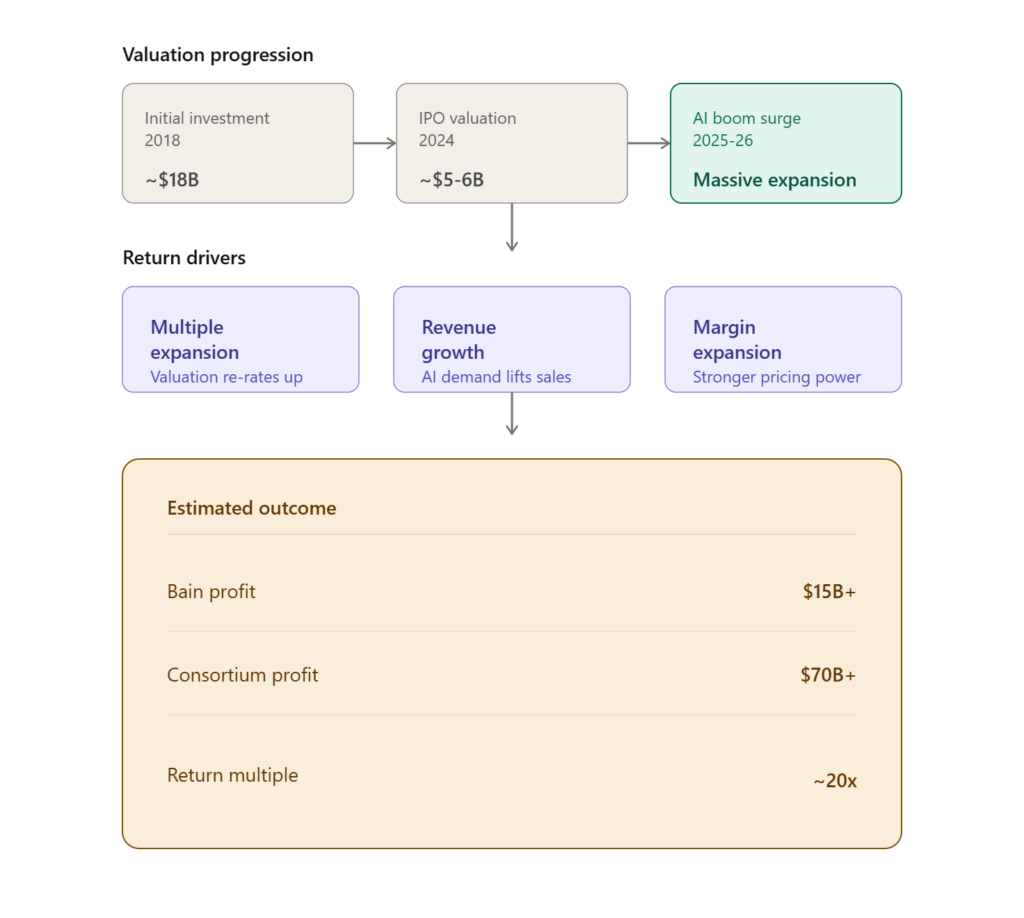
In private equity, investments that generate 10× or 20× returns are the exception rather than the rule. Bain Capital’s stake in Kioxia, formerly Toshiba Memory, is emerging as one of those rare success stories. Acquired as part of a complex and distressed carve-out in 2018, the investment has evolved into a textbook example of how strategic timing, long-term conviction, and powerful technology megatrends, especially the rise of artificial intelligence, can create extraordinary value. Today, Bain’s position is estimated to be worth nearly 20 times its original investment, potentially delivering more than $15 billion in profits for the firm and over $70 billion for the wider investor group involved in the deal.
The Origin: A Distressed Opportunity
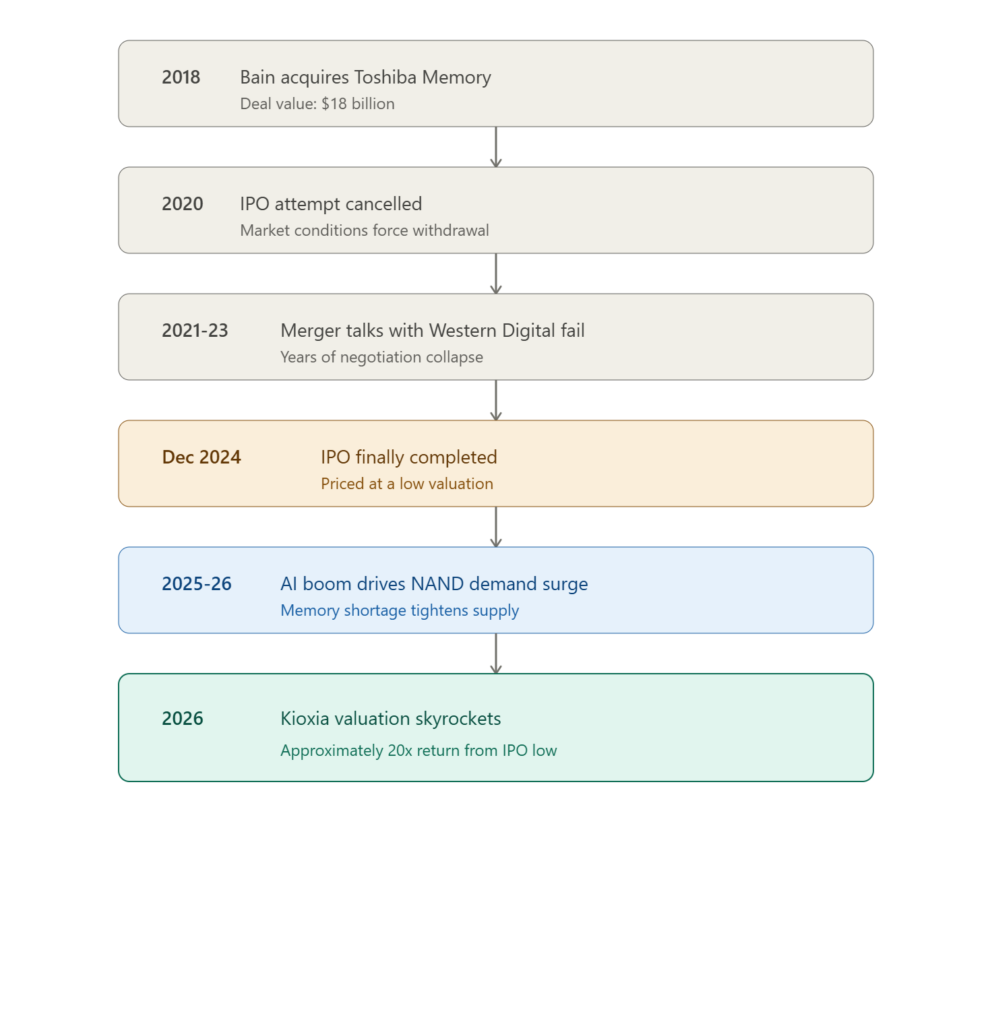
The story dates back to 2018, when Toshiba was compelled to divest its highly valuable memory chip business after an accounting scandal and mounting financial pressures. Bain Capital assembled and led a consortium of investors, including Apple and SK Hynix, to acquire the division for roughly $18 billion, making it the largest leveraged buyout in Asia at the time.
The investment case appeared compelling: NAND memory was a critical component underpinning modern electronics, Toshiba’s memory business held a leading position in the global market, and the forced sale created a rare opportunity to acquire a high-quality asset at an attractive valuation. Yet despite the strong fundamentals, the journey that followed was far more challenging than investors initially anticipated.
Early Challenges
Post-acquisition, Kioxia encountered a series of significant problems that stifled its growth ambitions and challenged investor patience. Its planned IPO in 2020 was shelved amid heightened market uncertainty and a proposed merger with Western Digital failed to materialise after protracted talks were scuppered by shareholder opposition. Simultaneously, the company had to navigate a tough memory market, as declining NAND prices and constant oversupply weighed on earnings and weighed heavily on its valuation.
Even when Kioxia eventually debuted on the Tokyo Stock Exchange in December 2024, the market response fell well short of expectations. The company’s initial valuation of roughly $5–6 billion was not only below investor hopes but also significantly lower than the valuation implied by the 2018 buyout. At that point, the investment hardly looked like a private equity triumph. Bain Capital was forced to remain patient, refinancing debt, extending investment timelines, and pursuing sale-and-leaseback transactions to strengthen liquidity and support the business through a challenging period.
The experience highlights a common reality in private equity: even the most successful investments can spend years appearing uncertain or underwhelming before their true value is ultimately realised.
The Inflection Point: AI Changes Everything
The investment’s fortunes began to change with the rapid rise of artificial intelligence. As AI applications and large language models gained traction, the need for massive amounts of data storage increased dramatically, placing NAND flash memory at the centre of the AI infrastructure boom.
NAND memory is a form of non-volatile storage widely used in solid-state drives (SSDs) and data centres. It is designed to store the vast datasets required for AI training and inference while offering high storage density at a relatively low cost.
As AI adoption accelerated, hyperscale data centres raced to expand their storage capabilities, driving a sharp increase in demand for NAND chips. The resulting supply-demand imbalance pushed memory prices higher and significantly improved industry profitability. In many respects, memory has become one of the key bottlenecks in AI infrastructure, with demand continuing to outpace supply and supporting a sustained upswing in pricing and margins.
The Explosion in Value
The emergence of AI as a major growth driver completely reshaped Kioxia’s outlook. As demand for AI infrastructure accelerated, investor sentiment toward memory manufacturers improved dramatically, triggering a remarkable re-rating of the company. Kioxia’s share price climbed more than 5,000% from its IPO level, while its market capitalisation expanded into the tens of trillions of yen, elevating it among Japan’s most valuable listed companies.
What had once appeared to be a troubled and uncertain investment was transformed into one of the most profitable private equity transactions on record, underscoring the power of patience, timing, and exposure to a powerful technological megatrend.
Why This Deal Matters
First, exceptional opportunities often emerge during periods of distress. Bain Capital was able to acquire a world-class semiconductor business at a time when Toshiba was under significant financial pressure, creating an attractive entry point into a high-quality asset.
Second, patience is often the difference between average and extraordinary returns. For much of the holding period, the investment failed to meet expectations, and many investors may have been tempted to walk away before the value creation story fully unfolded.
Third, powerful macro trends can dramatically reshape an investment outcome. While the AI revolution was far from certain in 2018, it ultimately became the primary catalyst behind Kioxia’s resurgence and the enormous returns generated for investors.
Finally, semiconductors have evolved into strategic assets. Memory chips are no longer viewed as simple commodity products; they have become critical infrastructure underpinning the global AI ecosystem, making companies like Kioxia increasingly important in the digital economy.
Conclusion
Bain Capital’s investment in Kioxia stands as a classic private equity success story: acquiring a high-quality asset during a period of uncertainty, remaining committed through years of volatility, and ultimately benefiting from a transformative long-term trend.
What began as a complex and seemingly troubled carve-out has evolved into a once-in-a-generation investment, generating close to 20× returns and creating tens of billions of dollars in value for investors. More importantly, it highlights a timeless lesson in investing: the most extraordinary outcomes often come not from flawless execution, but from having the foresight and conviction to be positioned early in front of a major technological revolution. In Kioxia’s case, that revolution was the rise of artificial intelligence.