


Fashion has never been short of companies capable of capturing attention. Turning that attention into a durable public company has proven considerably harder.
Reformation became the latest brand to test that proposition when it IPO’d. The sustainable womenswear company entered public markets with a valuation of US$1 billion, roughly twice last years revenue before its shares climbed 7.5% following the listing.
On the surface, there’s plenty for investors to like.
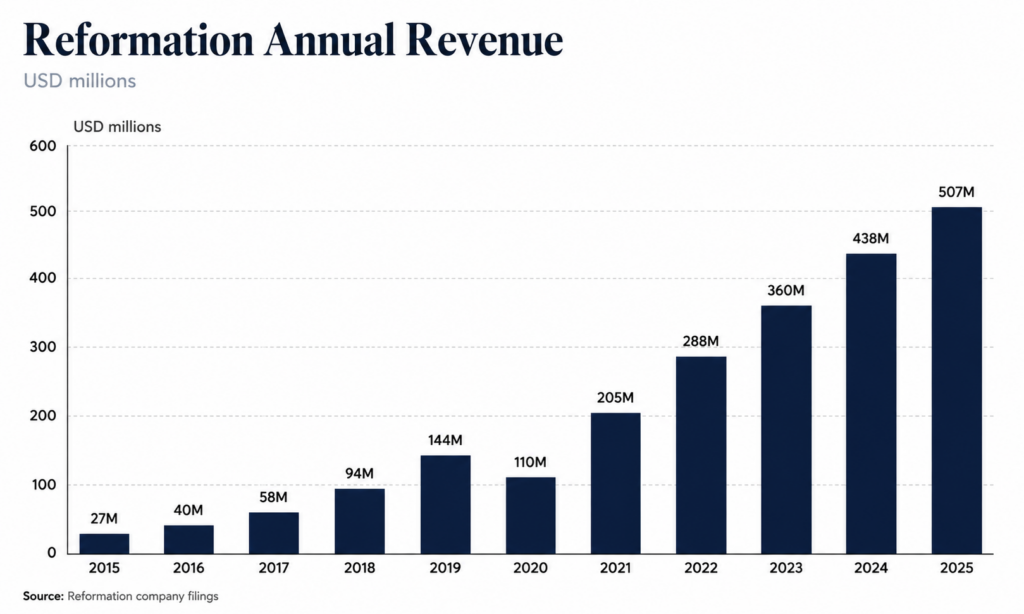
What began as a small vintage clothing store in LA in 2009 has developed into an international fashion business generating more than half a billion in annual revenue. Reformation now operates around 70 stores, has four million social-media followers and counts celebrities including Taylor Swift, Jennifer Aniston and Kendall Jenner among those photographed wearing its clothes.
More importantly, the popularity appears to translate into unusually strong customer loyalty. Nearly 70% of Reformation’s direct-to-consumer revenue in 2025 came from returning customers, while 77% of active customers surveye described Reformation as either one of their favourite or their favourite brand.
But public markets ultimately demand more than cultural relevance.
Reformation’s revenue increased from US$438.2 million in 2024 to US$507.1 million in 2025, yet net profit fell from US$33 million to US$12.6 million. Annual revenue growth also moderated from 22% to 16%, raising questions over how quickly the company can expand as it moves beyond its core customer base.
There are already signs that growth could reaccelerate. Revenue increased 30% year-on-year in the first quarter of 2026, while the company’s active customer base expanded 18%. Reformation is simultaneously opening stores, expanding internationally and moving into additional product categories.
That leaves investors with a relatively simple question.
Is Reformation at the beginning of its transformation into a global fashion brand, or has its IPO arrived just as the easy growth begins to run out?
From Vintage Store to Global Fashion Brand
Reformation’s investment case begins with something notoriously difficult to manufacture in fashion: brand loyalty. Its growth has been built around a relatively simple strategy: identify what customers want quickly, produce it in limited quantities and scale the products that sell.
That approach is particularly valuable in fashion, where predicting demand months in advance can leave retailers holding large amounts of unwanted inventory. Rather than committing heavily to collections before knowing how customers will respond, Reformation initially produces many styles in smaller quantities before increasing production when demand becomes clearer.
The company’s supply chain is designed around that model. Around half of its products have reached its distribution centre within 60 days or less over the past three years, allowing Reformation to respond relatively quickly to changes in consumer demand. Between 2021 and 2025, approximately 80% of its direct-to-consumer revenue came from products sold at full price.
Physical stores have increasingly become another part of that strategy. Rather than replacing online sales, stores appear to deepen customer spending across both channels. Customers shopping both online and in-store generated 3.1 times more revenue per customer than single-channel shoppers, while the proportion of revenue generated by these omnichannel customers increased from 19% in 2021 to 34% in 2025.
This gives Reformation several avenues for expansion. It can open additional stores, enter new international markets and broaden its product range without having to reinvent the brand that made it successful.
The challenge is whether those opportunities are large enough to sustain the growth investors are now paying for.
Growth Is Getting Harder
For all of Reformation’s strengths as a brand, its recent financial performance presents a more complicated picture.
Revenue increased from US$438 million in 2024 to US$507 million in 2025, representing growth of around 16%. That remains impressive for a fashion retailer of Reformation’s size, but it marked a slowdown from the roughly 22% growth recorded a year earlier.
Profitability also moved in the wrong direction. Net income fell from approximately US$33 million to US$13 million, despite the increase in sales. For a newly listed company valued at around US$1 billion, continued revenue growth becomes considerably less attractive if each additional dollar of sales is accompanied by weaker profitability.
There are, however, early signs that the slowdown may not persist. Revenue grew approximately 30% year-on-year in the first quarter of 2026, while active customers increased 18%. If that momentum continues, the moderation seen last year could prove temporary rather than evidence that Reformation is approaching the limits of its growth.
That distinction matters because Reformation’s valuation leaves relatively little room for stagnation. At roughly two times annual revenue, investors are not simply paying for the business that exists today. They are paying for continued store expansion, international growth and Reformation’s ability to sell more products to a larger customer base without sacrificing margins.
For a fashion company, delivering that consistently is particularly difficult. Consumer tastes can change quickly, yesterday’s best-selling product can become tomorrow’s unwanted inventory, and expanding too aggressively can dilute the scarcity and cultural relevance that made a brand successful in the first place.
Reformation therefore enters public markets at an interesting point in its development: large enough that maintaining rapid growth is becoming harder, but still small enough that substantial expansion remains possible.
Fashion’s Problem
Reformation’s challenge is not unique. Fashion has historically been a difficult industry for public-market investors.
Unlike businesses built around recurring subscriptions or long-term contracts, fashion companies must repeatedly convince consumers to buy products whose appeal can change remarkably quickly. A successful collection provides little guarantee that the next one will perform equally well, while getting demand wrong can leave retailers carrying excess inventory that ultimately has to be discounted.
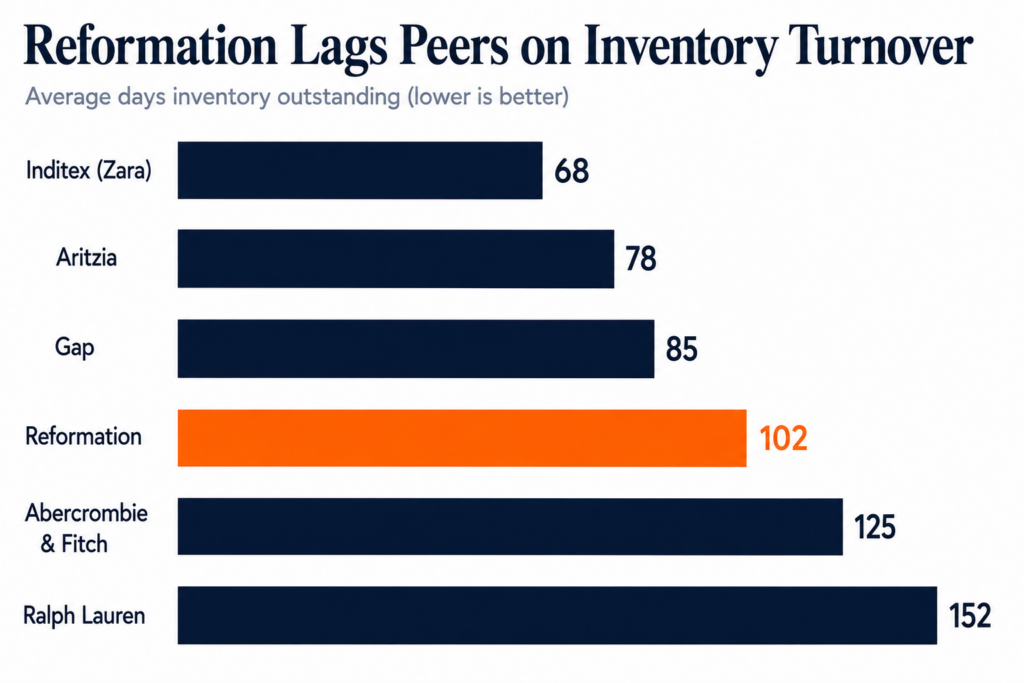
That makes inventory management particularly important. Reformation’s test-and-scale model is designed to reduce this risk, but its inventory still turns more slowly than several comparable fashion businesses, increasing the potential for markdowns if demand weakens or individual products fall out of favour.
There is also the problem of growth itself. Fashion brands often become successful because they develop a distinctive identity with a particular group of consumers. Expanding beyond that audience without diluting the brand can be difficult. Opening more stores and entering new markets may increase sales, but growth becomes considerably less valuable if it requires heavier discounting, higher marketing expenditure or weaker margins.
Public markets have historically been unforgiving of that combination. According to data cited by The Wall Street Journal, fashion companies that went public between 2010 and 2024 generated an average return of just 1.7% over their first three years as listed companies.
Reformation does have advantages that distinguish it from many fashion businesses that have struggled after listing. It is profitable, generates around 90% of sales directly through its own channels and has a substantial base of repeat customers. But those strengths do not eliminate the fundamental challenge facing any fashion company: today’s popularity has to be earned again tomorrow.
That makes Reformation’s US$1 billion valuation the central question rather than the quality of the brand itself.
What Is Reformation Worth?
At around US$1 billion, Reformation is valued at roughly twice its 2025 revenue. That does not look particularly extreme for a profitable consumer brand growing at double-digit rates, but it leaves investors paying for substantial future growth.
Reformation generated US$507 million of revenue in 2025, up 16%, while net income fell to US$12.6 million. At the IPO valuation, that equates to close to 80 times trailing earnings, although expenses weighing on 2025 profitability make that an imperfect measure of the company’s underlying earning power.
Aritzia provides one example of what successful expansion can look like. The Canadian fashion retailer increased fiscal 2026 revenue by 35% to C$3.7 billion, while also improving net income and margins. Its rapid U.S. expansion demonstrates that a concentrated fashion brand can successfully scale beyond its original market—but also sets a high benchmark for businesses commanding premium valuations.
Reformation has reasons for optimism. Revenue growth accelerated sharply in the first quarter of 2026, while further store openings, international expansion and new product categories provide additional avenues for growth.
The IPO should also strengthen its financial position, although much of the proceeds will go towards the balance sheet. Reformation expected to receive approximately US$134.5 million, with around US$125 million earmarked to repay existing borrowings.
Reformations Test: What It Needs To Prove
Reformation has already accomplished something most fashion labels never do: it has transformed cultural relevance into a sizeable, profitable business with a loyal customer base.
Going public creates a different challenge.
Fashion trends change. Consumers move on. Expansion increases the risk of overexposure, while the quarterly expectations of public markets leave considerably less room for experimentation than private ownership.
Reformation therefore does not need to prove that it is a good brand. Its customers have largely done that already.
It needs to prove that a good brand can become a much larger business without losing what made it valuable in the first place.
That is the real $1 billion test.