

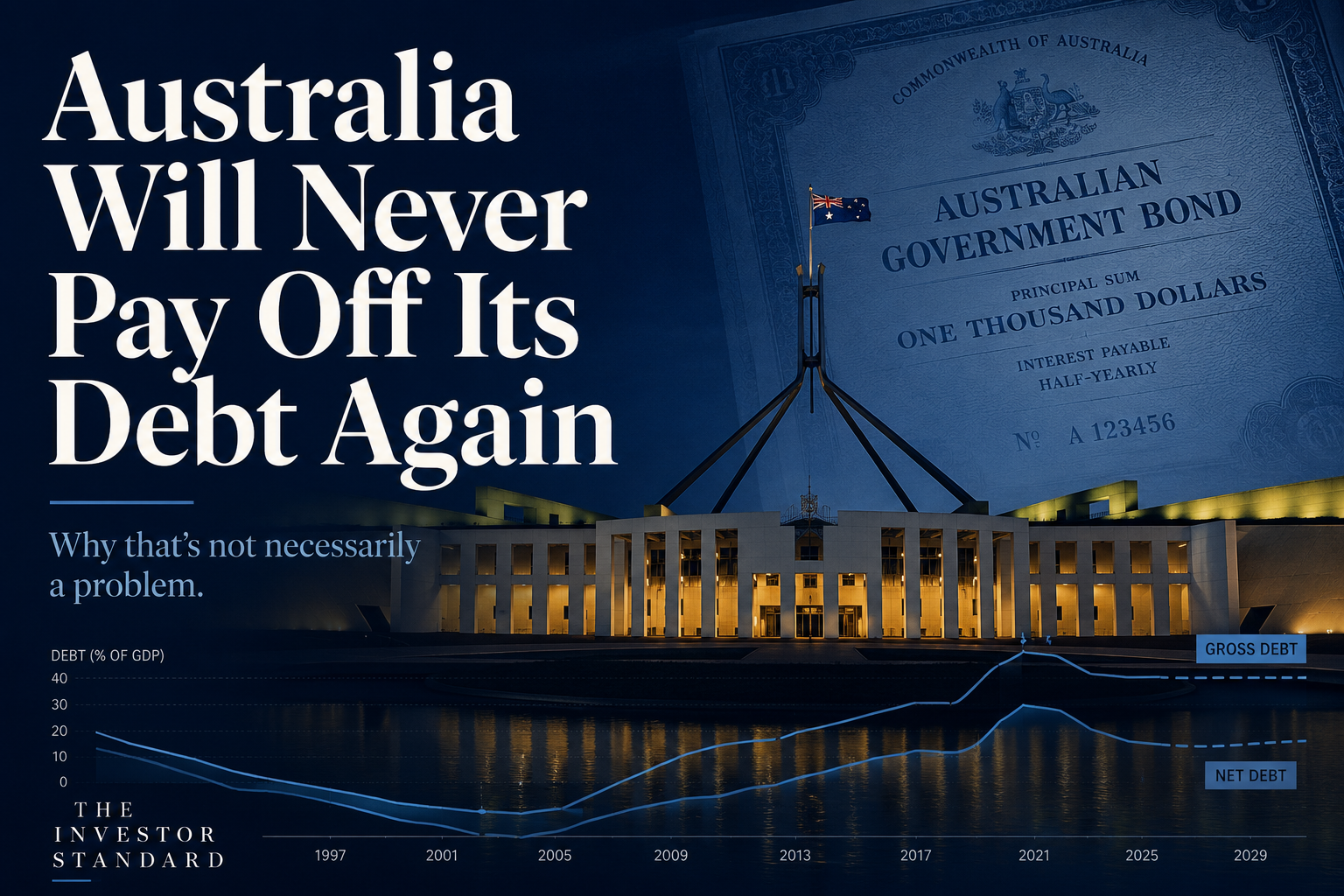
Australia’s federal debt is approaching $1 trillion. It’s a figure so large that it naturally raises concerns about the country’s finances and prompts a simple question: how will we ever pay it back?
- Governments Don’t Manage Debt Like Households
- But Didn’t Australia Eliminate Its Debt Before?
- It Didn’t Eliminate All Government Debt
- A Much Lower Starting Debt Burden
- Exceptionally Strong Circumstances
- Tens of Billions In Privatisation Proceeds
- Fewer Structural Spending Pressures
- Higher Tax Receipts
- Government Debt Serves An Important Purpose
- Is Australia’s Debt Sustainable?
The answer may come as a surprise.
We probably won’t and that’s fine.
That doesn’t mean Australia is heading towards a debt crisis or leaving an impossible burden for future generations. In fact, virtually all advanced economies will never eliminate their government debt. Instead, they continually refinance it while allowing their economies to grow over time.
The real question isn’t whether Australia can reduce its debt to zero. It’s whether that debt remains affordable, productive and sustainable.
Understanding the difference helps explain why Australia’s debt is unlikely to ever return to zero and why that isn’t something to fear.
Governments Don’t Manage Debt Like Households
This idea often feels counterintuitive because we naturally compare government finances to our own. Households borrow for a house or a car before gradually repaying the loan over time. The phrases “paying off the mortgage with the credit card” and “Our grandchildren will be paying this off” is common in the debate over government debt. However, governments operate under a fundamentally different model.
Most government borrowing occurs through bonds issued to investors. These bonds have fixed maturity dates, ranging from months to decades. When a bond matures, the government repays the investor in full.
This is where many people assume the story ends. In practice, however, governments usually issue new bonds at the same time. The proceeds from these new bonds help finance the repayment of the old ones while also covering any new borrowing required for the budget.
Rather than steadily eliminating debt, governments continuously refinance it. Individual bonds are repaid every year, but the overall stock of debt is typically rolled over instead of disappearing.
Debt only becomes a problem when investors lose confidence that a government can continue servicing and refinancing it at reasonable interest rates. As long as that confidence remains, governments can carry debt for decades without experiencing a crisis.
But Didn’t Australia Eliminate Its Debt Before?
It Didn’t Eliminate All Government Debt
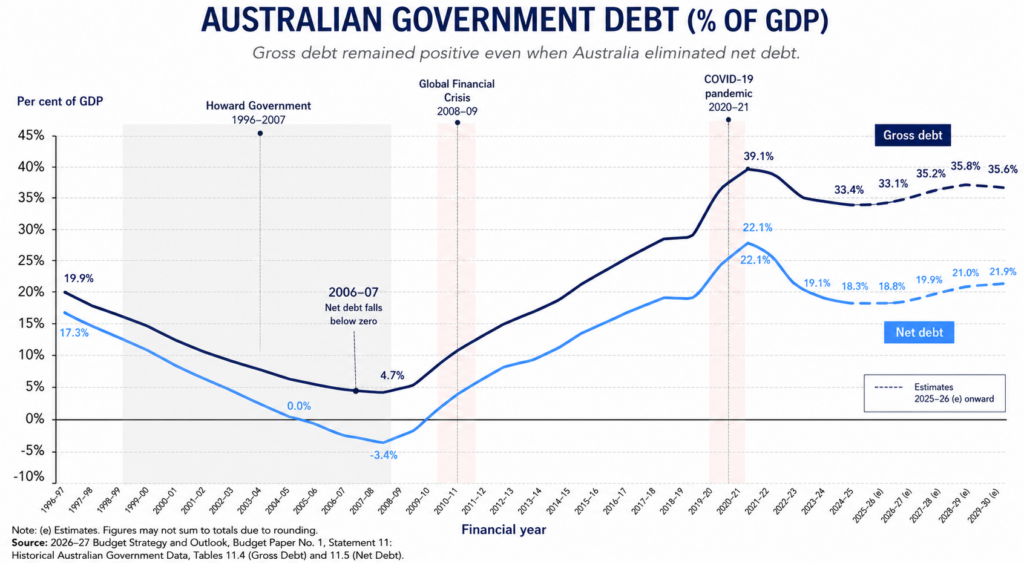
This is probably the most misunderstood part of the story. While the Howard Government eliminated net debt, the Commonwealth still had outstanding AGS’s. Gross debt remained around $55 billion, but government financial assets exceeded those liabilities, resulting in negative net debt.
That distinction matters because it reinforces the central point of this article: governments don’t need to eliminate every dollar of debt to be in a strong fiscal position.
A Much Lower Starting Debt Burden
Reducing debt is far easier when there isn’t much of it to begin with.
In 1996 Australia had less than $100B in net debt from the outgoing Keating Government. As of the end of the last financial year net debt is estimated to be about $550B, meaning the scale of the challenge is fundamentally different before any policy decisions are even made.
Exceptionally Strong Circumstances
The Howard years coincided with one of the most favourable economic periods in Australia’s modern history.
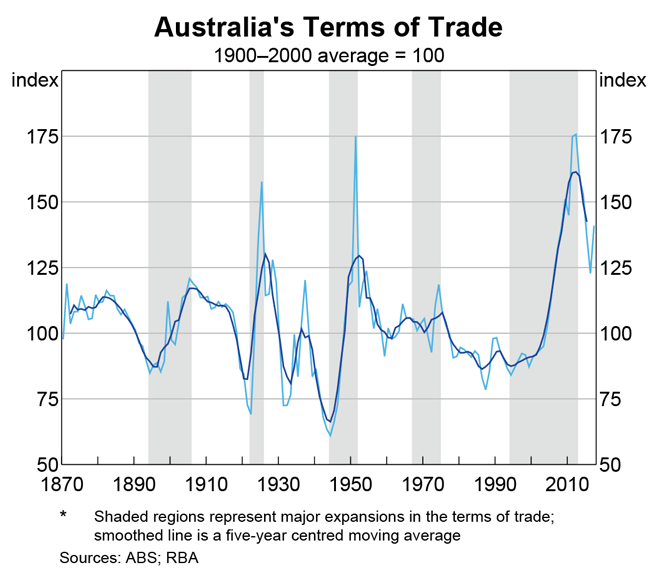
The late 90s benefited from strong global growth following the recovery from the recession and from the dot-com boom. While the early 2000s second half was dominated by China’s rapid industrialisation and a once-in-a-generation mining boom. Record demand for Australian commodities boosted employment, spenidng, wages, investment, company profits and, ultimately, government tax revenue.
Tens of Billions In Privatisation Proceeds
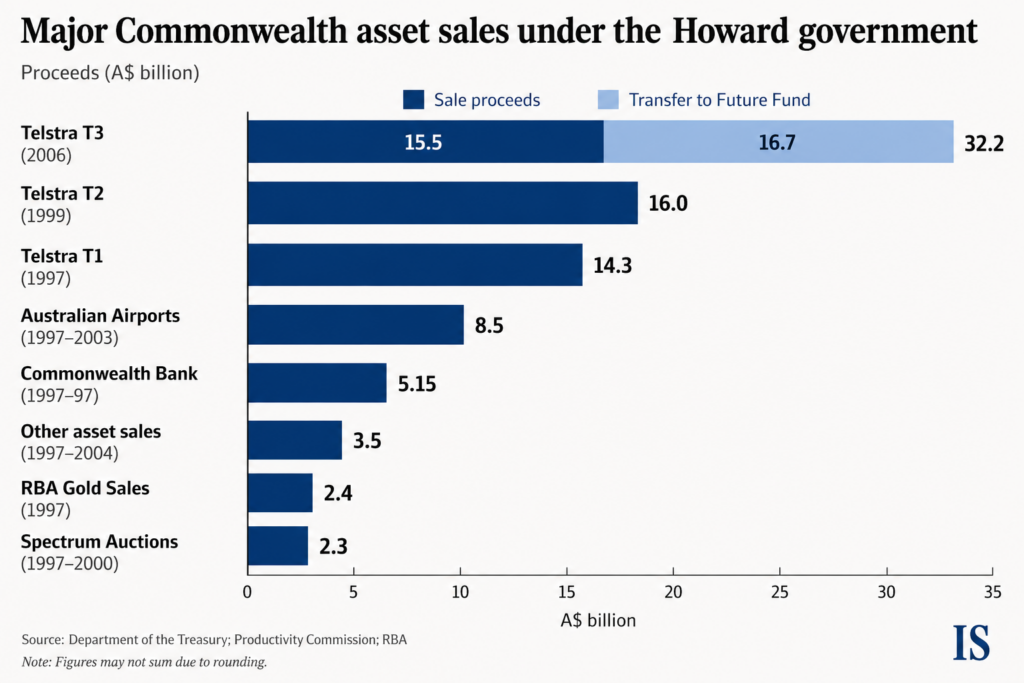
The Commonwealth also benefited from the enormous amounts government assets being sold This included Telstra, federal airports, half of Commbank, the government shipping line ANL, Freightcorp, DASFLEET, RBA gold, Commonwealth Employment Service, telecom and radio spectrum and so on.
These privatisations generated tens of billions of dollars in one-off proceeds that strengthened the government’s headline balance. Unlike tax revenue, however, these were non-recurring. Assets can’t be sold again and can only be sold once meaning we can’t see these proceeds again.
Fewer Structural Spending Pressures
Australia was also a much younger country with 13% of the population over 65 in 2007 while today that is 18%.
The NDIS did not exist, spending on aged care and healthcare was significantly lower, and demographic pressures from an ageing population were far less pronounced than they are today.
As a result, governments had considerably more fiscal capacity to generate sustained budget surpluses through bother higher receipts and lower payments.
Higher Tax Receipts
The tax system was also more favourable to revenue collection.
Income tax rates were generally higher, bracket creep was less constrained by successive tax cuts, and booming employment and commodity prices generated exceptionally strong receipts across multiple revenue sources.
In 2000 the tax wedge was 31%, in 2025 it was under 28%. The Howard Government still remains the highest taxing government in terms of tax reciept-to-GDP ratio at 23.8%.
Government Debt Serves An Important Purpose
Government debt is often viewed simply as a liability that should be minimised as much as possible. However, government bonds also play a vital role in the functioning of financial markets.
AGS’s are widely regarded as the country’s closest equivalent to a risk-free asset. Banks, superannuation funds, insurers and other institutional investors rely on them to preserve capital, satisfy regulatory requirements and manage liquidity. Because they are backed by the Commonwealth, government bonds are among the safest and most liquid investments available in Australia with virtually 0 default risk.
They also underpin much of the broader financial system. Government bond yields serve as the benchmark from which many other borrowing costs are determined, influencing everything from corporate bond issuance to fixed-rate mortgages and bank lending. Their deep and liquid market also provides high-quality collateral that supports lending, repurchase agreements and other wholesale funding markets.
For these reasons, government debt performs functions that extend well beyond financing budget deficits. A complete elimination of Commonwealth Government Securities would reduce the supply of Australia’s primary risk-free asset, remove an important pricing benchmark and diminish liquidity across domestic capital markets.
This does not mean governments should borrow without restraint. Excessive debt can still place pressure on public finances and increase interest costs over time. However, neither is the complete elimination of government debt necessarily desirable. The objective of fiscal policy should not be to remove government bonds from the financial system, but to ensure that borrowing remains affordable, productive and sustainable over the long term.
Is Australia’s Debt Sustainable?
Despite the sharp increase in debt from 2008-2022, Australia’s public finances remain strong by international standards.
The Commonwealth’s net debt is projected to stabilise at around 20–22 per cent of GDP over the coming years, while gross debt is expected to remain in the mid-30 per cent range. Both will peak in 2028-29 before declining before the end of the decade as the budget moves back into balance. Both measures are well below those of many advanced economies, where government debt often exceeds annual economic output such as in the US, Japan and France.
More importantly, investors continue to view AGS’s as among the safest investments in the world with Australia still retaining a triple A rating. Strong demand for Commonwealth bonds allows the government to borrow at relatively low interest rates and refinance existing debt as it matures, reducing the risk of a funding crisis.
This does not mean debt can grow indefinitely. Australia’s ageing population, rising healthcare and defence spending, and persistent structural budget deficits will place increasing pressure on public finances over coming decades. If debt were to grow consistently faster than the economy, interest payments would consume an increasing share of government revenue and reduce fiscal flexibility.
For now, however, Australia’s debt appears sustainable. The challenge facing future governments is not to eliminate debt altogether, but to ensure borrowing remains affordable, supports productive investment where possible, and grows no faster than the economy over the long run.
Australia will never pay off its debt again.
Nor does it need to.
The real test of fiscal responsibility is not whether governments eliminate debt, but whether they can manage it and its growth sustainably, so far the answer is yes.