


For decades, France could afford to postpone difficult decisions about its public finances, that privilege is now disappearing.
French government borrowing costs have surged in recent weeks, with on 10-year bond yields climbing above 4%, levels not seen since the Eurozone debt crisis. 30-year yields have risen even further, approaching 5% as investors demand greater compensation for lending to the French government over longer periods.
France is not alone. Long-term government bond yields have risen across much of the developed world as investors contend with persistent inflation, elevated government borrowing and renewed uncertainty surrounding global energy markets.
But France enters that environment from an unusually vulnerable position.
Public debt has climbed to about 117% of GDP, among the highest levels in the EU, while the government continues to spend considerably more than it collects. France recorded a budget deficit equivalent to 5.1% of GDP in 2025, with the IMF expecting that deficit to widen to 5.2% in 2026.
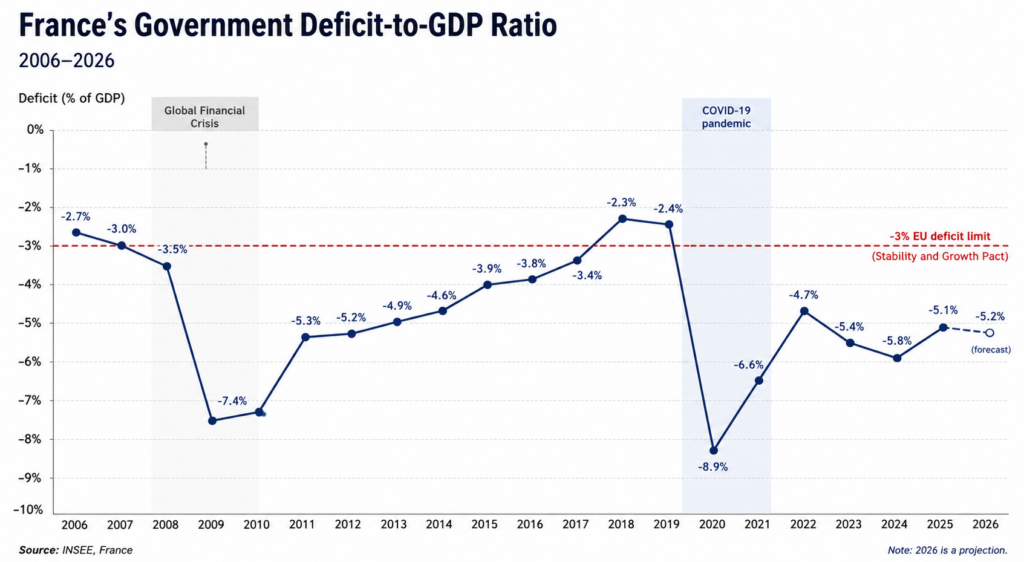
Concerns over France’s fiscal trajectory have also reached the major credit-rating agencies. Fitch downgraded France from AA- to A+ in September 2025, citing rising government debt, persistent deficits and political uncertainty. S&P followed in October, also cutting France to A+, leaving the sovereign at its lowest rating from either agency in decades.
Both currently maintain stable outlooks, but the downgrades underline how France’s deteriorating public finances have begun to affect perceptions of its creditworthiness.
At the same time, economic growth is fading.
The IMF expects the French economy to expand by just 0.6% this year, leaving the government unable to grow its way out and use rising tax revenue as it attempts to stabilise its finances. Higher borrowing costs are simultaneously increasing the amount France must spend to just service the debt it already has.
The result is an increasingly uncomfortable combination: high debt, high and persistent deficits, weak growth and rising interest costs.
None of this means France is about to default. It remains one of Europe’s largest economies, possesses deep capital markets and benefits from membership of the euro area.
But sovereign debt crises rarely begin with governments suddenly becoming unable to borrow.
They begin when investors start questioning whether the trajectory of government finances is sustainable.
And France’s trajectory is becoming increasingly difficult to ignore.
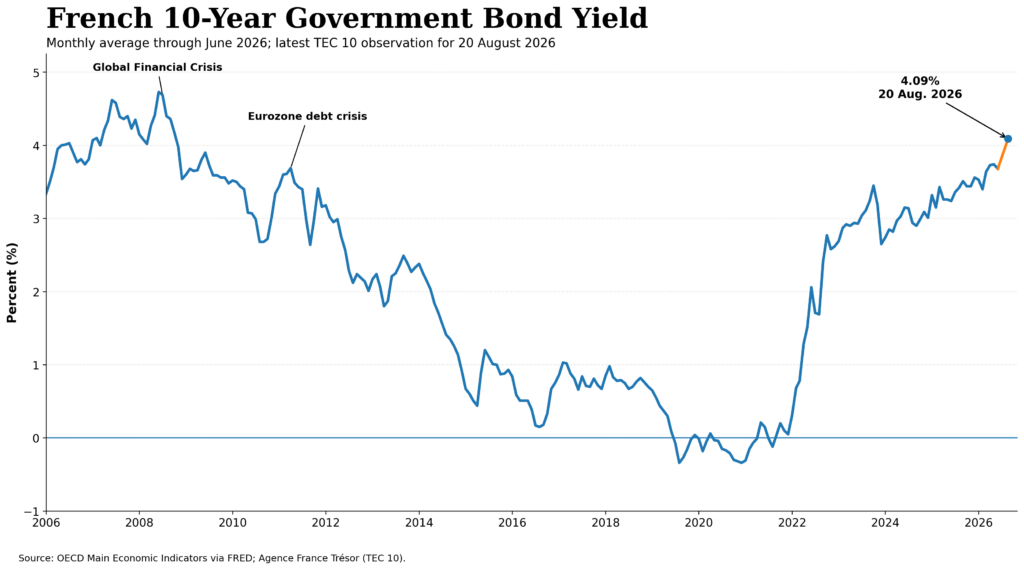
France’s Borrowing Costs Are Surging
The most immediate warning is coming from the bond market.
The yield on France’s benchmark 10-year bond recently climbed above 4%, while 30-year borrowing costs are approaching 5%. These are levels France has not experienced for nearly two decades.
For the government, higher yields eventually translate into higher expenditure to service the debt.
France does not suddenly pay today’s market interest rate across its entire existing debt stock. Much of that debt was issued years ago at considerably lower rates and will retain those rates until maturity. The problem emerges as those bonds mature and must be refinanced.
Debt issued during the era of 0% European interest rates is gradually being replaced with considerably more expensive borrowing as the ECB holds rates at 2.4%.
The effect is already becoming visible.
€77 billion will be spent servicing its debt in 2026, up from €66 billion the year prior. That puts interest expenditure alone close to 3% of annual economic output.
And unlike spending on infrastructure, education or healthcare, higher interest payments provide the government with no additional public services. They simply represent the cost of financing decisions already made.
If yields remain elevated, France will pay increasingly more to refinance its enormous debt stock at today’s higher rates. Especially worrying as the French deficit was over 5% of GDP in 2025 and is expected to widen.
That is where the country’s existing fiscal problems become considerably more difficult to solve.
The Debt Problem
Higher borrowing costs would be easier to absorb if France had healthy public finances. It doesn’t, debt has risen to 117% of GDP, among the highest in the EU and OECD.
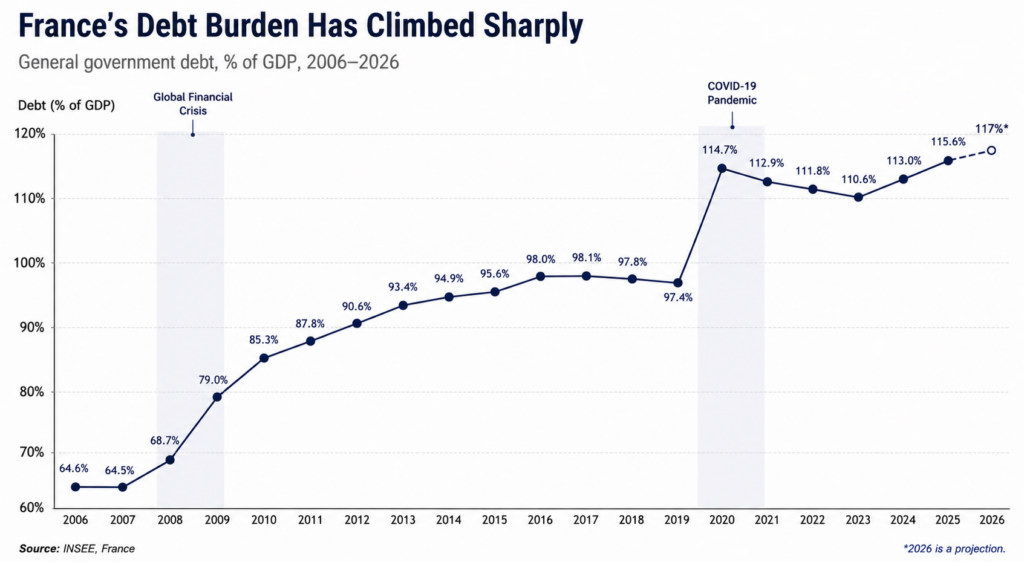
More importantly, France continues to add to that debt through persistent and large deficits.
In 2025, the deficit was 5.1% of GDP. The government hoped to narrow it to 5% this year, but the IMF now expects it to instead widen slightly to 5.2%.
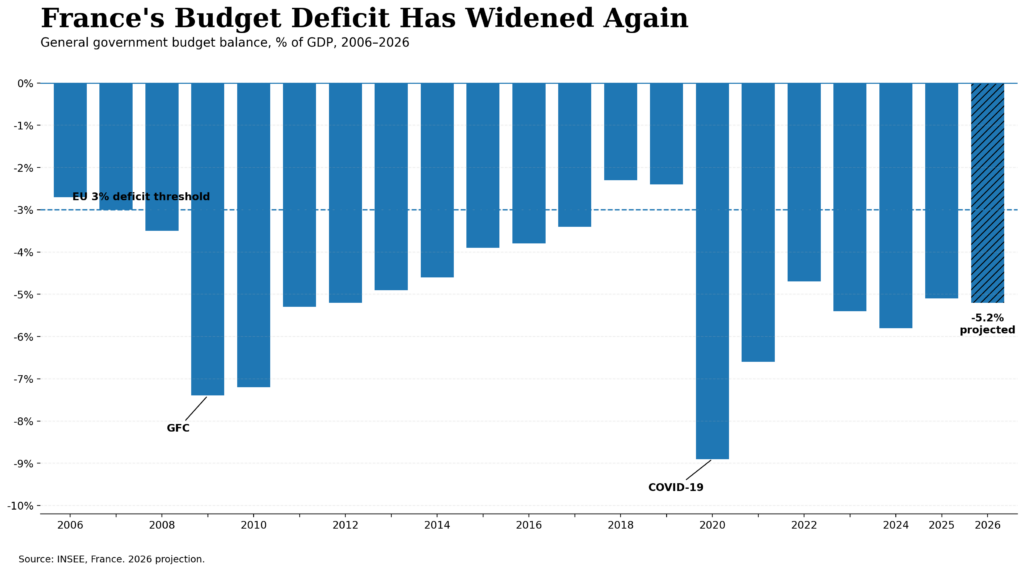
France isn’t simply refinancing a large existing stock of debt at higher interest rates. It also issues new debt to finance the gap between spending and revenue, creating pressure from both directions.
Reducing the deficit has proved politically difficult.
France has one of the highest levels of government expenditure in the world, with significant commitments across pensions, healthcare and welfare. Bringing the deficit materially lower will require spending cuts, higher taxes and stronger growth, none of which currently offers an easy solution.
Attempts at fiscal consolidation have already destabilised governments. With President Macron lacking a parliamentary majority, passing budgets has become increasingly difficult, and previous governments have relied on Article 49.3 of the Constitution to force legislation through without a parliamentary vote.
The approaching 2027 presidential election makes the politics even harder. Spending cuts and tax increases are rarely popular, and politicians across the spectrum have little incentive to champion painful fiscal measures immediately before voters head to the polls.
France therefore faces a problem that is as political as it is fiscal.
The country needs to convince bond markets that its debt trajectory can eventually be stabilised. But many of the measures required to achieve that are precisely the measures its political system is struggling to deliver.
Normally, stronger economic growth could make that adjustment considerably easier, France cannot currently rely on that either.
Growth Isn’t Coming to the Rescue
Politically, the easiest way for France to improve its public finances would be through stronger growth.
A faster-growing economy generates more tax revenue, shrinks debt ratios and allows governments to reduce deficits without relying entirely on politically difficult spending cuts or tax hikes, French growth isn’t there.
The IMF expects the French economy to grow by just 0.6% in 2026, down from 0.8% in 2025 and below the assumptions underpinning the government’s previous fiscal plans. Growth during the first half of the year was already close to stagnant, with GDP contracting 0.1% in Q1, it’s first contraction since the pandemic in Q2 2020 and expanding just 0.2% in Q2.
The labour market is also weak. Unemployment has risen to 8.3%, its highest level since the pandemic, creating another drag on household consumption and government revenues.
External pressures could make the outlook worse.
Renewed disruption to global energy markets following the war with Iran threatens to raise costs for European households and businesses, while France has also been hit by severe heatwaves. One recent analysis estimated that extreme heat could reduce French economic growth by as much as 1.4%.
For France’s public finances, even a modest deterioration matters.
Slower growth generally means weaker tax receipts while simultaneously increasing demand for unemployment benefits and other government support. Unless spending falls elsewhere, that widens the deficit and creates a need for still more borrowing.
This is what makes France’s current position particularly uncomfortable. The government needs stronger growth to make fiscal consolidation easier at precisely the moment economic momentum is weakening.
And if growth cannot solve the problem, the adjustment ultimately has to come from somewhere else.
That means spending cuts, higher taxes or some combination of the two.
Politically, none will be easy.
Could France Face a Debt Crisis?
France is not currently facing a debt crisis.
It remains the euro area’s second-largest economy, has access to deep capital markets and benefits from a financial system considerably stronger than those of the countries at the centre of Europe’s sovereign debt crisis more than a decade ago.
But those advantages do not make its fiscal trajectory sustainable indefinitely.
With public debt at 117% of GDP, a deficit above 5%, economic growth close to stagnation and borrowing costs at their highest levels in nearly two decades, France has increasingly little room for further deterioration.
The immediate danger is therefore not that France suddenly loses access to bond markets. It is that years of weak growth, persistent deficits and higher interest costs gradually make restoring the public finances more painful.
Eventually, something has to change.
France must generate stronger growth, reduce spending, increase revenues or accept an ever-larger debt burden. The longer those decisions are postponed, the greater the adjustment required later becomes.
That leaves France’s political and financial timelines increasingly at odds.
Politicians may prefer to wait until after the 2027 presidential election before confronting the country’s most difficult fiscal decisions.
Bond markets are under no obligation to wait with them.