
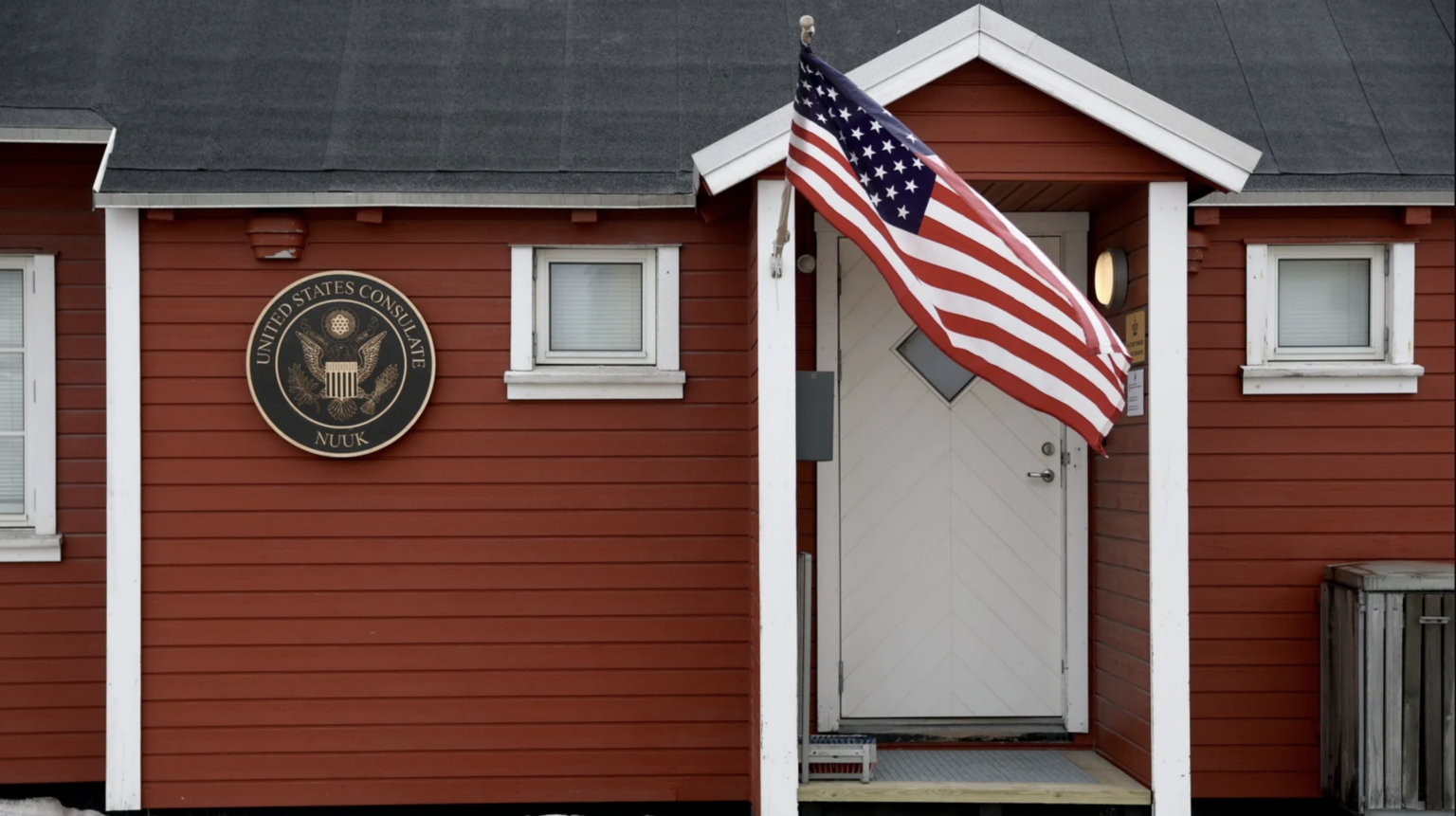
The US consulate building in Nuuk
The US announces additional 10% tariffs on European allies amid Greenland dispute
In a dramatic escalation over the US’s bid over the acquisition of Greenland, US President Donald Trump has announced plans to impose an additional 10% tariff on imports from eight European countries until the US is allowed to wholly purchase the autonomous Danish territory. The move heightens trade tensions with key allies and raises questions over transatlantic relations and the future of NATO.
Denmark, which has sovereignty over Greenland, alongside Norway, Sweden, France, Germany, the Netherlands, Finland and the United Kingdom will face the new 10% tariffs from February 1, 2026 which would rise to 25% from June 1, 2026 “until such time as a Deal is reached for the Complete and Total purchase of Greenland.” Trump said on Truth Social.
EU leaders are set to convene an emergency meeting in the coming days to address the tariff threat, with in-person talks likely by the end of this week, according to an EU official. Discussions will centre on growing indications that Brussels could trigger its Anti-Coercion Instrument with potential retaliatory measures, including the imposition of levies on approximately €93 billion ($US108 billion) worth of US goods.
Trump has sought to justify his calls for a U.S. takeover of Greenland by repeatedly claiming that China and Russia have their own designs on the nation, which holds vast untapped reserves of critical minerals.
Market Implications
The first market impacts are to be felt in Europe itself, as U.S markets will be closed on Monday in observance of the birthday of the late civil-rights leader Dr. Martin Luther King Jr.
Early risk signals from futures markets point to a risk-off reaction, with US equity futures lower late Sunday, while gold and silver prices climbed sharply, reflecting a defensive shift. In equities, the most direct pressure will be targeted at European industrial supply chains and cyclicals/exporters, where tariffs can squeeze margins by imposing higher costs and weaker demand in US markets.
Trump’s tariff policy have already previously roiled US markets, most notably the “Liberation Day” tariffs where the S&P 500 fell by 12% in a single week, recording the 2nd and 3rd largest single-day point declines in its history.
Currency should be treated as a key transmission channel and has already began to reflect some uncertainty. The Euro and Pound have weakened against the US dollar as investors price in slower European growth and the possibility of trade disruption, while safe-haven demand has supported the dollar. These early shifts matter because sustained weakness in currency can tighten financial conditions and reinforce risk-off positioning before any tariffs are even implemented.
However, markets may ignore and brush off these threats as “political noise and gesturing,” according to Richard Steinberg, chief market strategist of Focus Partners Wealth. “I don’t see a scenario where the market thinks we are buying Greenland.” he said in an interview on Saturday, though the White House hasn’t ruled out taking the territory by force.
Economic and Legal Implications
The main macro risk is not just the tariff rate, it’s uncertainty. Shifting tariff headlines and trade policy may delay corporate investment, disrupt planning and supply chains, and widen risk premiums. Global markets have been sensitive to tariff-driven volatility before and investors may again bracing for turbulence.
“To all those who said that investment-stifling tariff uncertainty would wane this year: it’s maybe time to revise your projections,” wrote Scott Lincicome, a trade expert at the Cato Institute, in a message on X.
Finally, there’s a legal overhang: Trump’s latest threat lands while the Supreme Court is still weighing a separate, high-stakes case on the legality of tariffs imposed under the International Emergency Economic Powers Act of 1977. This decision that could influence how markets assess the credibility and durability of tariff policy. Lower courts have found that the president has exceeded his authority under the law, and opponents have said that the statute doesn’t mention tariffs in its text.
The court may rule as soon as Tuesday, the next day opinions could be released. Yet it has in the past saved major rulings until the summertime.
What to Watch Next
- US legal/policy headlines: Supreme Court developments on IEEPA tariffs remain a swing factor for how markets price tariff durability and refund/volatility risk. This ruling may influence how markets assess the credulity of durability of current and future tariffs.
- European markets: watch whether European equities and FX markets underperform or dip, often the cleanest first read on growth-risk pricing. Markets may just brush off the threats.
- EU retaliation clarity: any confirmation around a retaliation list or the Anti-Coercion Instrument would raise the probability of escalation and broaden exposure and effects.
- Safe-haven demand: follow gold/silver. Continued strength signals persistent stress rather than a one-day headline move
- Timeline risk: the hard dates are Feb 1 (additional 10% tariff start) and June 1 (escalation to 25%).