

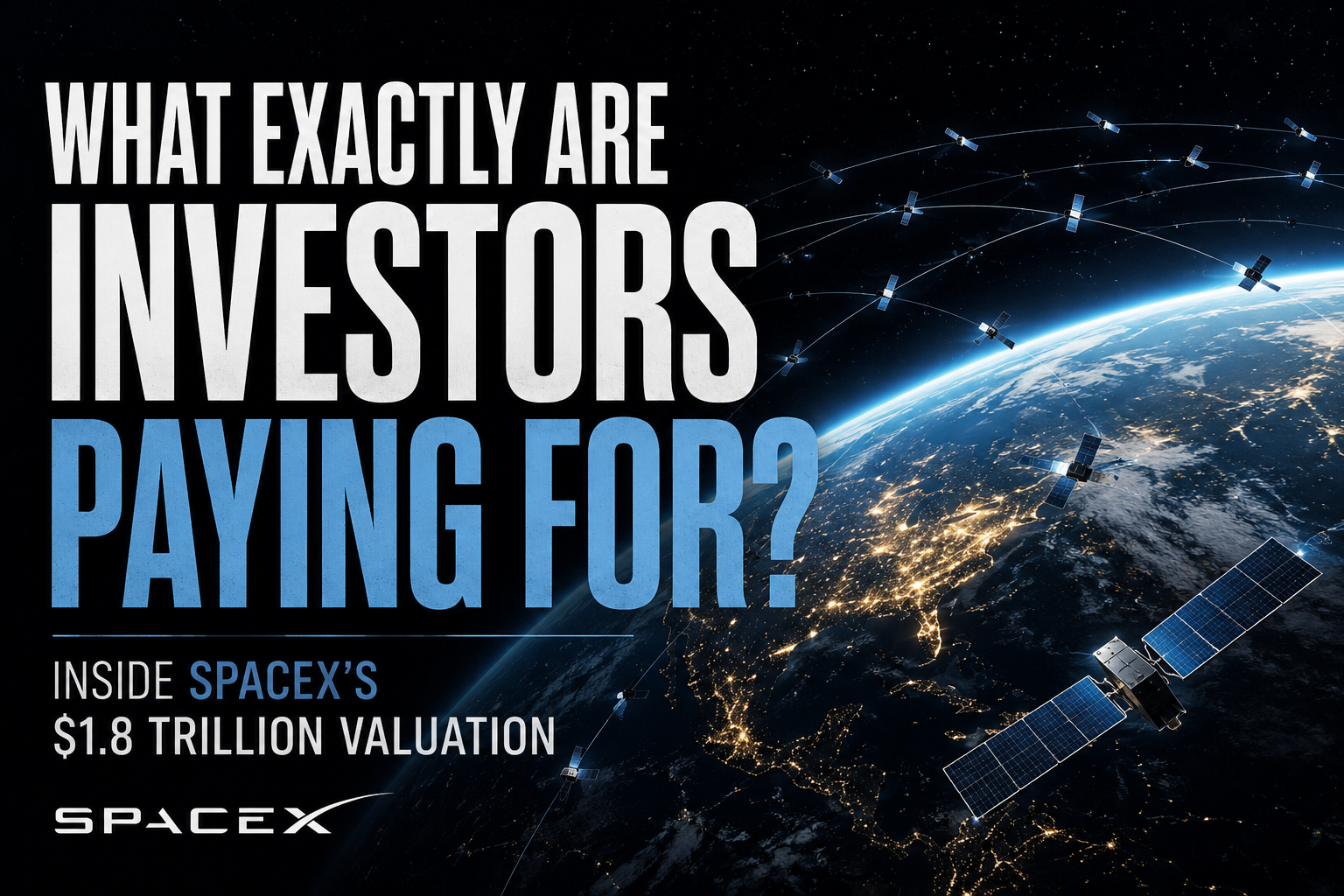
SpaceX public debut has instantly made it one of the most valuable companies in the world.
At a valuation approaching $1.8 trillion, the company now sits alongside some of the largest technology giants in history. Yet unlike many of its peers, SpaceX generates less than $20 billion in annual revenue and remains unprofitable.
That creates an obvious question. What exactly are investors paying for?
Traditional valuation measures offer little comfort. Based on reported revenue, SpaceX trades at a 94x multiple, a number that would make even the most aggressive technology investors pause. Conventional measures of earnings and cash flow are even harder to apply given the enormous sums the company continues to invest in rockets, satellites and launch infrastructure.
Yet investors are buying anyway.
The explanation is that markets are not valuing SpaceX based on what it is today. They are valuing it based on what it could become.
In many ways, purchasing shares of SpaceX isn’t a single investment thesis. It’s a collection of several ambitious bets bundled together under one ticker.
SpaceX Valuation Problem
Valuing SpaceX isn’t simple or straightforward.
At its IPO price, the company is valued at about US$1.8 trillion. Last year, it generated around US$18.7 billion in revenue while reporting billions of dollars in losses as it continued investing heavily in Starship, Starlink and launch and AI infrastructure.
That implies a price-to-sales ratio of roughly 94x revenue.
To put that into perspective, many of the world’s largest technology companies trade at a fraction of that valuation. Even high-growth software businesses rarely sustain such multiples once at a sizeable scale.
The discrepancy highlights a fundamental challenge.
Investors are not paying for SpaceX’s current financial performance. If they were, the valuation would be difficult to justify.
Instead, the market is assigning enormous value to businesses and services that have not yet and may even not fully materialise. Future cash flows, future market dominance and future industries are all being priced into the stock today.
That does not necessarily mean investors are wrong.
History is filled with companies that appeared expensive before growing into their valuations. Amazon spent years looking overvalued to traditional analysts before becoming one of the most valuable businesses in the world.
But it does mean that buying SpaceX requires a different mindset.
Investors are not purchasing a mature aerospace company. They are purchasing a series of ambitious assumptions about the future.
4 Bets Embedded In SpaceX Valuation
Starlink Becomes A Global Telecom Giant
The most important assumption is that Starlink continues its rapid expansion.
Today, the satellite internet business serves millions of customers in over 100 countries. But investors are not valuing Starlink as an internet provider. They are valuing it as a potential global communications platform capable of competing with traditional telecom companies on bigger scale.
If Starlink continues to grow, it could eventually become one of the world’s largest communications networks.
SpaceX Maintains Its Launch Dominance
SpaceX currently dominates the commercial launch market.
Its reusable rocket technology has reduced launch costs and created a competitive advantage that competitors find hard to match. Investors are effectively betting that this advantage remains intact for the future.
The risk is that aerospace has historically been a cyclical and competitive industry. Dominance today does not guarantee dominance tomorrow and forever.
Defence Spending And Government Contracts Accelerates
SpaceX is increasingly becoming a strategic asset.
Governments rely on its launch capabilities, while Starlink has demonstrated its value in military and emergency situations around the world. As geopolitical tensions rise, investors expect defence-related revenues to become a larger part of the business.
In many ways, SpaceX now sits at the intersection of technology, communications and national security.
Starship Creates Entirely New Markets
This is the most uncertain and speculative bet.
Unlike Starlink or launch services, Starship’s future value is difficult to quantify because many of the markets it could enable simply does not exist currently. SpaceX believes dramatically lower launch costs could unlock entirely new industries ranging from space manufacturing to large-scale lunar and extra-planetary infrastructure and colonisation.
Investors are effectively assigning value to opportunities that remain largely theoretical today.
That is both the appeal and the risk of the investment.
Investors Are Buying The Future
Ultimately, the challenge of valuing SpaceX comes down to a simple reality.
Investors are not buying what SpaceX is today, they’re buying the company they believe it could become.
At nearly US$1.8 trillion, the valuation implies far more than a successful launch business. It assumes Starlink continues its rise as a global communications platform, that SpaceX maintains its leadership in space transportation, that defence revenues expand meaningfully and that Starship unlocks entirely new markets that remain difficult to quantify.
That is an extraordinary and generous set of assumptions.
But then again, SpaceX is an extraordinary company.
Few businesses have transformed an industry as dramatically as SpaceX has transformed access to space. Fewer still have managed to build a satellite network, build a monopoly on launch and be defence contractor all at the same time.
The question facing investors is whether that success can continue at a scale large enough to justify one of the most ambitious valuations in modern market history.
If these bets pay off, today’s valuation may eventually look reasonable.
If they do not, investors may discover that even revolutionary companies can become poor investments when expectations move too far ahead of reality.
For now, one thing is clear.
Investors are not simply buying a company.
They are buying a vision of the future.