


Prometheus, the industrial AI startup founded by Jeff Bezos and Vik Bajaj, is reportedly closing one of the largest private funding rounds ever seen in the technology sector, a $12 billion Series B that would value the company at $41 billion. The scale of the raise reflects growing conviction among institutional investors that AI’s next major opportunity lies beyond digital applications and into the physical economy.
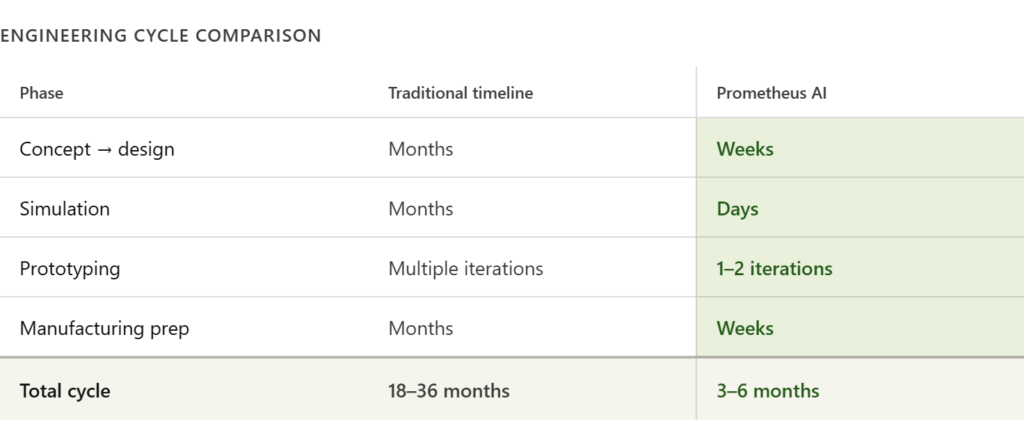
Rather than focusing on generating text, images, or software code, Prometheus is building AI systems designed to accelerate engineering and manufacturing. Its vision is to transform how complex products are conceived, designed, tested, and produced. By dramatically shortening development cycles for everything from aerospace systems to medical technologies, the company aims to reduce processes that traditionally take years into timelines measured in months or even weeks, creating a far faster path from idea to finished product.
A New Category: Industrial AI for Physical Product Acceleration
While much of the AI boom has focused on software, chatbots, and content generation, Prometheus is tackling a different challenge: speeding up the process of designing and building physical products. Engineering projects often face lengthy development cycles due to complex simulations, costly prototypes, repeated testing, regulatory approvals, and manufacturing preparation. Prometheus believes its AI platform can streamline these steps, helping companies move from an initial idea to a production-ready product much faster and at a lower cost. This isn’t a gradual improvement; it’s a step change. If Prometheus achieves even part of its goals, it could transform aerospace, automotive, energy, medical devices, and advanced manufacturing.
The Vision: A Unified AI Stack for the Physical World
Prometheus is developing an end-to-end AI platform designed to support every stage of the engineering process. Its technology can generate and refine product designs, simulate how those designs will perform in the real world, recommend materials and manufacturing methods, and identify potential production challenges before they arise. By combining engineering, simulation, and manufacturing intelligence into a single system, the company aims to streamline the journey from concept to production.
At the heart of Prometheus’ vision is a powerful idea: if AI can accurately understand and model the physical world, innovation in hardware could accelerate dramatically, bringing development timelines closer to the rapid pace seen in software.
Why Investors Are Interested
The calibre of investors backing Prometheus is striking, with support from major institutions including J.P. Morgan, BlackRock, Goldman Sachs, DST Global, ARCH Venture Partners, and Jeff Bezos himself. These firms typically focus on opportunities with significant long-term potential, making their involvement a strong vote of confidence in the company’s vision.
Their investment reflects a broader belief that industrial AI could become one of the next major growth markets. While AI applications in software are becoming increasingly competitive, the use of AI to solve real-world engineering and manufacturing challenges remains largely untapped. Many investors also see hardware development as one of the biggest constraints on future productivity gains, particularly in industries such as energy, aerospace, and healthcare.
Just as importantly, Prometheus combines substantial resources with experienced leadership. Bezos brings a track record of scaling ambitious businesses over decades, while Vik Bajaj contributes deep expertise in science, engineering, and artificial intelligence. Together, they are positioning the company to become a leader in a category that could reshape how physical products are developed and manufactured.
A $41B Valuation: Ambitious or Irrational?
What sets Prometheus apart is that its value proposition isn’t based on growing user numbers or increasing cloud usage. Instead, investors are betting on its ability to fundamentally improve how physical products are designed, tested, and brought to market.
If the company delivers on its vision, the impact could be significant across multiple industries. Aerospace companies could reduce research and development costs by billions, medical device manufacturers could bring new products to patients faster, and clean-energy technologies could be deployed more quickly. The platform could also help accelerate innovation in the automotive sector and support the discovery of entirely new materials and manufacturing techniques.
In many ways, Prometheus is aiming for something much larger than a traditional software business. Its ambition is to become a core piece of the infrastructure that powers the next generation of industrial innovation.

Strategic Implications
Prometheus is aiming to become the AI foundation that powers the next wave of industrial innovation. If its technology can perform reliably at scale, the implications could extend far beyond a single company. One of the biggest opportunities is making advanced engineering more accessible. Smaller businesses and startups could develop sophisticated products that previously required enormous research and development budgets. At the same time, countries that embrace industrial AI may gain a competitive edge by bringing new technologies to market faster and more efficiently than their peers.
The technology could also reshape global manufacturing by reducing the time needed to move from design to production, making it more practical to manufacture products closer to where they are consumed. Perhaps most importantly, it could enable a new generation of AI-native hardware companies, allowing entrepreneurs to build complex products: from robotics and medical devices to engines and energy systems, with significantly lower capital requirements than in the past.
Conclusion
Prometheus’ proposed $12 billion Series B is about far more than raising capital; it reflects growing confidence that AI’s next major opportunity lies in transforming the physical world. Backed by Jeff Bezos, led by AI and engineering expert Vik Bajaj, and supported by some of the world’s largest investment firms, the company is pursuing an ambitious goal: dramatically reducing the time it takes to turn an idea into a real-world product.
If Prometheus can deliver on that vision, the impact could be profound. From aircraft and energy systems to medical technologies and advanced manufacturing, the pace of innovation could accelerate significantly, reshaping how industries design, build, and deploy the products that power modern society.