

US President Donald Trump has claimed on multiple occasions that his tariffs has successfully reduced the US’s trade deficit. Claiming at Davos that he shrunk the monthly trade deficit by a staggering 77% with no inflation. But has Trump really slashed the deficit by that much? And should it be credited to tariffs?
Have the trade deficits fallen by 77%?
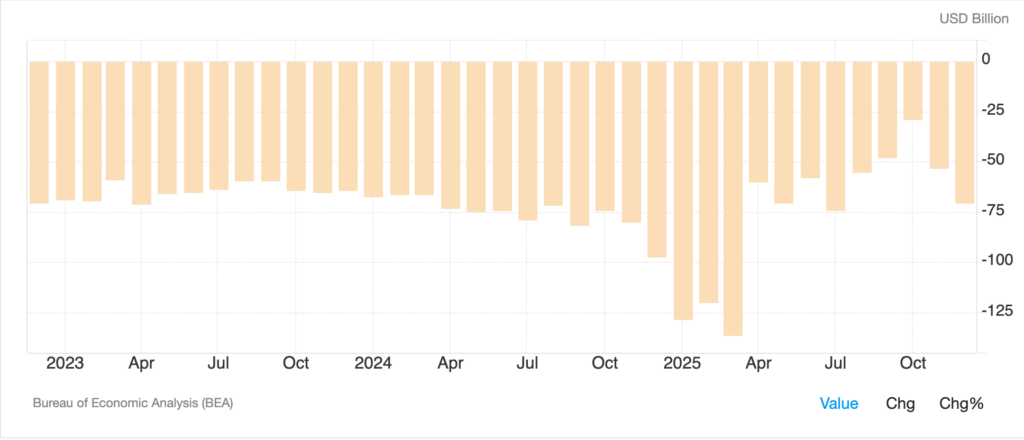
Yes but context matters. The 77% figure comes from comparing the trade deficit in October 2025 to January 2025. Though the October 2025 deficit was the smallest since 2009, this figure is misleading for a few reasons. First, using year-to-date to measure changes in the deficit in unusual because trade has a seasonal factor to them. Thus, it’s more accurate and common to measure them on a month-to-moth basis, where it fell by 40% from September to October 2025 or a year-to-year basis where it fell 61%. So in terms of raw numbers yes the trade deficit did fall.
Source: Trading Economics
Was the fall due to tariffs?
Not really, Octobers smaller deficit were largely due two main goods, gold and pharmaceuticals which aren’t tariffed. Excluding them, the October deficit grew from the September one. This is as imports of goods including those two, surged in the first three months of 2025 because people thought they would be subject to tariffs. This made companies front-load them but since then it became evident that Trump isn’t going to tariff those goods which is why their exports surged in October. This is why the first three months of 2025 saw record deficits, increasing by 138% from October 2024 (the month before Trump won the elections and thus tariff policy became more probable) and to March 2025 and a staggering 238% increase from March 2024.
Another large part of the decline in monthly trade deficits is because companies started using the stockpiles they stocked up. When accounting for that the trade deficit fell by just 0.2% from 2024 to 2025. While the goods deficit hit a record high increasing 2.4% from 2024.
Why have MoM Deficits Fallen?
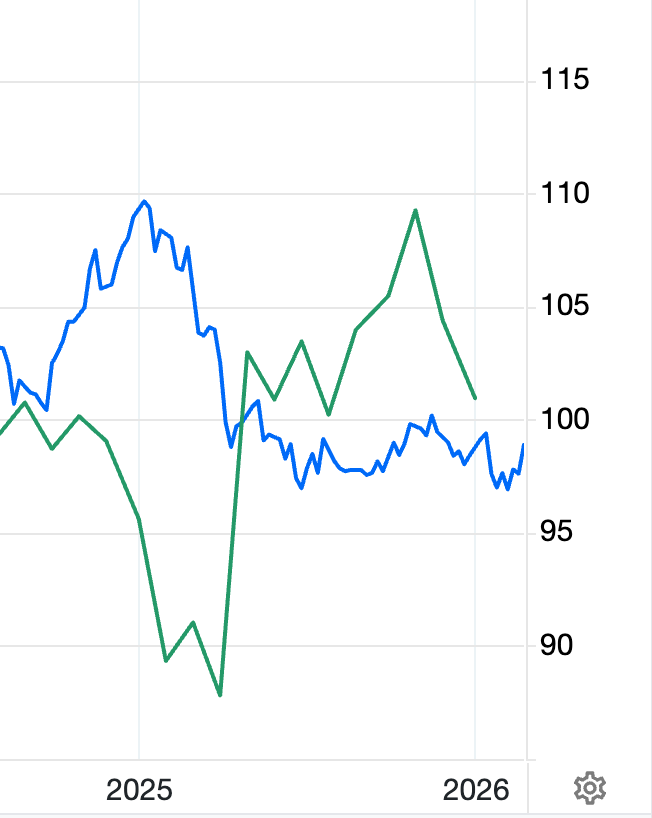
Though in part due to the previously mentioned stockpiling, another reason is the US Dollar. A weaker dollar decreases the deficit as imports become more expensive and exports more competitive. Which is why when the dollar strengthens like it did in deficits widened and when it weakened it narrowed. The dollars faltering appeal as a safe haven as a result of Trump’s unorthodox and volatile economic policies and his assault on the sovereignty of the Fed.
US Dollar vs US Trade Balance Source: Trading Economics
Though advocates spoke of a manufacturing revival manufacturing employment continued to fall in 2025.
What Now?
Though a longer period is needed to fully assess the impact, the Supreme Court ruled against Trump’s tariffs, saying he did not have the legal authority to impose them using emergency powers under the IEEPA. Though tariffs through other measures are still in place, tariffs are expected to wind down and wild swings of surprise tariffs like we saw in the Greenland episode are less likely.
But so far, tariffs have not meaningfully decreased the deficit, brought back manufacturing or raised nearly enough revenue to abolish federal income tax.