


Budget season always produces big numbers.
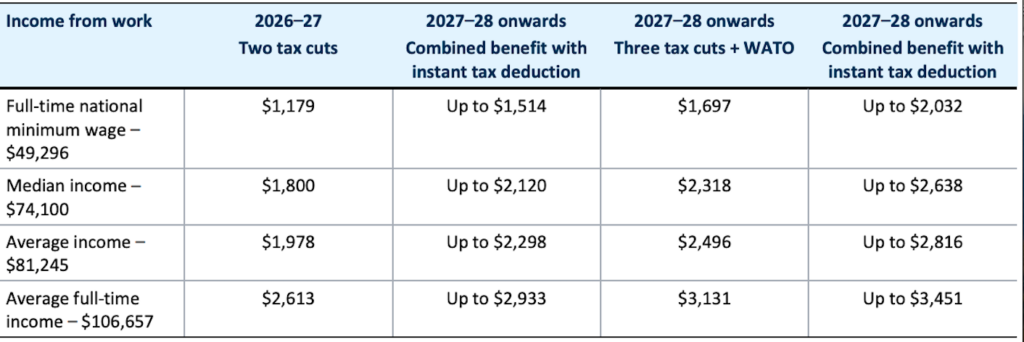
This year, one of the most widely repeated is the claim that the average Australian worker will be roughly $2,800 better off.
But before accepting the headline, it is worth asking a simple question:
Where does the number come from, and how much of it would actually end up in the average Australian’s pocket?
Source: budget.gov.au
Where Does The Number Come From?
The figure comes from the combined impact of tax cuts and tax-related relief measures announced by the government.
Rather than a single direct payment, the widely cited number is the result of adding together several separate policies designed to reduce the average worker’s tax burden.
On paper, that can produce a figure approaching $2,800.
But whether an individual Australian actually receives that full benefit depends entirely on their circumstances.
The Breakdown
The headline figure is based on an Australian worker earning the average wage of $81,245. Rather than a single payment, it combines five separate tax cuts and tax-related measures. These are:
- Stage 3 tax cuts starting in FY2024
- Cutting the bottom marginal rate from 16% to 15% starting FY2026
- $1000 instant tax deduction starting FY2026
- Another tax cut to the bottom marginal rate from 15% to 14% starting FY2027
- $250 Working Australian Tax Offset (WATO) starting FY2027.
Stage 3 Tax Cuts
Originally legislated under the Morrison Government to commence in FY2024, it was revised under the Albanese Government in 2024 to reshape the distribution of tax relief toward lower and middle-income earners.
The tax cuts made 4 changes:
- Reduced the 19% tax rate to 16%.
- Reduced the 32.5% tax rate to 30%.
- Increased the threshold above which the 37% tax rate applies from $120,000 to $135,000.
- Increased the threshold above which the 45% tax rate applies from $180,000 to $190,000.
| Pre-Stage Three (FY2023-24) | Morrison Stage 3 Tax cuts | Albanese Stage 3 Tax Cuts |
| Threshold ($) | Rate (%) | Threshold ($) | Rate (%) | Threshold($) | Rate (%) |
| 0 – 18,200 | 0% | 0 – 18,200 | 0% | 0 – 18,200 | 0% |
| 18,201 – 45,000 | 19% | 18,201 – 45,000 | 19% | 18,201 – 45,000 | 16% |
| 45,001 – 120,000 | 32.5% | 45,001 – 200,000 | 30% | 45,001 – 135,000 | 30% |
| 120,001 – 180,000 | 37% | Abolished | 37% | 135,001 – 190,000 | 37% |
| 180,001+ | 45% | 200,001+ | 45% | 190,001+ | 45% |
On an income of $81,245, this provides a net tax cut of $1710 p.a.
Income Tax Cuts
In addition to the existing Stage 3 changes, the government has announced further reductions to the bottom marginal tax rate. These are:
- Reducing the 16% tax rate to 15% in FY2026
- Reducing the 15 tax rates to 14% in FY2027.
For workers, this means a progressively lower tax burden on income within the lower tax bracket, giving a net tax cut of $536 p.a.
Instant Tax Deduction
From FY2026, eligible workers will be able to claim an instant tax deduction of $1,000 for work-related expenses without needing to keep receipts.
At first glance, this sounds like a $1,000 payment but it’s not.
A tax deduction reduces taxable income, not tax payable dollar-for-dollar.
So for a worker earning the average wage, they sit in the 30% tax bracket and pay a 2% medicare levy.
That means a $1,000 deduction reduces tax by $320 p.a, not $1,000.
Crucially, this is not an extra $1,000 on top of existing deductions.
Workers must choose between claiming the instant deduction or claiming their actual work-related expenses.
For Australians who already claim more than $1,000 in deductions, the policy provides no additional benefit whatsoever.
Working Australian Tax Offset
The WATO is a new permanent annual tax offset beginning in FY2027.
Unlike a tax deduction, which reduces taxable income, a tax offset directly reduces the amount of tax payable dollar-for-dollar.
This means an eligible worker receiving the full offset would receive the full $250 tax benefit, rather than a smaller effective saving determined by their marginal tax rate.
Crucially, the offset applies only to income earned from work, not all Australians universally and is expected to benefit more than 13 million Australian workers, with 97% receiving the full amount.
Verdict
The claim is technically true but requires important context.
The widely cited $2,800 figure is achievable for a working Australian earning the average wage under the government’s assumptions, most importantly that you don’t already claim tax deductions at the end of the financial year.
It is not a direct payment, not delivered in a single budget year, not immediate cash, and not a benefit that applies equally to every Australian.
The figure combines existing tax cuts, future tax cuts, an offset, and an optional deduction mechanism across 3 financial years from FY2024 to FY2027.
Verdict: Mostly true, but potentially misleading in how it is commonly presented and under what assumptions.
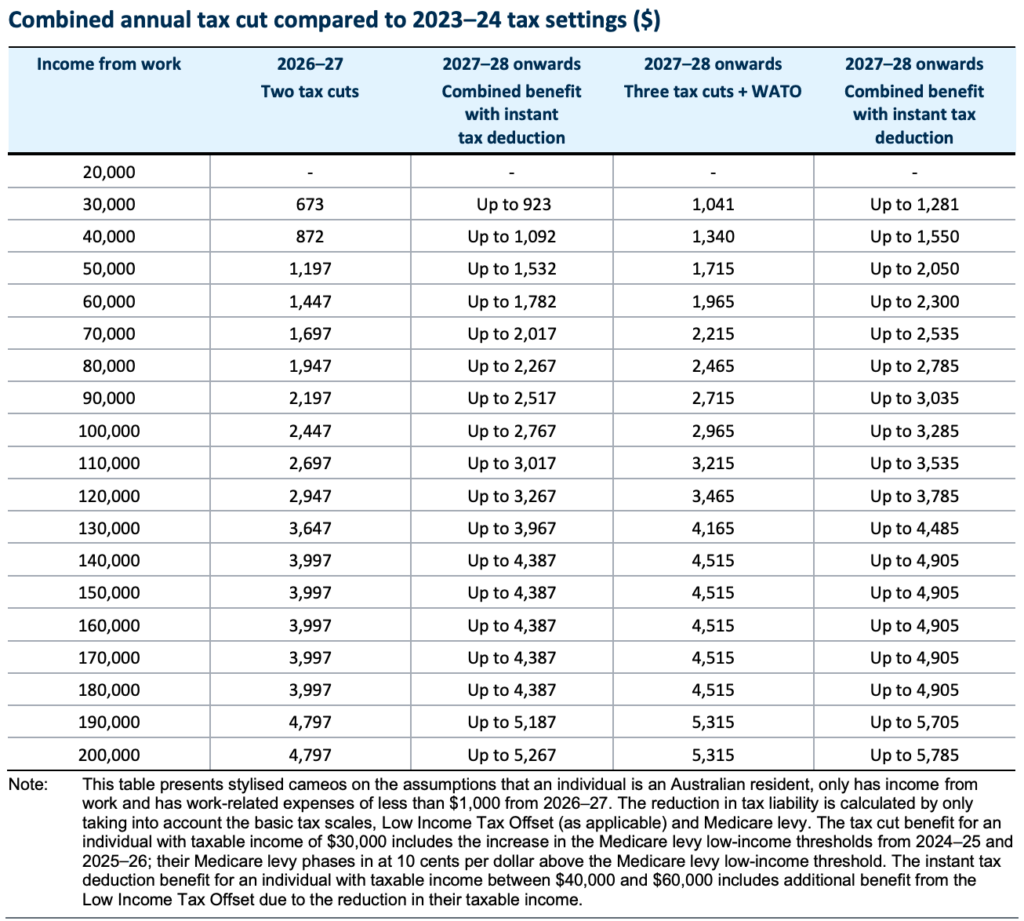
How Much Better Off Will You Be?
Source: budget.gov.au