

KPMG is once again under intense scrutiny.
The consulting and audit giant is facing allegations that confidential client information was misused, whistleblower concerns weren’t adequately investigated, and parliamentary inquiries may have been misled. This scandal has already claimed the firm’s CEO and prompted calls for KPMG to be barred from government contracts.
For many, the story may feel familiar.
Just a few years ago, PwC found itself engulfed in a scandal involving the misuse of confidential government tax information.
The scandal’s fallout was severe, the firm’s government consulting business was ultimately sold for just $1, and PwC since has been mostly absent from federal government work.
The similarities raise an uncomfortable question: why do scandals seem to repeatedly emerge from the world’s largest professional services firms?
KPMG: The Trust Business
At their core, the Big 4 firms, KPMG, PwC, Deloitte and EY, sell trust.
Their auditors verify company accounts. Consultants advise governments and corporations on strategy. Tax specialists provide guidance on complex regulations. Transaction team advises on complex M&A deals. Their reports influence investors, boards and policymakers.
The value of these firms doesn’t come from factories, patents or natural resources. It comes from reputation and trust.
That is what makes recurring scandals particularly damaging. When trust is the product, credibility is the asset.
KPMG: Growing Conflict Problem
The challenge is that modern professional services firms have become extraordinarily complex organisations.
A single firm may simultaneously audit a company, advise another company in the same industry, consult to government departments and compete for lucrative contracts across both the public and private sector.
While strict internal controls are designed to prevent conflicts of interest, the massive size of these organisations creates risks.
The KPMG allegations have once again brought those risks into public view.
Whether the specific allegations are ultimately proven or not, the controversy highlights a broader concern: can firms of this size effectively manage the competing interests that exist within their businesses?
From Big 8 To The Big 4
Regulators face a difficult balancing act.
Once, accounting used to be dominated by the “Big 8.” Through a series of mergers as well as previous scandals in the case of Arthur Andersen, that number eventually fell to 4.
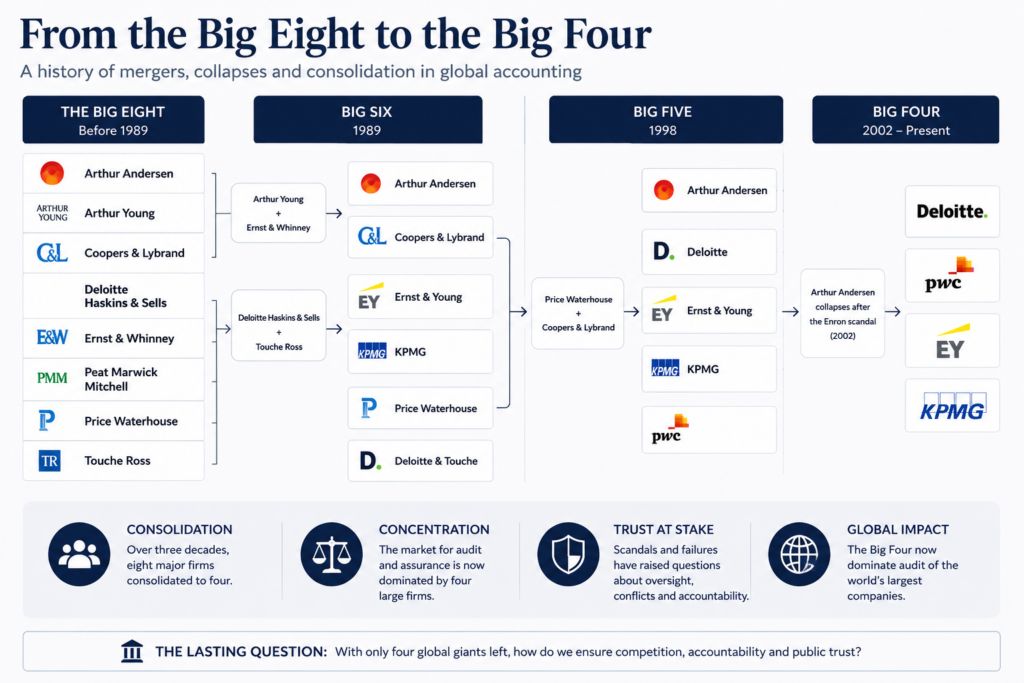
Today, KPMG, PwC, Deloitte and EY dominate large-scale auditing and consulting across much of the developed world.
Governments want accountability and competition. However, excluding one of the major firms from important work risks reducing competition even further.
The result is a market where regulators often have limited alternatives, even when serious concerns emerge.
Are The Rules Still Fit For Purpose?
The latest controversy has reignited debate about whether large partnerships should be facing more regulation and oversight.
Though some smaller competitors exist such as BDO and RSM, the concentration of the Big 4 creates an unusual problem.
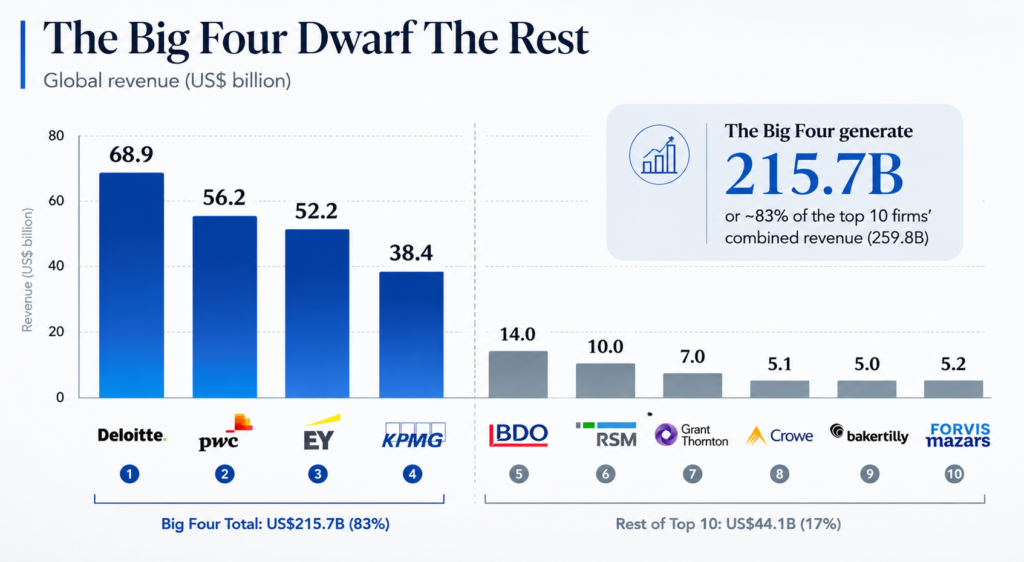
The Big 4 operate as a partnership and unlike public companies, partnerships operate under a different governance structure. Critics argue that this framework has struggled to keep pace with the size, complexity and influence of modern professional services firms.
Parliamentary inquiries have already recommended reforms, including stronger oversight and increased accountability.
Supporters argue that the vast majority of professionals working within these firms uphold high standards and that isolated failures should not justify sweeping changes.
Critics counter that the frequency of scandals suggests the problem may be more systemic.
More Than A KPMG Story
The immediate focus will remain on KPMG and the ongoing investigations.
But the broader issue extends well beyond a single firm.
Australia’s financial system relies heavily on trust in these firms, in auditors, in consultants and in professional advisers. Investors trust audit opinions. Governments trust external advice. Companies trust consultants with sensitive information.
When that trust is time and time again called into question or diluted from scandal, confidence in the entire system begins to weaken.
The real question is no longer whether another scandal will emerge.
It is whether the regulatory framework governing the Big 4 has evolved quickly enough to prevent the next one.