

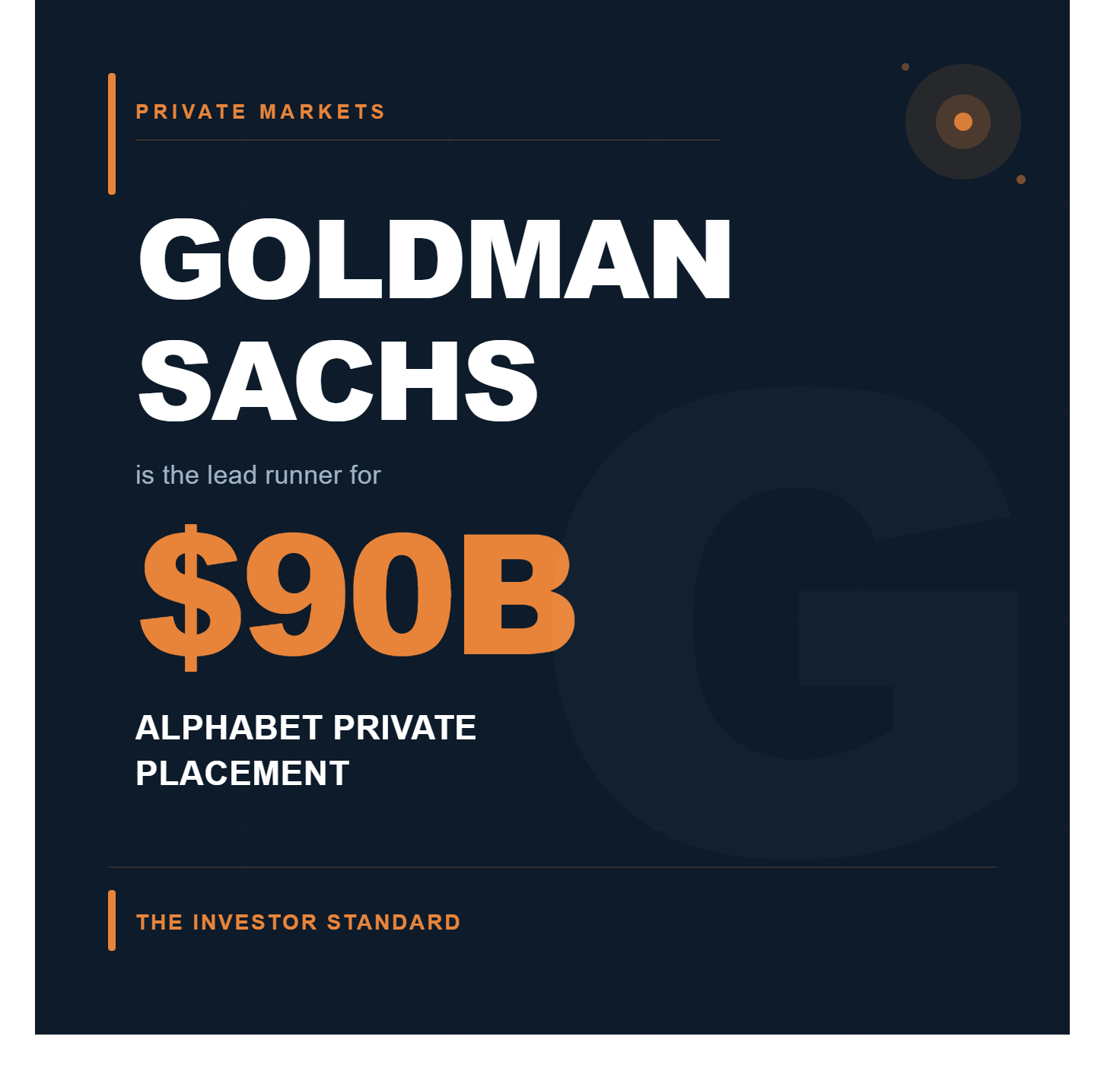
A Historic Capital Raise in the AI Infrastructure Race
On June 2, Alphabet unveiled one of the largest capital-raising initiatives ever undertaken by a corporate issuer, announcing a $90 billion equity and equity-linked financing package to accelerate the expansion of its AI infrastructure. The sheer scale of the raise highlights the increasingly intense competition for AI computing capacity, as major technology companies commit record levels of capital to secure advanced GPUs, expand data-centre networks, and develop the next generation of AI-powered cloud services.
- A Historic Capital Raise in the AI Infrastructure Race
- Goldman Sachs as Left Lead Bookrunner and Syndicate Trading Manager
- Sole Private Placement Agent on the Transaction
- Strategic Rationale Behind Alphabet’s Capital Raise
- Accelerating AI Compute Build‑Out
- Strengthening Google Cloud’s Competitive Edge
- Maintaining Strategic Optionality
- A Defining Transaction for the AI Era
The move also reflects a notable strategic shift for Alphabet. Instead of relying exclusively on its substantial internal cash generation, the company has chosen to access external capital markets to accelerate investment in high-performance computing clusters, next-generation networking infrastructure, and more energy-efficient data centres. As demand for AI applications continues to surge, Alphabet is positioning itself to support growing requirements from enterprise customers, software developers, and its own expanding suite of AI-driven products and services.
Goldman Sachs as Left Lead Bookrunner and Syndicate Trading Manager
Goldman Sachs played a central role in the transaction, acting as both left lead bookrunner and syndicate trading manager on what is likely to be one of the most significant capital markets deals of the decade. Securing the lead position on a financing of this scale reflects the firm’s deep relationship with Alphabet and its prominent standing in global equity capital markets.
In its capacity as left lead bookrunner, Goldman Sachs was responsible for structuring the multi-tranche offering, coordinating marketing efforts with institutional investors worldwide, managing the order book and price discovery process, and overseeing the allocation of securities to investors. The firm also led communication and execution across the underwriting syndicate to ensure the transaction was completed efficiently.
Its additional role as syndicate trading manager further underscored its importance to the deal, with responsibilities extending beyond the initial issuance to include supporting aftermarket liquidity, maintaining orderly trading conditions, and facilitating a smooth transition from the primary offering to the secondary market.
Sole Private Placement Agent on the Transaction
Alongside the public equity and equity-linked offering, Alphabet also completed a concurrent private placement, with Goldman Sachs serving as the sole placement agent. This private tranche enabled the company to tap into substantial pools of long-term capital from sovereign wealth funds, pension funds, and other large institutional investors looking to gain exposure to the rapidly expanding AI infrastructure sector.
As sole placement agent, Goldman Sachs was responsible for structuring the private transaction, negotiating terms with key cornerstone investors, overseeing confidential due diligence processes, and coordinating the documentation and settlement of the deal. The combination of these roles while leading the public capital raise while exclusively managing the private placement highlights Goldman Sachs’ ability to deliver integrated financing solutions across both public and private markets, particularly on transactions of exceptional scale and strategic importance.
Strategic Rationale Behind Alphabet’s Capital Raise
Accelerating AI Compute Build‑Out
As AI models continue to grow in scale, sophistication, and computational requirements, Alphabet is significantly expanding its infrastructure investments. The company is directing capital toward next-generation TPU clusters, advanced high-bandwidth networking systems, liquid-cooled data centres, and renewable energy-powered hyperscale campuses designed to support the rising demands of AI workloads.
Strengthening Google Cloud’s Competitive Edge
As competition among cloud providers intensifies, the ability to deliver powerful AI training and inference capabilities has become a key differentiator. Alphabet’s capital raise is intended to strengthen its position in this race by supporting broader enterprise AI adoption, expanding the Vertex AI platform, deepening partnerships with model developers, and scaling the infrastructure required to power Gemini and future generations of AI models.
Maintaining Strategic Optionality
By raising external capital, Alphabet preserves balance‑sheet flexibility while retaining the ability to pursue acquisitions, expand global infrastructure, and respond to competitive pressures from Microsoft, Amazon, and emerging AI infrastructure players.
A Defining Transaction for the AI Era
Alphabet’s $90 billion capital raise is far more than a funding exercise—it is a clear declaration of the company’s ambitions in the AI era. The transaction underscores the enormous capital commitments required to remain competitive in artificial intelligence and demonstrates how critical capital markets have become in financing the next wave of technological innovation.
For Goldman Sachs, the mandate marks a significant achievement. By serving as left lead bookrunner, syndicate trading manager, and sole placement agent for the private tranche, the firm played a pivotal role across every stage of the transaction. The assignment further strengthens Goldman Sachs’ reputation as a leading advisor and execution partner on some of the world’s largest and most strategically important capital markets deals, particularly within fast-evolving technology sectors.