
For much of the past few years, investing in Big Tech has been remarkably straightforward.
AI became the market’s dominant investment theme, and investors largely rewarded the companies spending the most on AI infrastructure. Whether it was Microsoft, Amazon, Alphabet or Meta, the assumption was largely the same: today’s enormous investment would become tomorrow’s competitive advantage.
Last week’s earnings season suggested that narrative may be beginning to fracture.
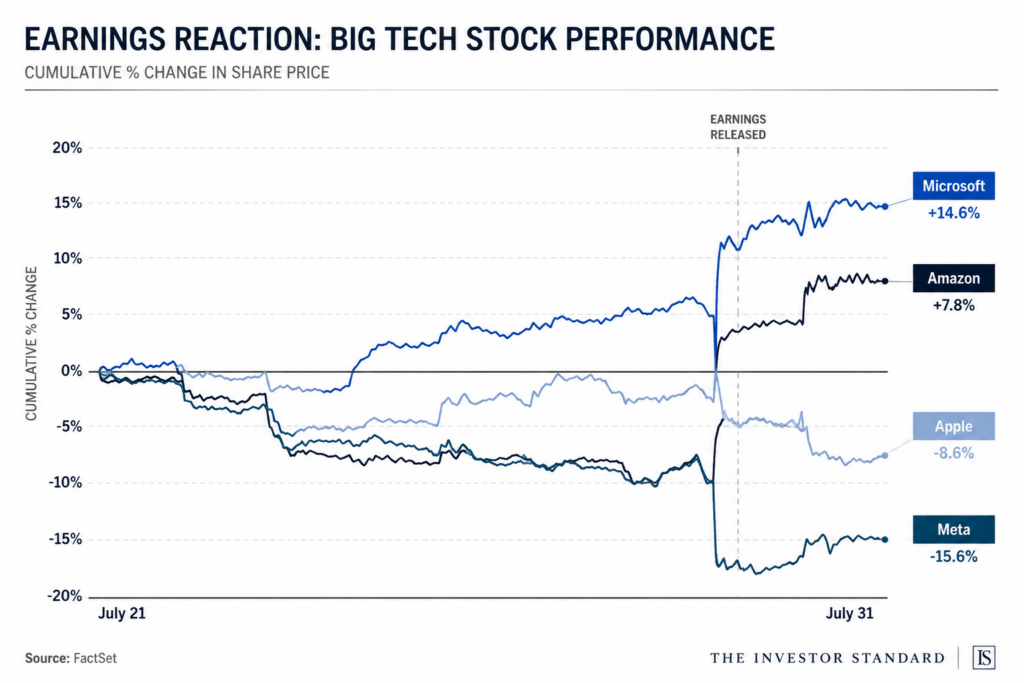
While Microsoft and Amazon surged following strong results, Apple and Meta saw sharp declines after reports disappointed investors. The contrasting reactions indicate that Wall Street is becoming increasingly selective, rewarding companies that can demonstrate tangible returns from their AI investments while becoming less forgiving of those that cannot.
One Industry, Four Very Different Stories
Rather than moving in lockstep, the world’s largest tech companies delivered dramatically different outcomes.
Microsoft’s shares surged after the company reported another quarter of strong Azure growth, adding hundreds of billions of dollars to its market value in a single trading session. Amazon also rallied after its cloud business continued to expand, reinforcing confidence that years of heavy investment in AI infrastructure are beginning to translate into stronger earnings.
The reaction was markedly different elsewhere.
Meta fell sharply after warning that free cash flow could turn negative as AI-related capital expenditure continues to climb, raising questions about how quickly those investments will generate financial returns. Apple also suffered its largest single-day decline in months after disappointing guidance overshadowed continued demand for its products.
Only a year ago, these companies were often treated as one broad AI trade. Last week suggested investors are beginning to judge them on far more than simply how much they spend.
Investors Are Demanding Results
For much of the AI boom, investors were willing to overlook soaring capital expenditure so long as companies continued expanding their AI capabilities. The prevailing belief was that investment today would eventually lead to greater earnings in the future.
That mindset now appears to be changing.
Microsoft’s results reinforced confidence that its enormous AI spending is supporting one of the fastest-growing cloud businesses in the world. Strong Azure growth suggested the company is beginning to generate tangible returns from its investment, helping justify the billions it has committed to expanding AI infrastructure.
Meta, by contrast, delivered a different message. While revenue growth remained strong, management warned that capital expenditure would continue climbing and that free cash flow could turn negative as investment accelerates. Rather than questioning the company’s long-term AI ambitions, investors appeared more concerned with how long those investments might take to generate meaningful returns.
The contrasting reactions highlight an important shift in investor thinking. Spending heavily on AI is no longer enough on its own. Markets increasingly want evidence that those investments are translating into stronger earnings, higher cash flows and a clearer path to long-term shareholder value.
Rising Bond Yields Are Raising The Bar
Technology earnings were not the only force driving markets last week.
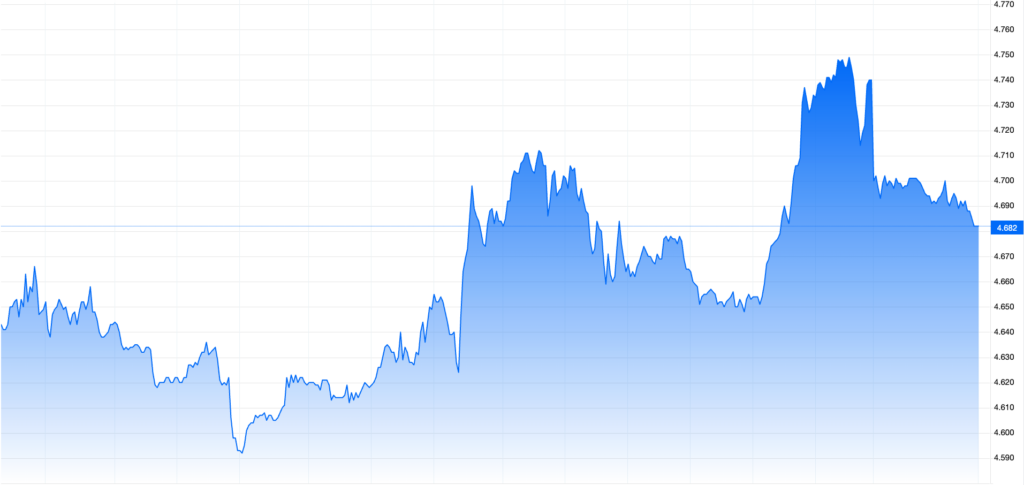
Following the Fed’s latest meeting, Treasury yields climbed sharply as investors reassessed the outlook for interest rates. The yield on the 10-year Treasury reached its highest level since October 2023, signalling that financial conditions may remain tighter for longer.
At first glance, bond yields and technology stocks appear unrelated. In reality, they are closely connected.
Higher bond yields increase the return investors can earn from relatively low-risk government debt. As those returns become more attractive, investors demand higher expected returns from equities particularly high-growth companies whose valuations rely heavily on profits expected many years into the future.
Higher bond yields also raises borrowing costs. For companies such as Meta, which may increasingly rely on debt as AI investment outpaces free cash flow and it turns negative, that makes financing future expansion more expensive.
Source: Trading Economics
That raises the hurdle for technology companies. Strong revenue growth and ambitious AI investment are no longer sufficient on their own. Investors increasingly expect evidence that today’s spending will translate into higher earnings and stronger cash flows within a reasonable timeframe.
In that environment, the market has become far less forgiving. Companies that exceed expectations continue to be rewarded handsomely, while even modest disappointments can result in sharp share-price declines.
The AI Trade Is Maturing
AI remains one of the most significant technological opportunities of the century, and few investors doubt that the world’s largest technology companies will continue spending heavily to secure their place in that future.
What appears to be changing is the market’s willingness to reward that spending unconditionally.
Last week’s earnings season demonstrated that investors are becoming more selective, placing greater emphasis on execution, profitability and the ability to convert enormous capital investment into sustainable financial returns. Companies that can demonstrate tangible benefits from their AI spending continue to be rewarded, while those asking investors for more time and more capital are facing increasing scrutiny.
That shift is both healthy and inevitable. Financial markets ultimately exist to allocate capital efficiently, and even the most transformative technologies must eventually justify the investment they require.
For much of the AI boom, owning Big Tech meant buying a single narrative.
Increasingly, it means choosing between very different businesses.