

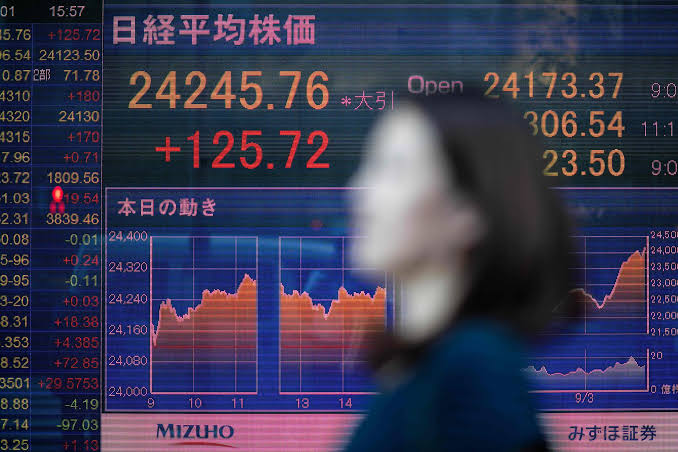
For decades, the yen was regarded as one of the world’s safest currencies. During periods of economic uncertainty, investors often flocked to the yen, viewing the currency as stable backed by a country strong institutions and deep financial markets.
Today, the picture looks very different.
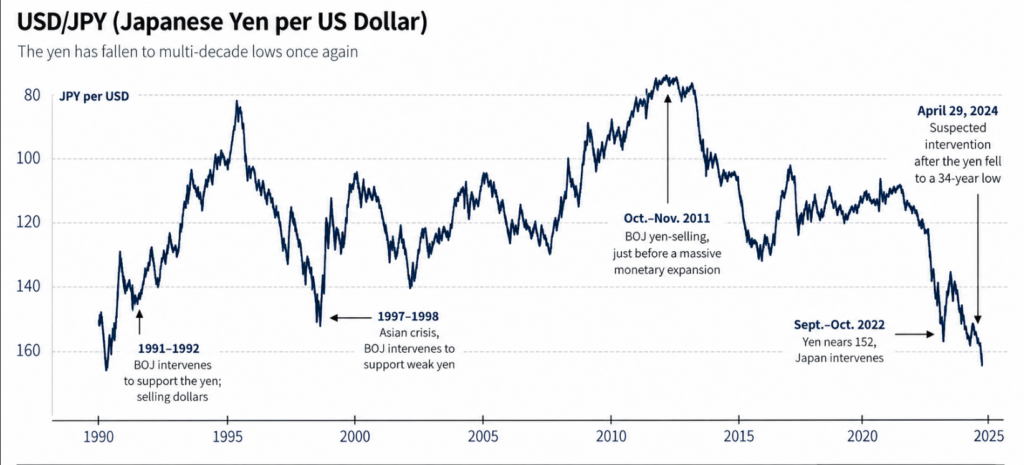
The yen has fallen to multi-decade lows against the US dollar despite repeated interventions by Japanese authorities, who have spent tens of billions of dollars attempting to support their currency. Last week, that effort took an unusual turn when reports emerged that the US Treasury had joined Japan in intervening in foreign exchange markets, one of the first coordinated actions of its kind in decades.
The intervention strengthened the yen and it also begs a much larger question.
Why has Japan struggled to defend its currency in the first place?
Why Has The Yen Become So Weak?
Interest Rates Matter
Every currency has a price, and like any other asset, that price is heavily influenced by supply, demand and expected returns.
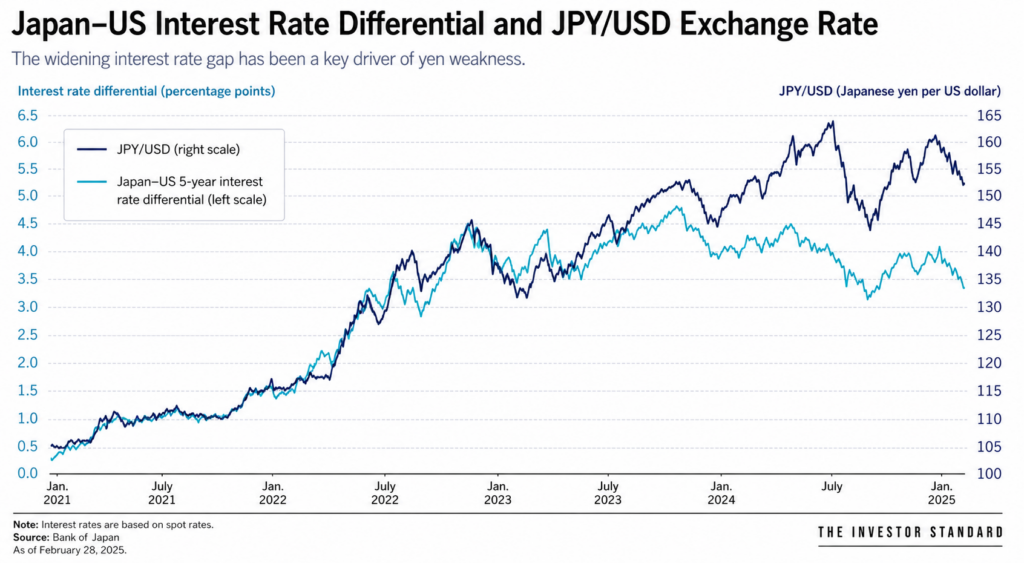
Over the past several years, the US has raised interest rates sharply to combat inflation. Higher interest rates allow investors to earn greater returns on US assets such as treasuries and savings accounts, making the US dollar more attractive.
Japan has taken a very different approach.
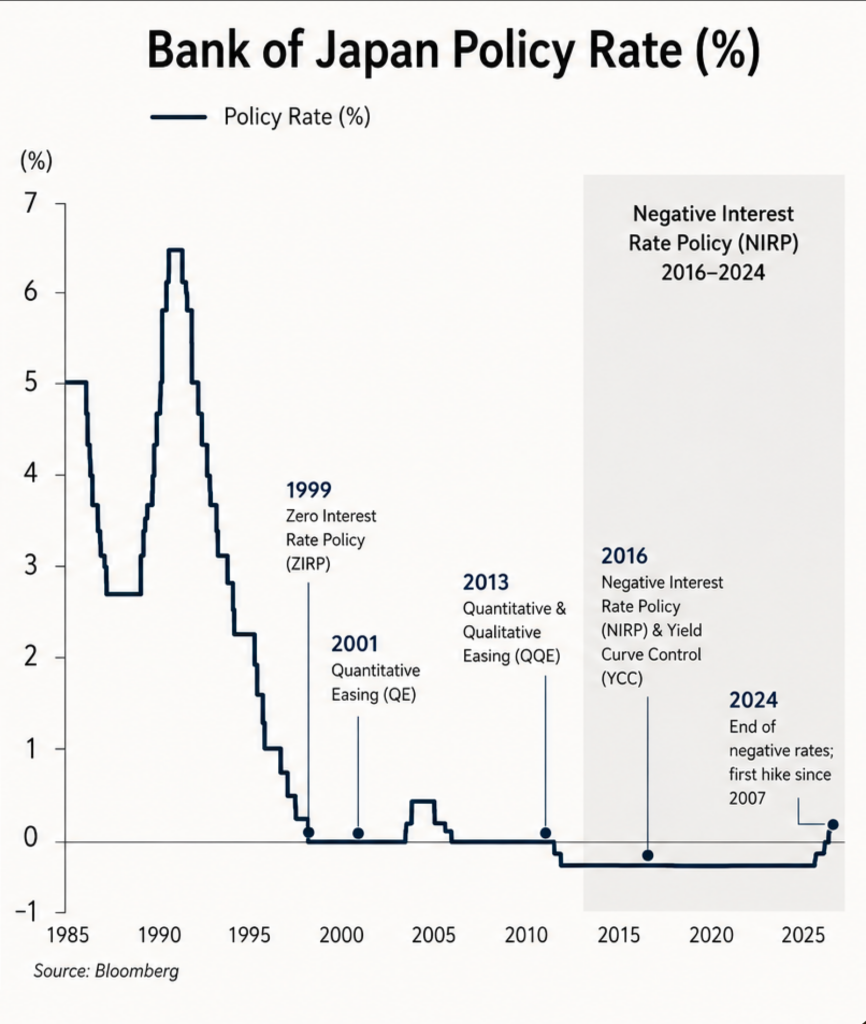
For decades, the BoJ kept interest rates close to zero and even negative in an effort to stimulate economic growth and combat persistent deflation. Although rates have begun to rise, they remain well below those in the United States.
The result is straightforward: investors can earn significantly higher returns by holding US dollars than Japanese yen, encouraging capital to flow out of Japan and out of the yen and into dollar-denominated assets.
The Carry Trade
One of the biggest drivers of the yen’s weakness is carry trade.
Investors borrow money in yen, where interest rates remain low, before converting those into higher-yielding currencies like the dollar. The proceeds are then invested in assets offering much higher returns, allowing investors to profit from the difference in rates.
This strategy creates additional selling pressure on the yen. Every time investors borrow and exchange yen, they increase the supply of yen on global markets while boosting demand for dollars and other higher-yielding currencies.
As long as the gap between Japanese and overseas interest rates remains wide, the carry trade continues to place downward pressure on the yen.
Why Japan Can’t Raise Interest Rates
In theory, the solution appears straightforward.
Higher interest rates would make Japanese assets more attractive, encouraging investors to hold yen and JGBs rather than investing overseas. A stronger currency would also help reduce imported inflation by lowering the cost of goods imported.
In practice, however, Japan faces a constraint unlike almost any other major economy.
The Japanese government carries public debt equivalent to more than 200 per cent of GDP, the highest among advanced economies. Although much of that debt has been issued at exceptionally low interest rates, a sustained increase in borrowing costs would gradually make refinancing existing debt far more expensive as older bonds mature and are replaced with new ones at higher interest rates.
At the same time, Japan is grappling with an ageing population, rising healthcare costs and increasing pressure on government finances. In addition, Japan has seen decades of weak growth, undershooting its inflation target and even deflation. Higher interest rates would therefore not only affect households and businesses, but also place additional strain on the government’s budget through higher interest payments and further weaken growth and inflation.
That leaves policymakers in a difficult position. Keeping interest rates low supports the government’s finances and stimulates the economy but contributes to a weaker yen. Raising rates could strengthen the currency, but at the cost of significantly higher borrowing costs for an already heavily indebted government and weaken growth in an already sluggish economy.
Why Doesn’t Japan Just Buy More Yen?
If raising interest rates is difficult, Japan has another option: intervene directly in foreign exchange markets.
The mechanics are simple.
The Japanese government holds hundreds of billions of dollars in foreign currency reserves. When authorities want to support the yen, they sell some of those foreign assets and convert the proceeds into yen.
Like any market, increasing demand tends to push prices higher. By buying large quantities of yen, the government hopes to strengthen the currency or at least slow its decline.
Japan has used this strategy repeatedly over recent years, spending tens of billions of dollars defending the yen as it approached increasingly weaker levels against the US dollar. While these interventions have often produced sharp short-term rallies, those gains have generally proved temporary.
The reason is straightforward. Currency intervention addresses the symptoms rather than the underlying cause. As long as interest rates remain significantly higher in the United States than in Japan, investors still have a strong incentive to sell yen and buy dollars. Government purchases can temporarily overwhelm private markets, but they struggle to reverse a trend driven by economic fundamentals. And unlike the BoJ defending JGB yields, they only have a finite amount of foreign reserves.
Why Did The United States Step In?
Japan’s latest intervention was unusual because it did not act alone.
According to reports, the US Treasury entered foreign exchange markets alongside Japanese authorities, marking one of the first coordinated efforts between the two countries to support the yen in decades. Rather than selling US dollars directly, the Treasury reportedly used its euro reserves to purchase yen, helping lift the currency back below the psychologically important ¥160 per US dollar level.
The decision surprised many investors. Countries typically intervene to strengthen their own currencies, not someone else’s. So why would the United States help support the yen?
One explanation is economic. US Treasury Secretary Scott Bessent has repeatedly described the yen as undervalued, arguing that a stronger Japanese currency would help reduce trade imbalances by making Japanese exports less price competitive while increasing Japan’s purchasing power abroad.
There is also a strategic dimension. Japan remains one of America’s closest allies in the Indo-Pacific, and maintaining financial stability in the region is firmly in Washington’s interests. A rapidly weakening yen risks increasing market volatility, undermining investor confidence and placing additional strain on Japan’s already fragile public finances.
Whatever the motivation, the intervention was significant. It signalled that concern over the yen’s decline now extends beyond Tokyo and has become an issue attracting attention in Washington.
Will It Actually Work?
History suggests currency intervention can slow a currency’s decline, but rarely reverses it on its own.
Foreign exchange markets are among the largest and most liquid financial markets in the world, with trillions of dollars changing hands every day. Even coordinated interventions by major governments can struggle to overpower the underlying economic forces driving exchange rates.
Ultimately, the yen’s future will depend less on how many reserves Japan or the United States are willing to spend, and more on whether the factors weakening the currency begin to change. As long as interest rate differentials remain significantly higher, investors will continue to have a strong incentive to hold dollars over yen, while carry trade is likely to remain attractive.
That doesn’t mean intervention is pointless. Buying yen can slow periods of rapid depreciation, reduce market volatility and signal to investors that policymakers are prepared to defend the currency if movements become disorderly. In some cases, that alone can discourage speculative attacks and restore confidence, at least temporarily.
The challenge is that confidence can only go so far. If economic fundamentals continue pointing in one direction, markets eventually begin testing whether governments are willing and able to continue defending their currency.