

What is the VanEck Australian Banks ETF?
The VanEck Australian Banks ETF (ASX: MVB) is a passive exchange-traded fund that gives investors broad exposure to Australia’s banking sector by tracking the MVIS Australia Banks Index. Rather than selecting individual stocks, the ETF holds a basket of leading institutions, including the “big four,” Commonwealth Bank of Australia, ANZ, NAB, and Westpac, alongside other major financial names such as Macquarie Group, Bendigo & Adelaide Bank, and Bank of Queensland. This structure allows investors to gain diversified exposure to the country’s dominant financial institutions in a single trade, reducing reliance on the performance of any one bank while maintaining a strong link to the health of the Australian economy.
The ETF is designed to appeal to investors seeking both sector exposure and income, as Australian banks have historically paid relatively high dividends, often enhanced by franking credits. By spreading investments across multiple banks, MVB helps mitigate single-company risk while still capturing the earnings power of a sector closely tied to housing, business lending, and economic growth. Its management fee of 0.28% per year keeps costs relatively low for a sector-focused fund, making it a convenient vehicle for investors who want simple, rules-based access to Australia’s banking industry without the need to actively manage individual stock positions.
Performance Over the Years
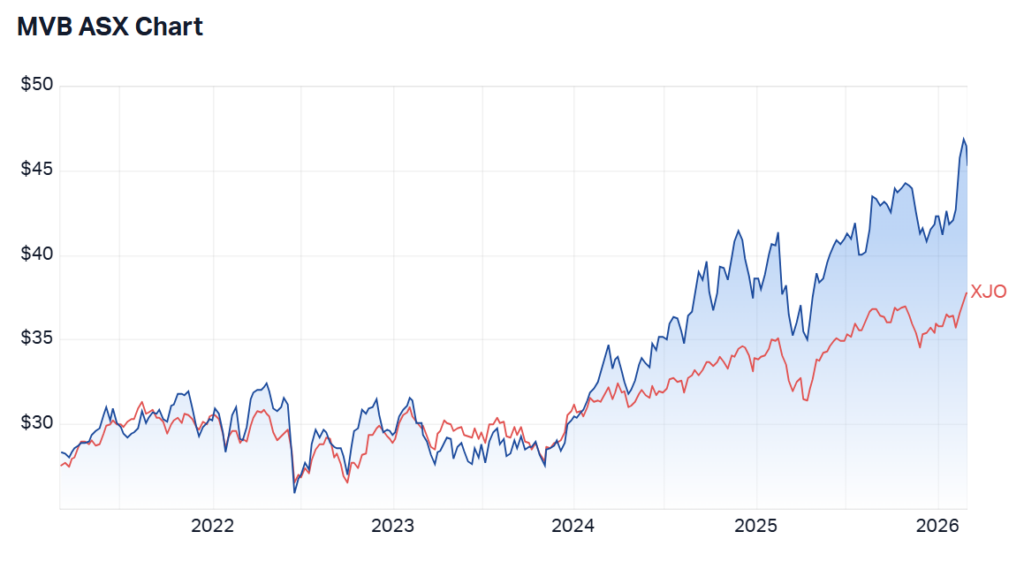
Over the five years to 31 January 2026, the MVB ETF generated a robust annualised total return of around 16.75%, driven by strong performance across Australia’s major banks and the broader financial sector. This equates to an overall gain of roughly 70% across the period, effectively turning every dollar invested into about 1.7 times its value. The bulk of this outcome stemmed from capital growth as bank share prices appreciated, while dividend income also contributed meaningfully to the ETF’s total returns.
Compared with the broader market, MVB’s five‑year results have generally outpaced typical ASX equity returns, demonstrating how its focused exposure to Australia’s banking sector, supported in recent years by strong profitability and consistent dividend payments, has contributed to above‑market performance. At the same time, its outlook remains sensitive to shifts in economic conditions, interest‑rate cycles, and bank earnings, and investors should remember that past performance does not guarantee future returns.
Why could the ETF be a viable investment?
Investing in the VanEck Australian Banks ETF provides a straightforward and cost-effective way to access Australia’s banking sector, giving investors exposure to the major banks and other leading financial institutions in a single investment while spreading risk across the sector rather than relying on one stock. Banking remains a cornerstone of the Australian economy and has historically generated solid earnings and relatively high, often franked, dividends, making MVB attractive to both income-oriented and growth-seeking investors. With a low management fee of 0.28%, the fund maintains cost efficiency, and its strong long-term track record, including a five-year annualised return of 16.75%, highlights the durability and stability of Australia’s large, well-regulated banking system across different market cycles.
Disclaimer
The Investor Standard provides general information for education and research only. It is NOT personal advice, a recommendation, or an offer to buy/sell any security. This content has been prepared without taking into account your objectives, financial situation or needs. Past performance is not indicative of future results. Before acting on any information, consider its appropriateness and seek independent advice from a licensed financial adviser.